Wednesday, April 26, 2006
Cognitive Comedy
Undoubtedly, some of you are Chomsky (qua linguist) fans, and some of you are, like me, Ali G fans. If either is the case, or both, then you have to check this out: Ali G interviews Noam Chomsky (via Omi Brain). The very fact that Ali G somehow manages to get into the man's office and get him on camera is, by itself, hilarious, but the interview is pretty funny too (if you didn't see the "bilingual" joke coming, slap yourself).


Monday, April 17, 2006
To Parents
If you're a parent, and especially if you're a parent of a child who's been diagnosed with an Autism Spectrum Disorder, you might want to check this out (from an email I received earlier):
ABA4Autism.com and the Psychology Department at the University of Tennessee at Martin are conducting a second survey on the causes of Autism Spectrum Disorders (ASD). This survey is for mothers of children with ASD as well as mothers of normally developing children who are ten years of age or younger. Mothers who participate in the survey will receive a free ABA program to teach their child to follow directions as well as free ABA mini programs for common problems like sharing. To take the survey please go to http://www.aba4autism.com. Thanks
Dr.Gary Brown
Professor and Chair
Psychologist/HSP
Sunday, April 16, 2006
Links, Easter Edition
I've been busy, busy, busy; too busy for lengthy posts, but not too busy to link to some of the cool stuff out there in the blogosphere and beyond. And since it's Easter, I feel duty bound to start with this website in which ground-breaking Peeps research is described. I was particularly impressed with the findings of the "Reaction to heat" experiment, which led the researchers to conclude:
OK, that's all the Easter I can stomach. Next up are two posts from John Hawks, the first of which links to a 1947 article on chimpanzee economics. The second is a link to this post at Afarensis on new world origins.
Then there's this post at Neurofuture, which links to a whole bunch of interesting science podcats, including one of V.S. Ramachandran discussing his work on aesthetics (which I blogged about long ago here, here, and here), and an interview with Michael Gazzaniga on "Ethics in the Age of Neuroscience."
And finally, I got an email the other day asking me about representation and memory retrieval. The email was from someone who works with two prominent cognitive scientists, who both work on representation and memory retrieval, so I suspect the emailer knows a little about the topic, and can learn about it from people who know a whole hell of a lot more about knowledge representation and memory than I do (or than just about everyone else, for that matter, since their work defines one way of modeling retrieval). Still, I think it might make for an interesting post, because how you theorize information is represented in memory, to a large extent, how you theorize information gets retrieved from memory, and that means it defines how you think about memory period. It would take several posts to lay out all of the issues, but I thought I might also approach it a different way. I'd been thinking about linking to classic or otherwise important papers in cognitive science, and seeing if people wanted to discuss them (perhaps over at the Yahoo group). So the first paper I'll try is John R. Anderson's "A spreading activation theory of memory." Anderson was the 2004 winner of the Rumelhart Prize, largely for his work on ACT cognitive architecture, and its later variants, and this paper presents the ACT theory of memory. If you want to read it and talk about it, then head on over to Yahoo.
Fascinating work.Furthermore, observations of Peep biochemistry indicate a molecular structure unlike any other terrestrial organisms yet encountered, leading to the obvious conclusion that Peeps are not of this world (Mulder & Scully, et. al. 1996). In addition, while early evolutionary biologists have suggested that the lack of variation in the peep population was due to an ancient bottleneck event, we suggest the more likely scenario of the founder effect phenomenon during terrestrial colonization.
Then, to continue with the Easter theme (while avoiding any religious content whatsoever, and throwing in a gratuitous link to Heo Cwaeth), Heo gives us Yeats' "Easter 1916," a poem about the characters of the 1916 Easter rebellion in Ireland, about which most of us probably know very little (I do know that the Germans provided the Irish with guns and ammo, and that it was bloody, though ultimately affective). But you don't need to know much about the historical event to grasp the message of ordinary people, bound by little more than a common homeland, can come together to do profound things. The attitudes of the poem present quite a contrast with contemporary American apathy. And besides, as Settembrini says in The Magic Mountain, literature is about beautiful words, and Yeats is a master of beautiful words.
OK, that's all the Easter I can stomach. Next up are two posts from John Hawks, the first of which links to a 1947 article on chimpanzee economics. The second is a link to this post at Afarensis on new world origins.
Then there's this post at Neurofuture, which links to a whole bunch of interesting science podcats, including one of V.S. Ramachandran discussing his work on aesthetics (which I blogged about long ago here, here, and here), and an interview with Michael Gazzaniga on "Ethics in the Age of Neuroscience."
And finally, I got an email the other day asking me about representation and memory retrieval. The email was from someone who works with two prominent cognitive scientists, who both work on representation and memory retrieval, so I suspect the emailer knows a little about the topic, and can learn about it from people who know a whole hell of a lot more about knowledge representation and memory than I do (or than just about everyone else, for that matter, since their work defines one way of modeling retrieval). Still, I think it might make for an interesting post, because how you theorize information is represented in memory, to a large extent, how you theorize information gets retrieved from memory, and that means it defines how you think about memory period. It would take several posts to lay out all of the issues, but I thought I might also approach it a different way. I'd been thinking about linking to classic or otherwise important papers in cognitive science, and seeing if people wanted to discuss them (perhaps over at the Yahoo group). So the first paper I'll try is John R. Anderson's "A spreading activation theory of memory." Anderson was the 2004 winner of the Rumelhart Prize, largely for his work on ACT cognitive architecture, and its later variants, and this paper presents the ACT theory of memory. If you want to read it and talk about it, then head on over to Yahoo.
Wednesday, April 12, 2006
Updated Blogroll
I drank way too much coffee this morning, got a little bored, and totally rearranged the blogroll. So, check it out, and let me know if you think there's a blog I should add. If you're on it, and think I put you in the wrong category, tell me. Categories are fuzzy things, and I'm bound to have misclassified some of the instances at the category boundaries.
Oh, "The Lesser Sciences" is a joke, so I don't want to get any nasty emails from physicists.
Oh, "The Lesser Sciences" is a joke, so I don't want to get any nasty emails from physicists.
Tuesday, April 11, 2006
Hostile Media Effects
Here are two things that, when taken together, cry out for explanation. Over the last five decades, study after study of media bias has found little or no evidence of systematic bias in either direction1, and a meta-analysis of bias studies over 6 decades, using several different measures of bias, found no bias in newspaper reporting, and only a miniscule, inconsequential right-wing bias in magazines, and left-wing bias on television2. Yet, while in 1988, only 12% of the public believed the media to be systematically biased3, that percentage has grown steadily over the last two decades, with 62% of Americans believing the media to be biased in 20054. And in almost every case, the perceived bias is towards the opposition. How is it that, over the same period in which studies have consistently shown a lack of media bias5, more and more people have come to believe that it exists, and that it favors their opponents' viewpoints? My reaction to the belief in media bias has usually been to assume that perception of bias was a result of people holding extreme views, and that as a result, anything to the right or the left of them, even if it's firmly in the center, will be perceived as bias. While this explanation might have worked in 1998, when only a few Americans believed the media to be biased, it doesn't work when the majority holds that belief. So, I had to look deeper to find an explanation.
If people tended to believe that the media was biased in favor of their own views, it would be easy to explain. There is an extensive literature on "assimilation bias," or the tendency to perceive neutral information as favoring one's own views. Since most perceptions of media bias are in the opposite direction, however, this explanation won't work. In fact, in one study, participants were presented with the exact same information either in the form of a journalist's report or a student's essay6. When reading the context of a journalist's report, participants perceived the information to be biased in favor of the opposition, but when reading the same information in the context of a student's essay, they tended to see it as neutral or as supporting their own position (assimilation bias). So there must be something about the context of mass media that elicits the perception of bias that is inconsistent with the way in which we usually interpret information. And that means it's not going to be easy to find an explanation. But many researchers have been trying, and I'm going to try to summarize some of what they've found.
Serious psychological study of perceived media bias began in the mid-1980s with studies by Vallone, Ross, and Lepper7, and by Perloff8. In both studies, pro-Israeli and pro-Palestinian participants were presented with television news coverage of Israel's invasion of Lebanon and subsequent fighting. The pro-Israeli participants believed that the coverage was biased in favor of the Palestinians, and that it would make neutral observers feel less favorable towards their side, while the pro-Palestinians were convinced the coverage was biased in favor of the Israeli side, and that it would hurt their image in the eyes of neutral observers. This is despite the fact that when neutral observers did view the coverage, in Perloff's study, they failed to perceive any bias, and their opinions of the two sides stayed the same. Vallone et al. termed this the "Hostile Media Phenomenon," or "Hostile Media Effect" (HME from here on out). After the publication of these two studies, research on the HME took off.
Both the Vallone et al. and Perloff studies looked at one specific issue, and used as participants people who had strong opinions about that issue. Subsequent research has shown that even those who have only a moderate involvement in a particular issue will tend to show the HME, though at a lower rate, and that both strong and moderate partisans will show the HME for general (e.g., liberal vs. conservative) viewpoints in addition to specific issues9. As is often the case, though, for the first decade or so after the initial finding of the HME, researchers tended to focus merely on demonstrating that it exists in a particular domain, rather than trying to figure out why it exists. And research on the mechanisms and factors involved still hasn't gotten very far. But the literature does provide some hints.
First off, the nature of the information, and its presentation, seem to be important. Obviously, any political issue is game, but it appears that political issues that are presented as conflicts (e.g., between ethnicities, between social classes, etc.) are particularly prone to elicit the HME10. On top of this, there are clear social and individual factors involved. In an analysis of data from a nationwide survey, Eveland and Shah11 found that the following factors were associated with HME:
Of course, the question that interests me is, what cognitive (and affective) mechanisms are involved in the HME? The research on this question is incredibly muddled, so I'm not going to talk about it in any detail. Suffice it to say that for every cognitive mechanism hypothesized to be involved, there's a paper presenting data that indicates it's not. I suspect that motivated reasoning is involved, though no direct evidence for this currently exists. If it is involved, it would mean that people are probably selectively retrieving memories of media coverage when they're reasoning about media bias, and that their interpretation of specific instances is biased as well12. This doesn't explain why the HME seems to be specific to the media and, as in the Gunther and Schmitt paper cited above (footnote 6), disappears when the same information is placed in another context. This is probably a result of the beliefs about the media that trigger motivated reasoning in the first place, and these beliefs are probably the result of complex socio-cultural factors. In addition, Gunther and Schmitt argue that their data may indicate the influence of the "perceived reach of the information." This may be true, and would explain why people are quick to claim that the coverage will hurt their side's image in the view of others, but it says little about the mechanisms involved in this reasoning, or even why the "perceived reach" has an effect at all. I imagine that near future research will explore people's beliefs about the media bias, and how those who exhibit the HME reason about information presented by mass media, more thoroughly, and perhaps we'll soon have an answer to the mechanism questions. Until then, we'll have to be satisfied with what the literature has told us: lower middle class, strongly partisan Republicans who spend a lot of time hanging out with other Republicans probably think there's a liberal bias in the media. Duh!
Let me end with a note on what inspired this post. First, there's that dizzingly surreal show on Fox News on Sunday evenings (I forget which one it is), during which a panel of mainstream media journalists, on a mainstream media TV network, talk about how biased the mainstream media is. Then there's the comments section of this post at The Volokh Conspiracy, in which the "liberal media" meme is tossed about with abandon. You won't find anything you haven't already seen, there, but the two combined made me want to talk about the HME. I don't think posting about it will change anyone's mind, really, as responses by those who believe the media to be biased to the research showing that it isn't are generally the same. Most of the time, the response I hear is something like this: "I don't care what the research says, because all I have to do is turn on the TV to see the bias with my own eyes." Others make at least a feeble effort to criticize the research, usually by saying the research itself must be biased, claiming that most people employed by mainstream media outlets are registered Democrats (a fact that might lead you to predict bias, but which is not itself an indication of bias), or citing the fatally flawed Groseclose and Milyo study linked in footnote five. But none of that speaks to the fact that over a period of more than 40 years, the Groseclose and Milyo study is the only major one to find systematic bias in the mainstream media, or to the empirical research on HME, in which people clearly perceive bias even when balance has been purposefuly included in the stimuli, and perceive it only when it's in the context of media coverage.
Of course, even when I'm not frustrated with "biased media" nonsense in blog comments and on Fox News, I still find the HME interesting, and empirical research on it important. I'm interested in it, and motivated reasoning in general, because I wonder about the role of schematic processes. But the research is also important because, more and more, the belief in media bias is having serious affects on our political process, and the media itself. The media, responding to claims of bias, seems to be taking extra pains to avoid looking biased by giving voice to opinions that have no real factual merit as contrasts to facts and opinions that are concentrated on one side of the political spectrum (e.g., in the evolution vs. Intelligent Design debate). Politicians, particularly on the political right, take advantage of the increasing distrust of a media perceived as biased, by blaming failures on the media, and dismissing negative claims those in the media make about them or their policies. So discovering, and countering, the processes and mechanisms involved in the HME will have very real practical implications.
1E.g., Woodard, J.D. (1994). Coverage of elections on evening television news shows: 1972-1992. In A.H. Miller & B.E. Gronbeck (Eds.), Presidential Campaigns and American Self Images. Boulder, CO: Westview; Mantler, G., & Whiteman, D. (1995). Attention to candidates and issues in newspaper coverage of 1992 presidential campaign. Newspaper Research Journal, 169(3), 14-28; Domke, D., Fan, D.P, Fibison, M., Shah, D.V., Smith,S.S., & Watts, M.D. (1997). News media, candidates and issues, and public opinion in the 1996 presidential campaign. Journalism & Mass Communication Quarterly, 74, 718-737; Shah, D.V., Watts, M.D., Domke, D., Fan, D.P., & Fibison, M. (1999). News coverage, economic cues, and the public's presidential preferences: 1984-1995. Journal of Politics, 61, 914-943; Waldman, P., & Devitt, J. (1998). Newspaper photographs and the 1996 presidential election: The question of bias. Journalism & Mass Communication Quarterly, 75, 302-311.
2D'Alessio, D., & Allen, M. (2000). Media bias in presidential elections: A meta-analysis. Journal of Communication, 50(4), 133-156.
3Eveland, W.P., Shah, D.V. (2003). The impact of individual and interpersonal factors on perceived news media bias. Political Psychology, 24(1), 101-117.
4See the Gallup Poll detailed here.
5I ignore this study by Groseclose and Milyo for the obvious reason that its methodology is not only worthless, but downright nonsensical.
6Gunther, A.C., Schmitt, K. (2004). Mapping boundaries of the hostile media effect. The Journal of Communication, 54(1), 55.
7Vallone, R.P., Ross, L., & Lepper, M.R. (1985). The hostile media phenomenon: Biased perception and perceptions of media bias in coverage of the Beirut massacre. Journal of Personality and Social Psychology, 49, 577-585.
8Perloff, R.M. (1989). Ego-involvement and the third person effect of televised news coverage. Communication Research, 16, 236-262.
9E.g., Dalton R. J., Beck, P. A., & Huckfeldt, R. (1998). Partisan cues and the media: Information flows in the 1992 presidential election. American Political Science Review, 92(1), 111-26.
10Price, V. (1989). Social identification and public opinion: Effects of communicating group conflict. Public Opinion Quarterly, 53, 197-224.
11Eveland Jr., W. P., & Shah, D. V. (2003). The impact of individual and interpersonal factors on perceived news media bias. Political Psychology, 24(1), 101-117.
12Schmitt, K. M., Gunther, A. C., & Liebhart, J. L. (2004). Why partisans see mass media as biased. Communication Research, 31(6), 623-641.
If people tended to believe that the media was biased in favor of their own views, it would be easy to explain. There is an extensive literature on "assimilation bias," or the tendency to perceive neutral information as favoring one's own views. Since most perceptions of media bias are in the opposite direction, however, this explanation won't work. In fact, in one study, participants were presented with the exact same information either in the form of a journalist's report or a student's essay6. When reading the context of a journalist's report, participants perceived the information to be biased in favor of the opposition, but when reading the same information in the context of a student's essay, they tended to see it as neutral or as supporting their own position (assimilation bias). So there must be something about the context of mass media that elicits the perception of bias that is inconsistent with the way in which we usually interpret information. And that means it's not going to be easy to find an explanation. But many researchers have been trying, and I'm going to try to summarize some of what they've found.
Serious psychological study of perceived media bias began in the mid-1980s with studies by Vallone, Ross, and Lepper7, and by Perloff8. In both studies, pro-Israeli and pro-Palestinian participants were presented with television news coverage of Israel's invasion of Lebanon and subsequent fighting. The pro-Israeli participants believed that the coverage was biased in favor of the Palestinians, and that it would make neutral observers feel less favorable towards their side, while the pro-Palestinians were convinced the coverage was biased in favor of the Israeli side, and that it would hurt their image in the eyes of neutral observers. This is despite the fact that when neutral observers did view the coverage, in Perloff's study, they failed to perceive any bias, and their opinions of the two sides stayed the same. Vallone et al. termed this the "Hostile Media Phenomenon," or "Hostile Media Effect" (HME from here on out). After the publication of these two studies, research on the HME took off.
Both the Vallone et al. and Perloff studies looked at one specific issue, and used as participants people who had strong opinions about that issue. Subsequent research has shown that even those who have only a moderate involvement in a particular issue will tend to show the HME, though at a lower rate, and that both strong and moderate partisans will show the HME for general (e.g., liberal vs. conservative) viewpoints in addition to specific issues9. As is often the case, though, for the first decade or so after the initial finding of the HME, researchers tended to focus merely on demonstrating that it exists in a particular domain, rather than trying to figure out why it exists. And research on the mechanisms and factors involved still hasn't gotten very far. But the literature does provide some hints.
First off, the nature of the information, and its presentation, seem to be important. Obviously, any political issue is game, but it appears that political issues that are presented as conflicts (e.g., between ethnicities, between social classes, etc.) are particularly prone to elicit the HME10. On top of this, there are clear social and individual factors involved. In an analysis of data from a nationwide survey, Eveland and Shah11 found that the following factors were associated with HME:
- Gender: Males are slightly more likely to perceive a hostile media bias than females.
- Income: as income goes up, perception of hostile media bias goes down.
- Political party: Republicans are much more likely to perceive a hostile media bias than Democrats.
- Strength of identification with a party: Strong partisans are somewhat more likely to perceive a hostile media bias than moderates.
- Political involvement: the more involved you are in politics, the more likely you are to perceive hostile media bias.
- What Eveland and Shah call "Safe Discussions": The more time you spend talking about politics with people who share your views, the more likely you are to perceive hostile media bias.
Of course, the question that interests me is, what cognitive (and affective) mechanisms are involved in the HME? The research on this question is incredibly muddled, so I'm not going to talk about it in any detail. Suffice it to say that for every cognitive mechanism hypothesized to be involved, there's a paper presenting data that indicates it's not. I suspect that motivated reasoning is involved, though no direct evidence for this currently exists. If it is involved, it would mean that people are probably selectively retrieving memories of media coverage when they're reasoning about media bias, and that their interpretation of specific instances is biased as well12. This doesn't explain why the HME seems to be specific to the media and, as in the Gunther and Schmitt paper cited above (footnote 6), disappears when the same information is placed in another context. This is probably a result of the beliefs about the media that trigger motivated reasoning in the first place, and these beliefs are probably the result of complex socio-cultural factors. In addition, Gunther and Schmitt argue that their data may indicate the influence of the "perceived reach of the information." This may be true, and would explain why people are quick to claim that the coverage will hurt their side's image in the view of others, but it says little about the mechanisms involved in this reasoning, or even why the "perceived reach" has an effect at all. I imagine that near future research will explore people's beliefs about the media bias, and how those who exhibit the HME reason about information presented by mass media, more thoroughly, and perhaps we'll soon have an answer to the mechanism questions. Until then, we'll have to be satisfied with what the literature has told us: lower middle class, strongly partisan Republicans who spend a lot of time hanging out with other Republicans probably think there's a liberal bias in the media. Duh!
Let me end with a note on what inspired this post. First, there's that dizzingly surreal show on Fox News on Sunday evenings (I forget which one it is), during which a panel of mainstream media journalists, on a mainstream media TV network, talk about how biased the mainstream media is. Then there's the comments section of this post at The Volokh Conspiracy, in which the "liberal media" meme is tossed about with abandon. You won't find anything you haven't already seen, there, but the two combined made me want to talk about the HME. I don't think posting about it will change anyone's mind, really, as responses by those who believe the media to be biased to the research showing that it isn't are generally the same. Most of the time, the response I hear is something like this: "I don't care what the research says, because all I have to do is turn on the TV to see the bias with my own eyes." Others make at least a feeble effort to criticize the research, usually by saying the research itself must be biased, claiming that most people employed by mainstream media outlets are registered Democrats (a fact that might lead you to predict bias, but which is not itself an indication of bias), or citing the fatally flawed Groseclose and Milyo study linked in footnote five. But none of that speaks to the fact that over a period of more than 40 years, the Groseclose and Milyo study is the only major one to find systematic bias in the mainstream media, or to the empirical research on HME, in which people clearly perceive bias even when balance has been purposefuly included in the stimuli, and perceive it only when it's in the context of media coverage.
Of course, even when I'm not frustrated with "biased media" nonsense in blog comments and on Fox News, I still find the HME interesting, and empirical research on it important. I'm interested in it, and motivated reasoning in general, because I wonder about the role of schematic processes. But the research is also important because, more and more, the belief in media bias is having serious affects on our political process, and the media itself. The media, responding to claims of bias, seems to be taking extra pains to avoid looking biased by giving voice to opinions that have no real factual merit as contrasts to facts and opinions that are concentrated on one side of the political spectrum (e.g., in the evolution vs. Intelligent Design debate). Politicians, particularly on the political right, take advantage of the increasing distrust of a media perceived as biased, by blaming failures on the media, and dismissing negative claims those in the media make about them or their policies. So discovering, and countering, the processes and mechanisms involved in the HME will have very real practical implications.
1E.g., Woodard, J.D. (1994). Coverage of elections on evening television news shows: 1972-1992. In A.H. Miller & B.E. Gronbeck (Eds.), Presidential Campaigns and American Self Images. Boulder, CO: Westview; Mantler, G., & Whiteman, D. (1995). Attention to candidates and issues in newspaper coverage of 1992 presidential campaign. Newspaper Research Journal, 169(3), 14-28; Domke, D., Fan, D.P, Fibison, M., Shah, D.V., Smith,S.S., & Watts, M.D. (1997). News media, candidates and issues, and public opinion in the 1996 presidential campaign. Journalism & Mass Communication Quarterly, 74, 718-737; Shah, D.V., Watts, M.D., Domke, D., Fan, D.P., & Fibison, M. (1999). News coverage, economic cues, and the public's presidential preferences: 1984-1995. Journal of Politics, 61, 914-943; Waldman, P., & Devitt, J. (1998). Newspaper photographs and the 1996 presidential election: The question of bias. Journalism & Mass Communication Quarterly, 75, 302-311.
2D'Alessio, D., & Allen, M. (2000). Media bias in presidential elections: A meta-analysis. Journal of Communication, 50(4), 133-156.
3Eveland, W.P., Shah, D.V. (2003). The impact of individual and interpersonal factors on perceived news media bias. Political Psychology, 24(1), 101-117.
4See the Gallup Poll detailed here.
5I ignore this study by Groseclose and Milyo for the obvious reason that its methodology is not only worthless, but downright nonsensical.
6Gunther, A.C., Schmitt, K. (2004). Mapping boundaries of the hostile media effect. The Journal of Communication, 54(1), 55.
7Vallone, R.P., Ross, L., & Lepper, M.R. (1985). The hostile media phenomenon: Biased perception and perceptions of media bias in coverage of the Beirut massacre. Journal of Personality and Social Psychology, 49, 577-585.
8Perloff, R.M. (1989). Ego-involvement and the third person effect of televised news coverage. Communication Research, 16, 236-262.
9E.g., Dalton R. J., Beck, P. A., & Huckfeldt, R. (1998). Partisan cues and the media: Information flows in the 1992 presidential election. American Political Science Review, 92(1), 111-26.
10Price, V. (1989). Social identification and public opinion: Effects of communicating group conflict. Public Opinion Quarterly, 53, 197-224.
11Eveland Jr., W. P., & Shah, D. V. (2003). The impact of individual and interpersonal factors on perceived news media bias. Political Psychology, 24(1), 101-117.
12Schmitt, K. M., Gunther, A. C., & Liebhart, J. L. (2004). Why partisans see mass media as biased. Communication Research, 31(6), 623-641.
Monday, April 10, 2006
Culture and Perception: The Role of the Physical Environment
Every time someone asks me about cultural differences in cognition, be it a student, a blog reader, or my mother, I cringe. I mean, sure, I can tell them about the various differences that have been observed in the laboratory, and point them to books like The Geography of Thought, but inevitably, they'll ask what causes the observed differences, and I have to tell them I don't know. No one does, really. The problem is that there hasn't been much experimental work designed to determine what might be causing these differences. Most of the empirical work amounts to demonstrations that the differences do exist. I usually tell people that there are a few possible explanations for the differences. The first possible explanation is that the differences are innate, that is, that something about the differences in the genetic make up of Europeans and East Asians, for example, causes differences in perception, conception, and reasoning. However, there's no evidence whatsoever for innate causes, so we can probably rule this type of explanation out. The second possible explanation is that there are differences in the environments of Europeans and East Asians, and that these differences somehow cause differences in cognition and perception. A third possible explanation is that the cognitive and perceptual differences are due entirely to differences in culture that arose purely by historical accident. And finally, a fourth explanation, along the lines of the Sapir-Whorf hypothesis, is that language differences cause cognitive and perceptual differences.
The problem, for researchers, with these last three levels of explanations is that they would all interact, and it would be difficult, if not impossible to tease them apart in practice. And of course, there are all sorts of observed differences, which may all have different causes. The best we can do, then, is look to see whether manipulating something from the environment, culture, or language (which, I know, isn't really separate from culture, but neither is the environment) affects a particular cultural difference. This won't tell us where that level fits in the causal chain, but it would at least be positive evidence that it fits in it somewhere. For example, by manipulating an hypothesized effect of culture, like fear of isolation, we can show that one factor resides at the level of culture, or by showing that cultures with different numbers of color terms perceive colors differently, we can show that language has some influence. Having talked about those levels in previous posts, I thought I'd talk a little bit about the potential role of the environment this time. Again, looking at one level doesn't exclude the other levels, because we don't know how the different levels might interact. It just says that that level plays a role. So the purpose of the research I'm going to describe is not to show that perception is the cause of cultural differences in cognition and perception, just that it might be one among many.
One interesting observed difference between Europeans an East Asian (e.g., Japanese and Filipinos) has to do with attention and perception. The difference is usually framed in terms of analytic vs. holistic perception. For example, in one experiment1, Japanese and European American participants were first given a square (which served as the frame) with a line inside it (see the figure below). That square was then removed, and they were given an empty square different in size from the original, and asked to draw a line inside it that was either the same length as the original line (absolute condition) or that had the same length relative to the frame (relative condition).
 Figure 1 from Ishii & Kitayama (2003).
The European American participants were significantly more accurate than the Japanese participants in the absolute condition, while the Japanese participants were significantly more accurate than the European American participants in the relative task.
In another experiment2, this one on "change blindness", European American and Japanese participants were presented with moving scenes. In each scene, there were large, "rapidly moving" foreground objects set against a static background scene. In one condition, aspects of the objects in the foreground changed, while in others, aspects of the static background changed. European Americans were significantly better than the Japanese participants at detecting changes to foreground objects, while Japanese participants were better at detecting changes to the background.
These findings, and others, have been used to argue that Europeans tend to focus their attention on objects, independent of context (i.e., to attend and perceive analytically), while East Asians focus on the context (attending and perceiving holistically). But again, they just demonstrate the difference, and weren't designed to assess any causal hypotheses. However, these findings do contain clues. Miyamoto, Nisbett, and Masuda3 noted that in the change blindness experiment, when the participants were shown Japanese scenes, both the European Americans and Japanese noticed more changes to the background than to the foreground objects, and when the scenes were American scenes, participants from both cultures detected more changes in the foreground objects. Might there be some difference in typical scenes to which people from the two different cultures are exposed, then, and might these differences influence the adoption of particular attentional styles?
To answer this question, Miyamoto et al. first gathered photos of scenes from similar contexts (schools, hotels, and post offices) from six cities, three in the U.S. and three in Japan. For each country, one of the cities was a small city (population less than 5,000), one medium-sized (population ~100,000), and one large (population ~8,000,000). Examples of the photos are below. They hypothesized that at each city-size, the Japanese scenes would be more "complex" and "ambiguous" than the American scenes. This, they further hypothesized, would cause the Japanese scenes to prime the holistic, context-focused attentional style observed in East Asian participants in previous experiments, while the American scenes would prime the analytic, object-focused attentional style observed in American participants. To test the first hypothesis, they used two measures of complexity and ambiguity. For the first, they presented participants with 82 photos, 41 of Japanese scenes and 41 of American, and asked them to answer the following four questions about each photo (on a 5-point scale):
 Having shown that the Japanese scenes were indeed more complex and ambiguous, Miyamoto et al. conducted another change blindness study to test their second hypothesis. In this study, culturally neutral scenes were presented to both Japanese and European American participants. In each scene, changes occurred either in the background or to foreground objects, as in the previous change blindness experiments. In this experiment, though, participants were primed with either Japanese or American scenes prior to viewing the culturally neutral scenes. Miyamoto et al. predicted that priming them with scenes from Japanese cities would prime holistic attentional focus, and the American scenes would prime analytic attentional focus, regardless of whether the participants were Japanese or American.
As in the previous change-blindness study, Japanese participants in this study perceived more changes to the background, overall, than American participants, though both American and Japanese participants detected about the same number of changes to foreground objects. In essence, Japanese participants detected more changes than American participants. More importantly, when primed with scenes from Japanese cities, both the American and Japanese participants detected more changes to the background than when they were primed with American scenes, and when primed with American scenes, Japanese participants detected more changes to foreground objects than when primed with Japanese scenes. American participants' detection of changes to foreground objects did not differ as a function of the type of priming image.
Overall, then, the data is consistent with the second hypothesis, that the different types of scenes in the two countries contribute to the differences in attentional style between the two cultures. Miyamoto et al. don't really offer any reasons why this might be. Perhaps the greater complexity in the Japanese scenes makes attending to specific objects more difficult, or makes each individual object slightly less salient, thus making it easier and more effective to attend to the overall context. They do, however, make it clear that differences in the complexity and ambiguity of the scenes is not likely to be the only cause of the differences in attention, and that there may be cultural factors that influence what types of scenes predominate in a particular culture, though they don't speculate on what those factors might be. In the final analysis, then, the study doesn't tell us a whole heck of a lot. At least the study provides a step in the right direction though, in that it shows that there are environmental factors at work in shaping cultural styles in attention and perception. So, while the study doesn't add anything to my answer to questions about cultural differences in cognition, it at least lets me feel more confident in telling people that environmental factors are one type of potential cause.
1Ishii, K., & Kitayama, S. (2003). Selective attention to contextual information in Japan. Poster presented at 25th Annual meeting of Cognitive Science Society; Kitayama, S., Duffy, S., Kawamura, T., & Larsen, J.T. (2003). Perceiving an object and its context in different cultures: a cultural look at new look." Psychological Science, 14(3), 201-206.
2Masuda, T., & Nisbett, R.E. (In Press). Culture and change blindness. Cognitive Science.
3Miyamoto, Y., Nisbett, R.E., & Masuda, T. (2006). Culture and the physical environment: Holistic versus analytic perceptual affordances. Psychological Science, 17(2), 113-119.
The problem, for researchers, with these last three levels of explanations is that they would all interact, and it would be difficult, if not impossible to tease them apart in practice. And of course, there are all sorts of observed differences, which may all have different causes. The best we can do, then, is look to see whether manipulating something from the environment, culture, or language (which, I know, isn't really separate from culture, but neither is the environment) affects a particular cultural difference. This won't tell us where that level fits in the causal chain, but it would at least be positive evidence that it fits in it somewhere. For example, by manipulating an hypothesized effect of culture, like fear of isolation, we can show that one factor resides at the level of culture, or by showing that cultures with different numbers of color terms perceive colors differently, we can show that language has some influence. Having talked about those levels in previous posts, I thought I'd talk a little bit about the potential role of the environment this time. Again, looking at one level doesn't exclude the other levels, because we don't know how the different levels might interact. It just says that that level plays a role. So the purpose of the research I'm going to describe is not to show that perception is the cause of cultural differences in cognition and perception, just that it might be one among many.
One interesting observed difference between Europeans an East Asian (e.g., Japanese and Filipinos) has to do with attention and perception. The difference is usually framed in terms of analytic vs. holistic perception. For example, in one experiment1, Japanese and European American participants were first given a square (which served as the frame) with a line inside it (see the figure below). That square was then removed, and they were given an empty square different in size from the original, and asked to draw a line inside it that was either the same length as the original line (absolute condition) or that had the same length relative to the frame (relative condition).
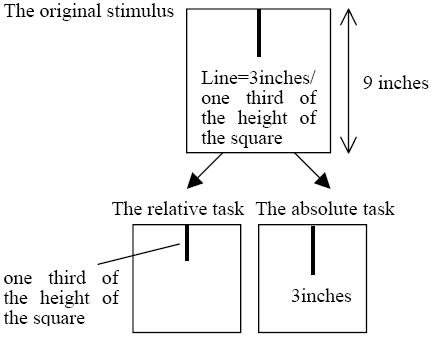 Figure 1 from Ishii & Kitayama (2003).
The European American participants were significantly more accurate than the Japanese participants in the absolute condition, while the Japanese participants were significantly more accurate than the European American participants in the relative task.
In another experiment2, this one on "change blindness", European American and Japanese participants were presented with moving scenes. In each scene, there were large, "rapidly moving" foreground objects set against a static background scene. In one condition, aspects of the objects in the foreground changed, while in others, aspects of the static background changed. European Americans were significantly better than the Japanese participants at detecting changes to foreground objects, while Japanese participants were better at detecting changes to the background.
These findings, and others, have been used to argue that Europeans tend to focus their attention on objects, independent of context (i.e., to attend and perceive analytically), while East Asians focus on the context (attending and perceiving holistically). But again, they just demonstrate the difference, and weren't designed to assess any causal hypotheses. However, these findings do contain clues. Miyamoto, Nisbett, and Masuda3 noted that in the change blindness experiment, when the participants were shown Japanese scenes, both the European Americans and Japanese noticed more changes to the background than to the foreground objects, and when the scenes were American scenes, participants from both cultures detected more changes in the foreground objects. Might there be some difference in typical scenes to which people from the two different cultures are exposed, then, and might these differences influence the adoption of particular attentional styles?
To answer this question, Miyamoto et al. first gathered photos of scenes from similar contexts (schools, hotels, and post offices) from six cities, three in the U.S. and three in Japan. For each country, one of the cities was a small city (population less than 5,000), one medium-sized (population ~100,000), and one large (population ~8,000,000). Examples of the photos are below. They hypothesized that at each city-size, the Japanese scenes would be more "complex" and "ambiguous" than the American scenes. This, they further hypothesized, would cause the Japanese scenes to prime the holistic, context-focused attentional style observed in East Asian participants in previous experiments, while the American scenes would prime the analytic, object-focused attentional style observed in American participants. To test the first hypothesis, they used two measures of complexity and ambiguity. For the first, they presented participants with 82 photos, 41 of Japanese scenes and 41 of American, and asked them to answer the following four questions about each photo (on a 5-point scale):
- "How ambiguous is the boundary of each object?"
- "How many different objects do there seem to be?"
- "To what degree do there seem to be parts of the scene that are invisible?"
- "To what degree is the scene either chaotic or organized?"
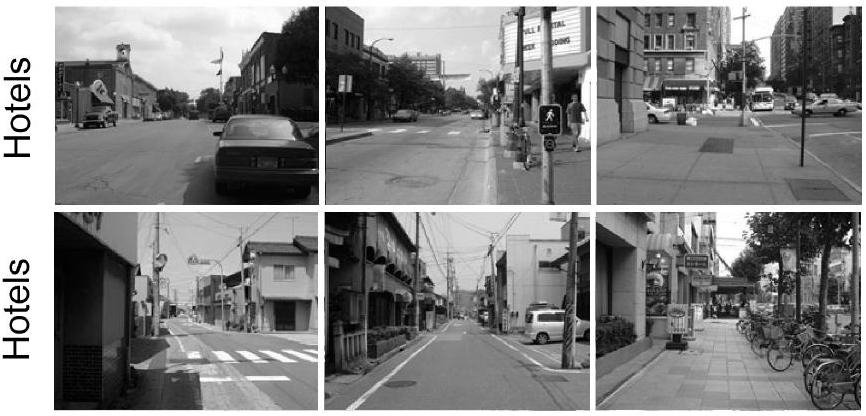 Having shown that the Japanese scenes were indeed more complex and ambiguous, Miyamoto et al. conducted another change blindness study to test their second hypothesis. In this study, culturally neutral scenes were presented to both Japanese and European American participants. In each scene, changes occurred either in the background or to foreground objects, as in the previous change blindness experiments. In this experiment, though, participants were primed with either Japanese or American scenes prior to viewing the culturally neutral scenes. Miyamoto et al. predicted that priming them with scenes from Japanese cities would prime holistic attentional focus, and the American scenes would prime analytic attentional focus, regardless of whether the participants were Japanese or American.
As in the previous change-blindness study, Japanese participants in this study perceived more changes to the background, overall, than American participants, though both American and Japanese participants detected about the same number of changes to foreground objects. In essence, Japanese participants detected more changes than American participants. More importantly, when primed with scenes from Japanese cities, both the American and Japanese participants detected more changes to the background than when they were primed with American scenes, and when primed with American scenes, Japanese participants detected more changes to foreground objects than when primed with Japanese scenes. American participants' detection of changes to foreground objects did not differ as a function of the type of priming image.
Overall, then, the data is consistent with the second hypothesis, that the different types of scenes in the two countries contribute to the differences in attentional style between the two cultures. Miyamoto et al. don't really offer any reasons why this might be. Perhaps the greater complexity in the Japanese scenes makes attending to specific objects more difficult, or makes each individual object slightly less salient, thus making it easier and more effective to attend to the overall context. They do, however, make it clear that differences in the complexity and ambiguity of the scenes is not likely to be the only cause of the differences in attention, and that there may be cultural factors that influence what types of scenes predominate in a particular culture, though they don't speculate on what those factors might be. In the final analysis, then, the study doesn't tell us a whole heck of a lot. At least the study provides a step in the right direction though, in that it shows that there are environmental factors at work in shaping cultural styles in attention and perception. So, while the study doesn't add anything to my answer to questions about cultural differences in cognition, it at least lets me feel more confident in telling people that environmental factors are one type of potential cause.
1Ishii, K., & Kitayama, S. (2003). Selective attention to contextual information in Japan. Poster presented at 25th Annual meeting of Cognitive Science Society; Kitayama, S., Duffy, S., Kawamura, T., & Larsen, J.T. (2003). Perceiving an object and its context in different cultures: a cultural look at new look." Psychological Science, 14(3), 201-206.
2Masuda, T., & Nisbett, R.E. (In Press). Culture and change blindness. Cognitive Science.
3Miyamoto, Y., Nisbett, R.E., & Masuda, T. (2006). Culture and the physical environment: Holistic versus analytic perceptual affordances. Psychological Science, 17(2), 113-119.
Friday, April 07, 2006
Links out the Wazoo
Welcome to this week's links post. First off, you may have heard about the study by social psychologists involving linguistic analysis of interviews by Kerry and Edwards during the 2004 campaign, and Gore during the 2000 campaign. A link to the paper (via Coturnix) is here. A more comprehensive analysis by the same research team, which compares Kerry, Edwards, Bush, and Cheney, can be found here. The analyses are undertaken using a program called LIWC (pronounced Luke), which stands for Linguistic Inquiry and Word Count. The program looks for the 2300 words and word stems in its dictionary (as of the 2001 edition; I believe the 2006 edition may have more), and divides them into 73 different categories. Previous research has correlated these categories with specific variables, such as cognitive complexity or honesty. So, your LIWC "scores" are meant to indicate how "honest" or "intelligent" (cognitively complex) your speech is. There are problems with this method, particularly in the procedures involved in correlating word categories with variables, but it makes for interesting reads. If you want to play with an abridged version of LIWC yourself, you can enter any text you like into the window at this website, and it will give you a short LIWC analysis.
Some of you may be aware of the ongoing debate about a face recognition module. Several studies have suggested that part of the right fusiform gyrus, an area of the brain in the temporal lobe, is specifically designed to detect and recognize faces. The area has been dubbed the "fusiform face area," or FFA. The debate is over whether this area is specifically designed to detect faces, or is instead simply an object-recognition area that detects certain kinds of complex (and perhaps highly familiar) shapes. Stephen of OmniBrain links to an article about the most recently published research on the problem. The authors of the paper offer a model from the object-recognition perspective that does a good job of accounting for the evidence used to argue for the existence of a face-recognition module. Unfortunately, the actual paper is not available without a subscription, but here is an excerpt from the abstract to whet your appetite1:
Joshua Knobe, who consistently produces experimental philosophy's most intriguing results, has a short post about one of his recent studies on "Psychopaths and Moral Responsibility," at The Garden of Forking Paths.
Speaking of philosophy, at his blog, Brian Leiter links to this review of a collection of essays on the history of philosphy and analytic philosophy. It contains the following quote:
And finally, Tony Brown of GNIF Brain Blogger links to this interesting talk (Real Player) by Francis Crick on consciousness.
Unfortunately, no updates in the "Medieval Women I Adore" series as of yet, but go read Heo Cwaeth anyway.
1Jiang, X., Rosen, E., Zeffiro, T., VanMeter, J., Blanz, V., & Riesenhuber, M. (2006). Evaluation of a shape-based model of human face discrimination using fMRI and behavioral techniques. Neuron, 50(1), 159-172.
Some of you may be aware of the ongoing debate about a face recognition module. Several studies have suggested that part of the right fusiform gyrus, an area of the brain in the temporal lobe, is specifically designed to detect and recognize faces. The area has been dubbed the "fusiform face area," or FFA. The debate is over whether this area is specifically designed to detect faces, or is instead simply an object-recognition area that detects certain kinds of complex (and perhaps highly familiar) shapes. Stephen of OmniBrain links to an article about the most recently published research on the problem. The authors of the paper offer a model from the object-recognition perspective that does a good job of accounting for the evidence used to argue for the existence of a face-recognition module. Unfortunately, the actual paper is not available without a subscription, but here is an excerpt from the abstract to whet your appetite1:
We present a neurophysiologically plausible, feature-based model that quantitatively accounts for face discrimination characteristics, including face inversion [difficulty recognizing upside-down faces] and "configural"” effects. The model predicts that face discrimination is based on a sparse representation of units selective for face shapes, without the need to postulate additional, "“face-specific" mechanisms.Next up, Richard of Philosophy, et cetera, has a very interesting post on "open relationships," which is followed by some very good discussion in the comments section.
Joshua Knobe, who consistently produces experimental philosophy's most intriguing results, has a short post about one of his recent studies on "Psychopaths and Moral Responsibility," at The Garden of Forking Paths.
Speaking of philosophy, at his blog, Brian Leiter links to this review of a collection of essays on the history of philosphy and analytic philosophy. It contains the following quote:
Analytic philosophy, Garber holds, has moved from its initial heady insistence on solving problems by logical analysis to its current watery demand for precision and rigor. It is currently in a state of crisis. Its practitioners are doing Kuhnian normal philosophy but the paradigm itself is coming unraveled. What properly and fully contextualized study of the past can do is to show us the many different things philosophers were doing in working on the problems we take as central.Leither asks for comments, and Jason Stanley obliges, with a post titled "What Crisis?"
And finally, Tony Brown of GNIF Brain Blogger links to this interesting talk (Real Player) by Francis Crick on consciousness.
Unfortunately, no updates in the "Medieval Women I Adore" series as of yet, but go read Heo Cwaeth anyway.
1Jiang, X., Rosen, E., Zeffiro, T., VanMeter, J., Blanz, V., & Riesenhuber, M. (2006). Evaluation of a shape-based model of human face discrimination using fMRI and behavioral techniques. Neuron, 50(1), 159-172.
Wednesday, April 05, 2006
Motivated Cognition in Relationships, or How Motivated Cognition Can Save Your Marriage
It's easy to see why research on motivated political reasoning/cognition has gotten a lot of attention in the blogosophere lately. It fits nicely with our intuitions about how people interpret political information (and by people, we mean other people, because our political decisions are all perfectly rational), and you don't have to look very far to see instances of motivated political reasoning. This week's news about Tom Delay, for example, has highlighted the fact that liberals are often all too ready to assume Delay is guilty, while conservatives, faced with the same facts, are equally ready to assume that Delay's legal troubles are the result of a liberal conspiracy to harm a prominent conservative. But you know, all this talk of motivated political reasoning is kind of depressing, and it gives motivated reasoning a bad rap. So I thought I'd talk a little bit about motivated reasoning in another domain, romantic relationships, where the good it can do is more apparent.
To start, think about what romantic relationships are. In most cases, two individuals who are likely to be very different from each other (at least on basic personality dimensions1) commit to each other in a way that has a the wide range of practical implications, concerning finances, careers, child rearing, location, etc. On top of all that (and perhaps because of it), we are generally pretty emotionally invested, staking much of our quality of life on the quality of our close relationships. So it's in our best interest that these relationships be satisfying. Contrary to the common wisdom (even among psychologists, especially therapists), though, realism and satisfaction tend to make poor bedfellows, with our satisfaction decreasing as our awareness of our partners' faults increases2. Right away, then, we can see how motivated reasoning might be good for romantic relationships. If you want to be satisfied in a relationship, then you're going to be motivated to see your partner in a positive light. Or, as Shakespeare put it in A Midsummer Night's Dream (a quote stolen from Murray et al.3), "Things base and vile, holding no quantity, Love can transform to form and dignity. Love looks not with the eyes, but with the mind. And therefore is winged Cupid painted blind."
In what ways is motivated reasoning used in relationships? I'm glad you asked. Let's start with attributions. Fincham and Bradbury4 conducted a 12-month study involving 130 couples in which the effects of different types of attributions on marital satisfaction were measured. They found that when participants attributed positive behaviors by their partners to situational factors, and negative behaviors to the partners themselves (as opposed to situational factors), their relationship satisfaction was significantly lower, 12 months later, than for participants who attributed positive behaviors to their partners, and negative behaviors to the situation. In other words, satisfied participants interpreted bad stuff as being caused by the situation, and positive stuff as being caused by their romantic partners.
Showing that differences in attribution affect relationship satisfaction is great, but maybe in relationships that are working, the good stuff really is more attributable to the person, and the bad stuff more attributable to the situation. To show that people are using motivated reasoning, we'd have to show that, at least in some cases, their perceptions of their partners seem to diverge from reality. This would indicate that they're selectively choosing the facts on which they base their perceptions in order to arrive at the desired conclusion. The first line of evidence for this divergence from reality comes from research showing that most people believe their own romantic partners to be more virtuous than the average5. Of course, most people's partners can't be better than average, but as Murray et al. (reference in footnote 3) point out, this could simply be the result of accurate perception of one's partner, and inaccurate perception of what the average is. So, in order to look for unrealistic perceptions, they conducted a study expressly designed to compare people's perception of their romantic partners to two converging measures of "reality." First, they gathered 77 married and 28 cohabitating couples, and gave each partner two tests (27 items in all) measuring positive and negative attributes. Each partner rated both him or herself, and his or her partner on each attribute. This allowed Murray et al. to compare partners' perceptions of each other to their self-perceptions. The participants also completed a test measuring their satisfaction with their relationship.
To add another measure of "reality," each couple was asked to provide the name of a friend who could evaluate both the two partners and the quality of their relationship. Murray et al. tracked those friends down, and sent them the two tests completed by the couples, and asked them to complete them for both members of the pair. Each friend also rated how close they were to the couple with whom they were friends, and how close they were to the couple. Thus, Murray et al. could compare the partners' perception of each other and their self-perceptions to the perceptions of their friends, with self-perceptions and friends' perceptions creating two measures of "reality." If motivated reasoning is at work, we'd expect partners' perception of each other to diverge from both self and friend perceptions.
What they found is pretty straightforward. Partners' self-perceptions and their friends' perceptions of them were very similar, indicating that they could both be used as accurate measures of reality. They also found that there was a small relationship between both self and friend perception and relationship satisfaction. People who perceived themselves as having more positive attributes, and fewer negative attributes, and whose friends perceived themselves as having more positive and fewer negative attributes, had partners who were more satisfied with their relationships. Thus, people were more satisfied with relationships when their partners had a lot of positive attributes (duh!). More importantly for our purposes, though, there was a statistical interaction between the two measures of "reality" (self and friend perceptions) and partners' perception of each other, on the one hand, and relationship satisfaction on the other. People who were unsatisfied with their relationship tended to see their partners as having fewer positive attributes than their partners and friends, while people who were satisfied in their relationships tended to perceive more positive attributes than either their friends or partners. Put differently, the perceptions of the dissatisfied were more negative than reality, and the perceptions of the satisfied were more positive than reality.
This association between perceptions that diverge from reality in one direction or the other, and relationship satisfaction, is pretty clear evidence of motivated reasoning in relationships. In the case of a satisfied partner, he or she is motivated to believe that his or her partner has a wealth of positive attributes, while a dissatisfied partner is motivated to believe that his or her partner has few positive attributes (thus making it possible to attribute the relationship problems to the other person, and justifying one's dissatisfaction). The question, of course, is whether satisfaction (or dissatisfaction) causes motivated reasoning, or motivated reasoning causes satisfaction. I don't know of any experimental work on the relationship between the two, to date, so the causal question is still unanswered. However, I suspect that it works in both directions. The more satisfied you are, the more motivated you are to see your partner in a positive light, and the more you see your partner in a positive light, the more satisfied you'll be.
Of course, being motivated to see your partner in a positive light, and thus selectively interpreting the facts so will do so, isn't always a good thing. It likely causes us to overlook many faults that might one day cause problems in our relationships. Still, the evidence that being realistic about our partners' faults is harmful to relationships is overwhelming. And that's not really very surprising. If we all focused on the things we don't like about our partners, no relationship would last very long. So all in all, you should be wary of thinking too poorly of motivated reasoning. It might save your marriage one day.
1Lykken, D.T., & Tellegen, A. (1993). Is human mating adventitious or the result of lawful choice? A twin study of mate selection. Journal of Personality and Social Psychology, 65(1), 56-58.
2Huston, T.L., & Vangelisti, A.L. (1991). Socioemotional behavior and satisfaction in marital relationships: A longitudinal study. Journal of Personality and Social Psychology, 61(5), 721-733.
3Murray, S.L., Holmes, J.G., Dolderman, D., & Griffin, D.W. (2000). What the motivated mind sees: Comparing friends' perspectives to married partners' views of each other. Journal of Experimental Social Psychology, 36(6), 600-620.
4Fincham, F.D., & Bradbury, T.N. (1993). Marital satisfaction, depression, and attributions: a longitudinal study. Journal of Personality and Social Psychology, 64(3), 442-452.
5Murray, S.L., & Holmes, J.G. (1997). A leap of faith? positive illusions in romantic relationships. Personality and Social Psychology Bulletin, 23, 586-604.
Saturday, April 01, 2006
Notes on Blogrolling
OK, I feel a bit silly writing this post, because this is not exactly a big time blog, but I've been getting a fair number of link requests lately, so I thought I should say something about how I decide whom to link on the blogroll. First, I have to know your blog exists, so feel free to send me an email, especially if you write a lot about cognitive science, any area of psychology, philosophy (any phenomenologists out there?), biology, or just about any other science or academic discipline (hell, I've got a medievalist on the blogroll!). Also, I'm really into feminist blogging, because while I've read a lot of feminist academic writing, I find that I learn as much, if not more, from reading the ideas and perspective of "rank and file" feminists, and while, as I said, this is just a podunk little blog, I would like to do my part to get other people to learn from them as well.
Second, I have to have read your blog for at least a little while. Usually what this entails is subscribing to the feed of a blog that I've just learned about and reading it for a few days. The reason for this is that I make a big to-do about the responsibility of academic bloggers, and while I may not always live up to my own ideals ("Bilingualism = Multiple Personality Disorder?" That's just an irresponsible title designed to get people to read me), I have to at least make sure you're not telling people things like, they "didn't even fire up the thinking parts of their brains." Also, racism, sexism, homophobia, and/or believing that linguists are better than cognitive psychologists are automatic grounds for exclusion.
Third, I'm both lazy and absent-minded. That means it's possible, even likely, that I have learned about your blog, read it, and liked it, and then forgotten to link it. If that's the case (as it was with, say, Cognitive Daily, which I'd been reading forever and had forgotten to link!), and you still want me to put you on the sidebar, then bug me as much as you want. If, after persistent nagging, I still haven't put you on the blogroll, and haven't given you a reason, then feel free to throw solid objects at me. My friends will tell you that's the best way to get me to do something.
Fourth, if you really want me to link to you, leave comments here. I love discussion. I've got some great regular commenters, but would like more. If you comment here regularly, I can virtually guarantee you you'll end up on the blogroll (as long as you're not talking about "thinking parts of the brain," of course). If you have been commenting here a lot, and I haven't blogrolled you, then see the previous paragraph.
Fifth, there's more to linking than blogrolling. I may have a post on a topic that you two have written about. Even if your post disagrees with everything I said in mine, send me a link. I'd be happy to put it in an update or in one of my new link posts.
And finally, tell me how wonderful I am. I'm a sucker for flattery. Heck, even if you don't want to be on the blogroll, or don't actually have a blog, you should probably be telling me how wonderful I am on a regular basis anyway. (This last one makes all that talk about having a "podunk blog" seem like feigned modesty, doesn't it?) I'm kidding, of course, but I do like feedback, even negative feedback (especially negative feedback, in many cases, as long as it's constructive), so give me as much feedback as you want. As with participating in discussions here, giving me feedback (again, even the negative kind) will so ingratiate you to me that I'll almost certainly link to you.
Second, I have to have read your blog for at least a little while. Usually what this entails is subscribing to the feed of a blog that I've just learned about and reading it for a few days. The reason for this is that I make a big to-do about the responsibility of academic bloggers, and while I may not always live up to my own ideals ("Bilingualism = Multiple Personality Disorder?" That's just an irresponsible title designed to get people to read me), I have to at least make sure you're not telling people things like, they "didn't even fire up the thinking parts of their brains." Also, racism, sexism, homophobia, and/or believing that linguists are better than cognitive psychologists are automatic grounds for exclusion.
Third, I'm both lazy and absent-minded. That means it's possible, even likely, that I have learned about your blog, read it, and liked it, and then forgotten to link it. If that's the case (as it was with, say, Cognitive Daily, which I'd been reading forever and had forgotten to link!), and you still want me to put you on the sidebar, then bug me as much as you want. If, after persistent nagging, I still haven't put you on the blogroll, and haven't given you a reason, then feel free to throw solid objects at me. My friends will tell you that's the best way to get me to do something.
Fourth, if you really want me to link to you, leave comments here. I love discussion. I've got some great regular commenters, but would like more. If you comment here regularly, I can virtually guarantee you you'll end up on the blogroll (as long as you're not talking about "thinking parts of the brain," of course). If you have been commenting here a lot, and I haven't blogrolled you, then see the previous paragraph.
Fifth, there's more to linking than blogrolling. I may have a post on a topic that you two have written about. Even if your post disagrees with everything I said in mine, send me a link. I'd be happy to put it in an update or in one of my new link posts.
And finally, tell me how wonderful I am. I'm a sucker for flattery. Heck, even if you don't want to be on the blogroll, or don't actually have a blog, you should probably be telling me how wonderful I am on a regular basis anyway. (This last one makes all that talk about having a "podunk blog" seem like feigned modesty, doesn't it?) I'm kidding, of course, but I do like feedback, even negative feedback (especially negative feedback, in many cases, as long as it's constructive), so give me as much feedback as you want. As with participating in discussions here, giving me feedback (again, even the negative kind) will so ingratiate you to me that I'll almost certainly link to you.
Friday, March 31, 2006
Links, Links, Links
I've decided that, for now, I'm going to do this link post thing every now and then, because I always like when Brandon does it, and hey, I've stolen just about every aspect of my blog personality from him, Richard, and Clark, so what's one more theft? Plus, there's a lot of cool stuff out there, and I might have noticed some of it that you didn't.
First up is Heo Cwaeth's fourth installment in her "Medieval Women I Adore" series. This one is on Hrotswitha von Gandersheim (try saying that 5 times fast!), about whom she writes:
Next, Carl Zimmer discovers that what looks like a myth about the brain, that it can perform a massive amount of calculations using only 10 watts, is true, even though it may have originated with the poet Paul Valery.
John Hawks has a nice post on two recent papers concerning off-line memory consolidation while we're awake. Very interesting stuff on a very poorly understood topic.
Via Omni Brain, "The Seven Warning Signs of Bogus Science."
Also, March saw the birth of a great new blog, Stop that Crow! You should stop by and read everything, but I recommend starting with this one on similarity-based theories of concepts.
And finally, Cognitive Daily talks about The Emotion of Shapes.
First up is Heo Cwaeth's fourth installment in her "Medieval Women I Adore" series. This one is on Hrotswitha von Gandersheim (try saying that 5 times fast!), about whom she writes:
My love for this woman comes not only from her desire to defend the role of women in Christianity at such an early stage, but from her absolute refusal to feign idiocy. In fact, she considers her intellect a gift from God that she is required to use. Doesn't get better than that in the tenth century, folks.Plus, did you know that she was the first European woman known to have written literary works? Now you do. As usual, Heo manages to make me adore Hrotsw... you know who I mean, too.
Next, Carl Zimmer discovers that what looks like a myth about the brain, that it can perform a massive amount of calculations using only 10 watts, is true, even though it may have originated with the poet Paul Valery.
John Hawks has a nice post on two recent papers concerning off-line memory consolidation while we're awake. Very interesting stuff on a very poorly understood topic.
Via Omni Brain, "The Seven Warning Signs of Bogus Science."
Also, March saw the birth of a great new blog, Stop that Crow! You should stop by and read everything, but I recommend starting with this one on similarity-based theories of concepts.
And finally, Cognitive Daily talks about The Emotion of Shapes.
Bilingualism = Multiple Personality Disorder?
OK, this (via Mind Hacks) is just cool, even if I don't know quite how seriously to take it. Apparently there's been a fair amount of research over the last few years on changes in attitudes, values, and behaviors that occur when bilinguals (or multilinguals) switch between languages. For example, in one study (p. 2):
But for social psychologists, the mere priming of values and attitudes is not sexy enough. They need something bigger; they need to show that switching between languages causes personality changes. Of course, this requires showing something equally sexy, namely that differences in personality exist between Spanish and English speakers in the first place. So the paper is, like, doubly sexy ("sexy" is, of course, a technical term in social psychology, and doesn't refer to anything related to actual sex... I hope).
In the first study, they administered the Big Five Inventory, which measures the Big Five personality dimensions, to 168, 451 (yes, that's a lot) English-speaking participants in the United States, and 1031 Spanish-speaking participants living in Mexico. They found small, but statistically different differences on all 5 dimensions (with samples that large, it's no wonder), such that the English-speakers scored higher on the Extraversion, Agreeableness, Conscientiousness, and Openness dimensions, while the Spanish-speakers scored higher on the Neuroticism dimension.
Using this finding, they then predicted that if bilinguals take the BFI in both languages, they will score higher on Extraversion, Agreeableness, Conscientiousness, and Openness when they take it in English, and higher on Neuroticism when they take it in Spanish. In three studies, with a combined sample of 249 English-Spanish bilinguals in Mexico and the United States, they found differences in the predicted directions on four of the five dimensions, with the difference on the Openness dimension being in the opposite direction, though not statistically significant. The difference between the scores on the Spanish and English versions on the Neuroticism dimension, while in the predicted direction, was also not statistically significant.
Once again, the authors interpret these results in terms of Cultural Frame Switching. They also make it clear that, while they found small changes in personality within individuals, the correlation between scores on the English and Spanish tests, across all participants, was 0.8. This implies that the differences between the scores for a single individual on the two versions of the test were relative. If one person takes the test in English and scores higher on the Extraversion dimension than another person did on the English version, it's likely that the first person will also score higher on the Extraversion dimension on the Spanish version than the second will on the Spanish version. Thus, switching languages isn't really altering your personality all that much. It's just tweaking the levels a little. And switching between Spanish and English doesn't seem to change your level of openness at all. I guess openness isn't as prone to priming effects as, say, extroversion. So, if you're an overly close-minded Spanish speaker, I'm afraid that learning English and speaking it exclusively probably won't help. But if you're an introverted Spanish speaker with a messy bedroom (Conscientiousness), and you want to have more fun at parties and finally clean that room, then by all means, learn English.
Hong Kong bilingual-Chinese managers who responded to a values questionnaire in English displayed means closer to a group of American managers in the US than did the bilingual-Chinese managers who responded to the same questionnaire in Chinese (Ralston et al., 1995).The explanation, which the authors of the linked study (two of whom I know pretty well personally, and still had never heard of this stuff) attribute to "Cultural Frame Switching" or "cultural accomodation," is that the language primes the culture that goes with it, and the cultures values and atitudes are thus primed as well. You know, I can almost buy that.
But for social psychologists, the mere priming of values and attitudes is not sexy enough. They need something bigger; they need to show that switching between languages causes personality changes. Of course, this requires showing something equally sexy, namely that differences in personality exist between Spanish and English speakers in the first place. So the paper is, like, doubly sexy ("sexy" is, of course, a technical term in social psychology, and doesn't refer to anything related to actual sex... I hope).
In the first study, they administered the Big Five Inventory, which measures the Big Five personality dimensions, to 168, 451 (yes, that's a lot) English-speaking participants in the United States, and 1031 Spanish-speaking participants living in Mexico. They found small, but statistically different differences on all 5 dimensions (with samples that large, it's no wonder), such that the English-speakers scored higher on the Extraversion, Agreeableness, Conscientiousness, and Openness dimensions, while the Spanish-speakers scored higher on the Neuroticism dimension.
Using this finding, they then predicted that if bilinguals take the BFI in both languages, they will score higher on Extraversion, Agreeableness, Conscientiousness, and Openness when they take it in English, and higher on Neuroticism when they take it in Spanish. In three studies, with a combined sample of 249 English-Spanish bilinguals in Mexico and the United States, they found differences in the predicted directions on four of the five dimensions, with the difference on the Openness dimension being in the opposite direction, though not statistically significant. The difference between the scores on the Spanish and English versions on the Neuroticism dimension, while in the predicted direction, was also not statistically significant.
Once again, the authors interpret these results in terms of Cultural Frame Switching. They also make it clear that, while they found small changes in personality within individuals, the correlation between scores on the English and Spanish tests, across all participants, was 0.8. This implies that the differences between the scores for a single individual on the two versions of the test were relative. If one person takes the test in English and scores higher on the Extraversion dimension than another person did on the English version, it's likely that the first person will also score higher on the Extraversion dimension on the Spanish version than the second will on the Spanish version. Thus, switching languages isn't really altering your personality all that much. It's just tweaking the levels a little. And switching between Spanish and English doesn't seem to change your level of openness at all. I guess openness isn't as prone to priming effects as, say, extroversion. So, if you're an overly close-minded Spanish speaker, I'm afraid that learning English and speaking it exclusively probably won't help. But if you're an introverted Spanish speaker with a messy bedroom (Conscientiousness), and you want to have more fun at parties and finally clean that room, then by all means, learn English.
Wednesday, March 29, 2006
Upcoming on Mixing Memory
I've got a few posts stewing on the following topics:
- Essentialism about social concepts
- Motivated cognition outside of politics
- Cultural differences in cognition
- Memetics
Tuesday, March 28, 2006
Richards Politics and Personality Meme
As some of you may remember, way back when, Richard of Philosophy, etcetera started a meme in which bloggers took both the IPIP-NEO personality test and the Political Compass quiz, and reported their results (if you want to participate, take the tests now, before reading on). Richard has posted the results, but I thought I'd say a little bit more about them. Naturally, none of these results should be treated as scientific, because, well, they're not. In addition to the fact that neither the online IPIP-NEO or the Political Compass are great tests, the sample was pretty skewed towards the Left and (Social) Libertarian ends of the Political Compass scales, as indicated in the two histograms below.
 The scales both go from -10 to +10, with -10 representing the most extreme Left/Libertarian score, and +10 the most extreme Right/Authoritarian score. As you can see, there weren't many bloggers on the Authoritarian end of the Libertarian-Authoritarian scale (16 out of 89, or 18%), and there were relatively few on the Right end of the Left-Right scale (23 out of 89, or 26%). Furthermore, on both scales, those on the Left and Libertarian ends tended to be more extreme than those on the Right and Authoritarian ends. The mean for those on the Left end was -5.6 (median = -5.88), while the mean for those on the left was 4.4 (median = 4.0). The difference is even bigger for the Libertarian-Authoritarian scale. The mean for those on the Libertarian end was -5.3 (median = -5.3), while the mean for those on the Authoritarian end was 2.3 (median = 1.7). In both cases, the differences in extremity are statistically significant. The one good thing the political compass results have going for them is that they seem fairly consistent with the bloggers' self-identification as either liberal or conservative.
The point of all that is simply to make it clear that, if you wanted to compare the relationships between the scores on the compass to the scores on the personality test, this isn't the sample to do it, because it's so heavily skewed. The fact that 67% of the bloggers who gave their results were male doesn't help either. But because this is a blog, and not a scientific journal, I'm going to report the results anyway. Just remember, "bullshit" would be a good word to describe these results. But it's interesting bullshit.
Since the interesting correlations were between the personality variables and the two political compass scores, I'll focus on those. I will quickly note, however, that there were no statistically significant correlations between the personality variables and either age or sex, though the correlation between age and artistic interest (.21) was pretty damn close. It indicates that as people got older, their artistic interest grew. Don't ask me what that might mean (young people and their terrible music! bah!). Also, the correlation between the Left-Right and Libertarian-Authoritarian scales was high (.75) and statistically significant.
For simplicity's sake, I'll report all statistically significant correlations between the compass scores and personality variables as being positive, with those that were negative (i.e., personality scores went up as individuals became more Left or Libertarian) being reported as positive correlations with Left/Libertarian. On the personality test, there were 5 personality categories (Extraversion, Agreeableness, Conscientiousness, Neuroticism, and Openness to Experience), the Big Five. Within each category there were 6 additional variables, each with its own score. First the correlations for the categories. Conscientiousness was positively correlated Right (.23) and Authoritarianism (.22), Agreeableness was positively correlated with Left (.22), and Openness to Experience was positively correlated with both Left (.63) and Libertarian (.66). For the variables within the categories, only one was significantly correlated with either Right or Libertarian. Dutifulness, which is in the Conscientiousness category, was positively correlated with Authoritarian (.23). There were a bunch of significant correlations with Left and Libertarian among the variables within the categories, so instead of writing them all out, I'll just let you read this table:
 As you can see, all six of the variables in the Openness to Experience category were positively correlated with both Left and Libertarian, with some of the correlations in the moderate to high range. I suppose it's a good thing that the personality variable Liberal correlated with Left, and that the correlation between Liberal and Libertarian was about the same as that between Left and Libertarian.
Before signing off, I should make a few comments (because I like to hear the sound of my own typing). I think it's interesting that these results are somewhat consistent with the two highly controversial studies I mentioned in a recent post. The correlations between the Left and the category Openness to Experience, as well as Imagination, Artistic Interests, Adventurous, and Intellectual are consistent with the Jost et al. results. I suppose the correlation between Left and Sympathy could be consistent with those results as well, as could the correlation between Authoritarian and Dutifulness. I suppose the fact that this sample was hardly representative of the population as a whole is another point of consistency. Also, it might be interesting to note that the correlation between depression and Left and Depression is consistent with the literature showing that conservatives/Republicans tend to rate themselves as being happier. I don't know what the hell the correlation between Emotionality and Left means. Maybe it's why they call 'em "bleeding heart liberals."
So there you have it, the results of Richard's meme. They're kind of interesting, somewhat consistent with what I think many of us would expect, and entirely meaningless. I don't know if you could ever get a truly representative sample through blogs (though it can't be any less representative that a sample of college undergrads), but it would be nice to have a more even distribution on both the Left-Right and Libertarian-Authoritarian scores. I suppose it's skewed because Richard and the other blogs that picked it up are mostly read by us lefties, though it's mighty tempting to say that the skew is because Richard's blog is a philosophy blog, and Intellectual is positively correlated with Left and Libertarian (that's really meant as a joke, folks).
 The scales both go from -10 to +10, with -10 representing the most extreme Left/Libertarian score, and +10 the most extreme Right/Authoritarian score. As you can see, there weren't many bloggers on the Authoritarian end of the Libertarian-Authoritarian scale (16 out of 89, or 18%), and there were relatively few on the Right end of the Left-Right scale (23 out of 89, or 26%). Furthermore, on both scales, those on the Left and Libertarian ends tended to be more extreme than those on the Right and Authoritarian ends. The mean for those on the Left end was -5.6 (median = -5.88), while the mean for those on the left was 4.4 (median = 4.0). The difference is even bigger for the Libertarian-Authoritarian scale. The mean for those on the Libertarian end was -5.3 (median = -5.3), while the mean for those on the Authoritarian end was 2.3 (median = 1.7). In both cases, the differences in extremity are statistically significant. The one good thing the political compass results have going for them is that they seem fairly consistent with the bloggers' self-identification as either liberal or conservative.
The point of all that is simply to make it clear that, if you wanted to compare the relationships between the scores on the compass to the scores on the personality test, this isn't the sample to do it, because it's so heavily skewed. The fact that 67% of the bloggers who gave their results were male doesn't help either. But because this is a blog, and not a scientific journal, I'm going to report the results anyway. Just remember, "bullshit" would be a good word to describe these results. But it's interesting bullshit.
Since the interesting correlations were between the personality variables and the two political compass scores, I'll focus on those. I will quickly note, however, that there were no statistically significant correlations between the personality variables and either age or sex, though the correlation between age and artistic interest (.21) was pretty damn close. It indicates that as people got older, their artistic interest grew. Don't ask me what that might mean (young people and their terrible music! bah!). Also, the correlation between the Left-Right and Libertarian-Authoritarian scales was high (.75) and statistically significant.
For simplicity's sake, I'll report all statistically significant correlations between the compass scores and personality variables as being positive, with those that were negative (i.e., personality scores went up as individuals became more Left or Libertarian) being reported as positive correlations with Left/Libertarian. On the personality test, there were 5 personality categories (Extraversion, Agreeableness, Conscientiousness, Neuroticism, and Openness to Experience), the Big Five. Within each category there were 6 additional variables, each with its own score. First the correlations for the categories. Conscientiousness was positively correlated Right (.23) and Authoritarianism (.22), Agreeableness was positively correlated with Left (.22), and Openness to Experience was positively correlated with both Left (.63) and Libertarian (.66). For the variables within the categories, only one was significantly correlated with either Right or Libertarian. Dutifulness, which is in the Conscientiousness category, was positively correlated with Authoritarian (.23). There were a bunch of significant correlations with Left and Libertarian among the variables within the categories, so instead of writing them all out, I'll just let you read this table:
 As you can see, all six of the variables in the Openness to Experience category were positively correlated with both Left and Libertarian, with some of the correlations in the moderate to high range. I suppose it's a good thing that the personality variable Liberal correlated with Left, and that the correlation between Liberal and Libertarian was about the same as that between Left and Libertarian.
Before signing off, I should make a few comments (because I like to hear the sound of my own typing). I think it's interesting that these results are somewhat consistent with the two highly controversial studies I mentioned in a recent post. The correlations between the Left and the category Openness to Experience, as well as Imagination, Artistic Interests, Adventurous, and Intellectual are consistent with the Jost et al. results. I suppose the correlation between Left and Sympathy could be consistent with those results as well, as could the correlation between Authoritarian and Dutifulness. I suppose the fact that this sample was hardly representative of the population as a whole is another point of consistency. Also, it might be interesting to note that the correlation between depression and Left and Depression is consistent with the literature showing that conservatives/Republicans tend to rate themselves as being happier. I don't know what the hell the correlation between Emotionality and Left means. Maybe it's why they call 'em "bleeding heart liberals."
So there you have it, the results of Richard's meme. They're kind of interesting, somewhat consistent with what I think many of us would expect, and entirely meaningless. I don't know if you could ever get a truly representative sample through blogs (though it can't be any less representative that a sample of college undergrads), but it would be nice to have a more even distribution on both the Left-Right and Libertarian-Authoritarian scores. I suppose it's skewed because Richard and the other blogs that picked it up are mostly read by us lefties, though it's mighty tempting to say that the skew is because Richard's blog is a philosophy blog, and Intellectual is positively correlated with Left and Libertarian (that's really meant as a joke, folks).
Saturday, March 25, 2006
Dennett on Religion on the Radio
Daniel Dennett, bringing out the "sweet tooth" metaphor again, was the primary guest on a Radio Open Source show titled "Is God in Our Genes?"(this is the link to the mp3 file of the show). His main point, which I assume is the main point of his recent book, is that religion is an appropriate topic for scientific study. He's preaching to the choir with me, of course. I've tossed around a few ideas for experiments on memory and religion (in line with Atran's work), so I have no compunction in studying religion scientifically.  But apparently some people do, perhaps because they're afraid that explaining religion will cause it to lose some of its value (or maybe just because they don't like hearing this stuff from a man who looks like Santa Claus).
Dennett starts to lose me when he gets into memetics, which I find utterly worthless, and as you might expect, he focuses a lot on evolutionary explanations of religion's origins, which I also find pretty worthless, but for the most part the interview is interesting. He's joined on the show by two evolutionary biologists, an Episcopal minister, and a philosopher of religion, each of whom has something interesting to say. So if you're into the psychology or biology of religion, you might find the interviews interesting, and if you plan to read Dennett's book, it seems to provide a nice preview of what you'll find in it. (I haven't read the book myself, but I suspect that Razib's giving good advice when he says that you should just go to the primary sources.)
 But apparently some people do, perhaps because they're afraid that explaining religion will cause it to lose some of its value (or maybe just because they don't like hearing this stuff from a man who looks like Santa Claus).
Dennett starts to lose me when he gets into memetics, which I find utterly worthless, and as you might expect, he focuses a lot on evolutionary explanations of religion's origins, which I also find pretty worthless, but for the most part the interview is interesting. He's joined on the show by two evolutionary biologists, an Episcopal minister, and a philosopher of religion, each of whom has something interesting to say. So if you're into the psychology or biology of religion, you might find the interviews interesting, and if you plan to read Dennett's book, it seems to provide a nice preview of what you'll find in it. (I haven't read the book myself, but I suspect that Razib's giving good advice when he says that you should just go to the primary sources.)
Friday, March 24, 2006
Leiter and Weisberg on Evolutionary Psychology
Brian Leiter and Michael Weisberg have written an article, available here, titled "Why Evolutionary Psychology Is (So Far) Irrelevant to Law." It has three sections, the first and third arguing against the relevance of EP to law, and the second presenting criticisms EP itself. The arguments in the first and third sections are interesting (and new to me, at least), but I'm naturally more interested in the criticisms of EP itself in the second section. None of those criticisms are new. Most of them come from authors whose work on EP many of you have probably read, such as Elisabeth Lloyd (e.g., in this paper, and this one), Stephen J. Gould, David Buller, Jerry Fodor, the Panskepps, etc. (heck, I offered one of the arguments in a post back in 2004). But it is a nice review of those criticisms. If you're not familiar with those authors' writings on EP, the Leiter and Weisberg article might be of interest to you. Just to give you the gist, most of the criticisms concern the methodological and theoretical connections between EP and contemporary biology. The problem with EP is that there are no such connections. EP relies on a fairly antiquated evolutionary framework, and its methodology -- to look for behaviors that fit with evolutionary reasoning, rather than to use evolutionary reasoning to explain the origins of observed behaviors -- is the exact opposite of what biologists generally do.
I do want to note that the article suffers from a common problem in discussions of EP outside of psychology (especially those by philosophers): very few citations of actual work by Evolutionary Psychologists. It seems strange, to me at least, to offer criticisms without actually citing examples of what you are criticizing. I hesistate to speculate that this occurs due to a lack of familiarity with the literature (though I'm pretty sure that's what got Buller into trouble), but it does lead to problems. For example, I still think Leiter and Weisberg's criticisms miss the mark, partially, by misrepresenting the reasons Evolutionary Psychologists argue for adaptationist explanations. While I think they're right in claiming that there may be many possible non-adaptationist answers for most, if not all EP findings, by mistakenly believing that Evolutionary Psychologists simply assume adaptationist explanations, they leave themselves open to the reply that such explanations are not assumed, but empirically tested, and since predictions derived from those explanations have been empirically confirmed, the burden of proof is on those who believe there may be alternative, non-adaptationist explanations. Of course, the empirical tests used by EP leave much to be desired, both from the perspective of empirical psychology and of evolutionary biology. But still, I think that philosophers and biologists criticizing EP would do well to cite more than one or two examples of actual EP research (or at least be familiar with more than one or two examples).
I do want to note that the article suffers from a common problem in discussions of EP outside of psychology (especially those by philosophers): very few citations of actual work by Evolutionary Psychologists. It seems strange, to me at least, to offer criticisms without actually citing examples of what you are criticizing. I hesistate to speculate that this occurs due to a lack of familiarity with the literature (though I'm pretty sure that's what got Buller into trouble), but it does lead to problems. For example, I still think Leiter and Weisberg's criticisms miss the mark, partially, by misrepresenting the reasons Evolutionary Psychologists argue for adaptationist explanations. While I think they're right in claiming that there may be many possible non-adaptationist answers for most, if not all EP findings, by mistakenly believing that Evolutionary Psychologists simply assume adaptationist explanations, they leave themselves open to the reply that such explanations are not assumed, but empirically tested, and since predictions derived from those explanations have been empirically confirmed, the burden of proof is on those who believe there may be alternative, non-adaptationist explanations. Of course, the empirical tests used by EP leave much to be desired, both from the perspective of empirical psychology and of evolutionary biology. But still, I think that philosophers and biologists criticizing EP would do well to cite more than one or two examples of actual EP research (or at least be familiar with more than one or two examples).
Do Whiny Kids Become Conservatives?
The study that's getting a lot of attention in the blogosphere, presenting data showing that differences in preschool are correlated with differences in adult political orientation, can be read here. The criticisms seem to be largely based on speculation, but I have to admit, it's hard to evaluate the study from the write-up, because it doesn't give any representation of the distribution of political orientation, and in order to get the data on things like SES, you have to read 25-year old write-ups of previous studies using the same data. It also seems natural to worry about the sample, since it comes from a town notorious for its progressive residents. As some of this post's commenters noted, it could just be that whiny kids grow up to be "hostile to their environment," and since the Berkeley environment is decidedly liberal, these particular kids grew up to be conservative. However, I will note that the study uses widely accepted methodologies and produces results that are, in many cases, highly statistically significant.
The one thing the study appears to have going for it is that its results, at least for the correlations between the adult personality measures and political orientation, are consistent with the work of John Jost and his colleagues (you can read their papers here and here, the second paper being a response to this paper). Recall that they found political conservativism to be positively correlated with death anxiety; system instability (i.e., things like social, economic, and political threats increase conservativism); dogmatism-intolerance of ambiguity; need for order, structure, and closure; and fear of threat and loss; and negatively correlated with openness to experience; uncertainty tolerance; integrative complexity (which just means cognitive complexity); and self esteem (though this negative correlation was fairly small). Since the Block and Block study found conservativism to be negatively correlated with things like "enjoys aesthetic impressions," "complicates simple situations," "has a wide range of interests," "tends to be rebellious, non-conforming," and positively correlated with things like "uncomfortable with uncertainty," and "behaves in a sex-typed manner," the two studies seem to line up fairly well. Of course, the Jost study has been widely criticized by conservatives, but the methods and data seem pretty sound to me. You can check out the papers and judge for yourself.
The one thing the study appears to have going for it is that its results, at least for the correlations between the adult personality measures and political orientation, are consistent with the work of John Jost and his colleagues (you can read their papers here and here, the second paper being a response to this paper). Recall that they found political conservativism to be positively correlated with death anxiety; system instability (i.e., things like social, economic, and political threats increase conservativism); dogmatism-intolerance of ambiguity; need for order, structure, and closure; and fear of threat and loss; and negatively correlated with openness to experience; uncertainty tolerance; integrative complexity (which just means cognitive complexity); and self esteem (though this negative correlation was fairly small). Since the Block and Block study found conservativism to be negatively correlated with things like "enjoys aesthetic impressions," "complicates simple situations," "has a wide range of interests," "tends to be rebellious, non-conforming," and positively correlated with things like "uncomfortable with uncertainty," and "behaves in a sex-typed manner," the two studies seem to line up fairly well. Of course, the Jost study has been widely criticized by conservatives, but the methods and data seem pretty sound to me. You can check out the papers and judge for yourself.
Tuesday, March 21, 2006
Motivated Reasoning II: Are Political Partisans Irrational?
Your response, I imagine, is "duh." Partisans are emotional; stop the presses, get me rewrite. Perhaps. But I find the graphic clarity of colorful brain scans to be sobering. It'’s one thing to know that some people get obnoxious during political arguments; it's another thing to see that 30 adult men who read candidates' quotes while strapped down in MRI machines didn't even fire up the thinking parts of their brains. - Dick Meyer, in his column on the Westen et al. study
"Didn't even fire up the thinking parts of their brains." Let me quote that one more time. "Didn't even fire up the thinking parts of their brains." When I read something that stupid in an article in the mainstream media, an article linked and quoted by many bloggers, I am at a loss for words. OK, maybe not a loss; an excess, really, if you consider how long the last post was, and that it was only the first in a two-part series. But I really am blown away. You don't even have to have read anything about the study to know that Meyers must be wrong. That's just not how the brain works. But since he's spread that nonsense all over the web, I feel it's important to explain exactly what the study does show. So, after giving the background of the study in the last post, I'm ready to talk about the methods, results, and conclusions of the study in this one. If you'd like to read the unpublished write-up of the study yourself, you can request a copy from Westen here1.
The study begins from the following position (p. 3):
Neural network models of motivated reasoning suggest that in affectively relevant situations, the brain equilibrates to solutions that simultaneously satisfy two sets of constraints: cognitive constraints, which maximize goodness of fit to the data, and emotional constraints, which maximize positive affect and minimize negative affect.In other words, as I described in the post yesterday, there are two systems at work in motivated reasoning: a cold system, that works to come to an accurate conclusion given the input from the environment and memory, and a hot system, driven by emotion, that seeks to come to a desired conclusion (and thus "maximize positive affect and minimize negative affect") by biasing the input and interpretation of information from the environment and memory with which the cold system can work.
The study is concerned specifically with how political partisans, people who are committed to one political party, and specifically to one candidate, utilize the "hot" and "cold" systems in reasoning when presented with "threatening" information about that candidate. Utilizing imaging work like that of Goel and Dolan (discussed in yesterday's post), Westen et al. predict that when partisans are presented with threatening information about their candidate, they will see increased activation in areas associated with "hot" cognition, specifically the ventromedial prefrontal cortex and the anterior cingulate cortex (an area associatwiththe emotion and reward), along with suppression of activity in areas associated with "cold" cognition, such as the lateral prefrontal cortex.
During the 2004 presidential campaign, Westen et al. recruited 28 right-handed men between the ages of 22 and 55 who were self-reported "committed Republicans or Democrats." They presented each participant with a series of statements either about their favored candidate (same party condition), about the opposing candidate (opposing party condition), or about a "politically neutral" individual (Tom Hanks, Hank Aaron, or William Styron; neutral party condition). I'll let Westen et al. describe the statements (p. 5):
Each statement set consisted of seven slides presenting verbal material, designed to present a clear contradiction between the target person'’s words and actions and then to resolve that contradiction... Slide 1 presented an initial statement, usually a quote from the target individual. Slide 2 presented a contradictory statement suggesting that the target'’s words and actions were inconsistent. Slide 3 asked subjects to consider whether the target's “statements and actions are inconsistent with each other,” and Slide 4 asked them to rate the extent to which they agreed that the target'’s words and deeds were contradictory, from 1 (strongly disagree) to 4 (strongly agree) using a four-button pad. Slide 5 presented an exculpatory statement that explained away the inconsistency. Slide 6 then asked subjects to consider whether the target'’s “statements and actions are not quite as inconsistent as they first appeared.” The final slide asked them once again to rate the extent to which they agreed with this statement, using the same 4- point scale.The key slides for the data analysis are those that present the contradiction (Slide 2) and those that present an exculpatory statement (Slide 5). Both slides present what are, in fact, contradictions to earlier information. The difference between the two is that, iin the same party condition, the contradiction slide gets inachievingof acheiving a desired conclusion, and thus should elicit motivated reasoning by triggering a negative emotional response, while the exculpatory statement allows the participant to arrive at his desired conclusion using cold cognition exclusively. Thus, based on the predictions described above, we would expect there to be more activity in the "hot" system areas while reading the contradiction slide than while reading the exculpatory slide. We would also expect their to be more activity in the "hot" system after reading the contradiction slide in the same party condition than in the neutral condition.
To test these predictions, Westen et al. performed four contrasts using the subtraction method. The first contrast involved subtracting the brain activity observed during the contradiction slide in the neutral condition from the activity observed during the contradiction slide in the same party condition. The results of this contrast can be seen in this figure (Figure 3 from Westen et al.):
 As the figure indicates (in case you couldn't tell), this is what they found (p. 7, all emphasis mine):
[P]rocessing emotionally threatening information about one's preferred candidate relative to a neutral target activated distributed sites in medial prefrontal cortex, including particularly the ventral ("affective"”) subdivision of the [anterior cingulate cortex] but also the more rostral ("“cognitive"”) subdivision. Also activated were a small superior medial prefrontal region and a larger ventromedial region of [the prefrontal cortex] associated with affective processing. The other notable finding was a large area of activation in the posterior cingulate cortex (along with coextensive regions of the precuneus and inferior parietal cortex), associated in prior studies with neural information processing related to social emotions, moral evaluations, and judgments of forgivability.To summarize the findings of the first contrast: relative to the neutral condition (let me repeat that again, for Meyer and anyone who read him, relative to the neutral condition), they found increased activation in areas associated with emotion and affect while reading the contradiction slide in the same party condition. Note, however, that they also found some increased activity in areas associated with cognitive processing, as well.
The second contrast tested the prediction that there would be a difference between the contradiction and exculpatory slides within the same party condition. Thus, the activity observed while reading the exculpatory slides was subtracted from the activity observed while reading the contradiction slide, all within the same party condition. This is what they found (p. 8, the figure is Figure 5 from Westen et al., all emphasis mine):

The contrast analysis showed activations in the left lateral inferior frontal cortex and left insula (not shown: maximum at -36, -18, 18), both consistent with processing of negative affect. Also seen were activations in the inferior orbitofrontal cortex (gyrus rectus) bilaterally, indicative of emotion processing as well as the precuneus (suggesting evaluative judgments, as above). The only other prominent activations were bilateral activations in the parahippocampal gyrus and extending to the hippocampus, perhaps indicative of efforts to generate solutions (rationalizations) based on memory retrieval. We again observed no differential activation of [dorsal lateral prefrontal cortex], suggesting that motivated reasoning did not engage regions previously linked with conscious attempts to reason, suppress information, or regulate affect.To summarize, in the same party condition they found increased activation in response to the contradiction, relative to the exculpatory statement, in areas consistent with negative emotional experiences, evaluation, and according to their speculative interpretation, "efforts to generate solutions (rationalizations) based on memory retrieval). Both of these contrasts are thus consistent with the hypothesis that partisans are engaged in motivated reasoning, i.e., biased interpretations, evaluations, and memory searches, in response to threatening information about their favored political candidate (I won't get into the third contrast, because it's a bit complex, but its results are consistent with the first two).
The fourth contrast, which many reporters and bloggers seem to have found incredibly interesting, was, the author admitted, more exploratory than the first three. It was designed to test the hypothesis that the motivated reasoning that occurred while reading the contradictory slide would reduce negative affect. They thus contrasted the activity observed while reading the slide (slide 3) that was shown after the contradictory slide (which was slide 2). If motivated reasoning serves to decrease negative emotional responses to the threatening material, then we would expect a decrease in the activation in areas associated with negative emotional responses (e.g., the left insular cortex). And that is, in fact, what they found: relative to the contradictory slide, activation in areas associated with negative emotions, such as the insular cortex and the lateral orbital frontal cortex decreased significantly. Activation was also seen in the anterior cingulate cortex (suggesting the processing of emotion, though not necessarily negative emotion), and in the left inferior regions of the parietal lobe (suggesting "effortful processing," or as Westen et al. speculate, "rationalization). Finally (and this is what the reporters and bloggers found so sexy), they also found increased activation in the ventral striatum, an area associated with the brain's reward system.
Summarizing all that jargon: when looking at the slide that follows the activation of motivated reasoning, they found decreased activation in areas associated with negative emotions, but continued processing of emotional information, along with areas potentially associated with rationalization (attempting to come up with a post hoc explanation for arriving at one's desired conclusion), and activation indicating that overcoming the threatening information and arriving at the desired conclusion (and the participants did arrive at the desired conclusion, as indicated by their ratings of the candidates) is rewarding. How was this reported by Meyer and others? Overcoming the threat activates the same areas of the brain that are activated by drug use and sex! Well, duh. So is any other rewarding experience (like, say, correctly classifying a chair as a chair).
OK, now we're in a position to see where Meyer went astray. First, he has no idea what the photos of brain activity data mean. If you look at the photos above you will see, as Meyer's said, little or no activity in the parts of the brain associated strictly with the "cold" system, or as Meyer's nonsensically put it, the "thinking parts of their brains." You know why you don't see that activity? BECAUSE THE PHOTOS ARE OF THE ACTIVITY EXCLUSIVE TO THE CONTRADICTION CONDITION! It is the photo of the activity observed after subtracting the activity from the neutral or exculpatory conditions. You don't see activity in the "thinking parts of their brains" because that activity was subtracted out for the analysis! Anyone, and I mean anyone, who knows anything about neuroscience would have recognized that immediately. But Meyer writes an article read by thousands, and picked up by who knows how many bloggers, who were then read by who knows how many thousands more (Leiter's blog alone gets thousands of readers per day), in which he tells everyone that partisans aren't using the "thinking parts of their brains." When Westen et al. use words like "absence," they don't mean that the "thinking parts" of the brain are shut off, they mean that motivated reasoning itself doesn't engage those parts any more than they are already engaged during cold cognition (e.g., in the neutral conditions). But trust me, the thinking parts of the brain are still working just fine, and they can even override the emotional areas activated by motivated reasoning, if the facts are overwhelming. Partisans, then, are not completely irrational. They are perfectly capable of objectively reasoning about even their own candidates, if given the right incentives and information. But as happens with all of us, when their "hot" systems were activated, it biased their own reasoning processes, without them even knowing it.
Meyer argues in his article that these findings may make political persuasion impossible. It should be obvious, by now, that he's full of shit. Nothing about the Westen et al. results implies, in the least, that persuasion is impossible, even in the case of steadfast political partisans. It does imply that when strong emotions are associated with social concepts, in this case political candidates, persuasion will be more difficult. You will have to help the cold cognition system to overwhelm the hot cognition system by presenting partisans with facts that they can't rationalize. That's easier said than done, of course, but the fact that the U.S. population, once staunchly in favor of both Bush and the Iraq War, have begun to change their opinions of both in the face of overwhelming evidence, is proof positive that it is not impossible. One thing is for certain, though: it's impossible to get people who have no clue what they're talking about to stop writing about science.
One more thing. I think it's important, whenever we talk about cognitive neuroscientific studies, to note their limits. The subtraction method is full of problems, not the least of which is that just because an area doesn't increase or decrease its activity in a targeted condition relative to the condition that is subtracted from it, does not mean that those areas are not performing vital functions exclusive to the processes activated by the targeted condition. You should always take cognitive neuroscience with a salt truck-full of grains of salt. Think of the studies, and their interpretations, as interesting speculations that may be borne out by future research. But don't, I repeat do not, treat them as scientific gospel.
1Westen, D., Blagov, P.S., Harenski, K., Kilts, C., & Hamann, S. (Unpublished Manuscript). An fMRI study of motivated reasoning: Partisan political reasoning in the U.S. Presidential election.
Monday, March 20, 2006
Motivated Reasoning I: Hot Cognition
The human understanding, when it has once adopted an opinion ... draws all things else to support and agree with it. Though there may be (more) instances to be found on the other side, yet these it either neglects or despises, or else by some distinction sets aside and rejects. -F. Bacon
It's been a while since I've posted a rant about an abuse of cognitive science by the popular press or bloggers, so I figure I've got catching up to do. Fortunately, both the popular press and bloggers have given me plenty of material, by writing about research by Drew Westen on motivated reasoning in politics (a few of the dozens of contributions by bloggers, none of which I recommend, can be found here, here, here, here, here, here, and here). he gist of the stories, both in the press and in the blogs (because the blogs got all their information from the stories, of course) is that "partisans," by which they mean people who are committed to voting for Democrats or Republicans, react to negative information about their preferred candidates emotionally, rather than rationally. The common refrain is, "partisans" are irrational. What the participants in the study are actually doing, according to Westen, is using the "hot" reasoning system, a system that is not exclusive to political partisans, and is not exclusive to political reasoning. In fact, we all use it quite often, particularly in social situations. So if "partisans" are irrational, so are we, even if our irrationality doesn't show itself in politics as strongly as their's does (though I bet you could make a case that many of those bloggers, especially the one who runs the first site I linked, have trouble using the "cold" system in anything even remotely related to politics).
OK, now that I've gotten that out of my system, I can move on. Before I get to the study, or even a little background to situate it, let me say that the study, by Westen et al. has not yet been published, but instead has just recently been presented at a conference (the Annual Conference of the Society for Personality and Social Psychology). Ordinarily I don't present unpublished work (I don't think this work has even been submitted for publication!) here unless I know at least one of the researchers involved. If I do, then I feel confident, based on what I know of his or her prior work, that the unpublished work is of a high quality. In the case of this study, however, I only know a little of one author's (Westen's) work, and therefore can't vouch for its quality without it first being subjected to peer review. The research report is well written and detailed, at least, so I think it's possible to evaluate the methods, results, and conclusions. Furthermore, because there has been so much attention to the study, so much of it based in ignorance (of the study itself, and of its context), I feel compelled to write about it now, rather than six months to a year from now when it's been published and everyone's forgotten about it, but integrated the bad information about it from the press into their background knowledge. Naturally, a post on this topic will be long (I'm wordy; sue me), but the study deserves a careful analysis that includes at least the bare minimum of context. So, I'm going to divide it up into two posts, with the first post containing the background, and the second post discussing the study. Hopefully that will ease the reading load for anyone who's actually bothered to read this far (hi Mom).
Motivated Reasoning and the Hot vs. the Cold
When cognitive science was born, emotion essentially became taboo, and until recently (say the last decade), remained so, in the serious study of cognition. This also seems to have been true, for the most part, in economics, where rationality was discussed with little reference to affect. But in social psychology, emotion was often central, even if it wasn't referenced directly, in the work of people like Festinger and Heider in the 60s, and Kruglanski and Kunda in the 80s. Cognitive psychologists were so afraid of emotion that some of them, like Richard Nisbett and Lee Ross (two big names in the history of cog sci), went to great links to show that cognitive mechanisms could account for the findings that social psychologists thought were in part the result of emotion. But as the field of social cognition grew into its own, and neuroscientists like Antonio Damasio showed just how important emotion is for cognition, emotion has become fair game in cognitive scientific research. And that has led to increased attention to motivated reasoning, and its use of "hot" cognition, as opposed to strictly "rational," "cold" reasoning.
What is motivated reasoning? Kunda1 describes motivated reasoning with the following example:
[P]eople who want to believe that they will be academically successful may recall more of their past academic successes than of their failures. They may also use their world knowledge to construct new theories about how their particular personality traits may predispose them to academic success... If they succeed in accessing and constructing appropriate beliefs, they may feel justified in concluding that they will be academically successful, not realizing that they also possess knowledge that could be used to support the opposite conclusion. The biasing role of goals is thus constrained by one's ability to construct a justification for the desired conclusion: People will come to believe what they want to believe only to the extent that reason permits. Often they will be forced to acknowledge and accept undesirable conclusions, as they appear to when confronted with strong arguments for undesired or counterattitudinal positions. (p. 482)In motivated reasoning, memory searches, interpretations of incoming information, evaluations of arguments, and even perception, are biased in such a way that we will be more likely to arrive at a desired conclusion (called a directional motivation; in the above example, the conclusion that we are likely to be academically successful is the directional motivation). The way this is achieved, in essence, is by limiting the information that is retrieved from long term memory into current working memory (the store of information that is available for current processing), thereby biasing the information available for supporting or evaluating conclusions and arguments, as well as interpreting incoming information (recall, as I've said here many times before, that incoming information is always interpreted in light of the background knowledge that it activates in memory). As Kunda notes in the quoted passage, our ability to arrive at that conclusion isn't absolute. If we're continually confronted with information that conflicts with that conclusion, we will be forced to deal with it. But as long as we can, we'll only deal with that information that is consistent with our conclusion (see, e.g., the quick discussion of the "my-side bias" in this recent post).
Motivated reasoning can, despite its limits, be quite powerful. Consider some experimental results. In some studies, participants' are asked to assess the probability of events, some of which are more desirable than others. Their ratings of the probability of an event depends on whether they found those events desirable. Desirable events are believed to be more likely to occur than undesirable events2, even when the desired event occurred less often in the observed series3. In other experiments, people's beliefs about their own introvertedness or extrovertedness vary depending on whether they have been told that introversion or extroversion leads to academic success4, and they are much better at retrieving memories of experiences of introvertedness if they believe the trait will lead to success5. People will even revise upwards their beliefs about the average person's knowledge of history if it serves to diminish the accomplishment of a high test scores on a history test by an opponent in a history trivia game6.
Very recent theories of motivated reasoning in social domains (e.g., politics) have begun to tap into the "hot cognition" system to explain motivated reasoning phenomena. In one theory7, important because it influences the perspective of Westen and his colleagues, the use of the "hot" system works something like this: First, through evaluation, social concepts become "affectively charged." This means that they develop an associated valence (positive or negative), and this valence is stored with those concepts in memory. When social concepts are activated, and retrieved from long term memory, they bring their valence with them. This activation of the concept with its valence serves to establish our "directional motivation," and thus to color our interpretation of any new information we are bringing in at the time, as well as biasing memory searches and so on. Lodge and Taber (see footnote 7) list the following situations in which we're likely to use hot cognition-driven motivated reasoning
- One's attitudes are challenged.
- An affective judgment is called for.
- The consequences of being wrong are weak.
- The judgmental task is complex.
- "Objective" information is not readily available or the evidence is ambiguous.
- Disconfirming evidence is not highlighted.
- Counter-arguments come easily to mind.
- One is distracted or under time pressure.
Here's how this would work in political reasoning. Imagine you're a staunch G.W. Bush supporter. Your Bush concept therefore has a strong positive emotional valence associated with it. Anytime your Bush concept is activated, the associated valence will be activated, and you will be motivated to interpret any incoming information about Bush in a positive light. If potentially negative information about Bush comes to your attention, you will search for information in memory and in the environment that will help you to come to a positive interpretation of that information. Once again, that does not mean that you will ultimately be able to interpret that incoming information in a positive light. If the negative aspects of that information are overwhelming, or you are unable to retrieve information from memory that will help you interpret it in a positive light, you will be forced to interpret that information negatively. This may then cause you to update the valence associated with Bush to make it more negative (though it may still have a positive overall valence). Recent studies in the political domain have supported this picture of political reasoning8.
This is the theoretical and empirical background against which Westen and his colleagues' work exists. Before turning to that work (in the next post), though, I want to say a little bit about the neuroscience of the hot and cold systems, because their study is an imaging study. In an earlier imaging study by Goel and Dolan9, participants were given emotionally-salient and emotionally-neutral syllogisms like the following, in order to activate the hot and cold systems:
Emotionally-Salient: No doctors are criminals. .While they read the syllogisms, their brains were scanned using an fMRI machine. Using the subtraction method (the details and problems of which I've discussed before, here), they were able to derive the activation of various regions in each condition relative to a baseline and the activation in the other condition (e.g., for the emotionally-salient condition, the level of activation from an emotional baseline condition, along with the activation in the emotionally-neutral condition minus its neutral baseline, were subtracted to get the activation in the "hot" system).
Some doctors are rapists.
Some rapists are not criminals.
Emotionally-Neutral: Some rock stars are guitarists.
All guitarists can sing.
Some rock stars can not sing.
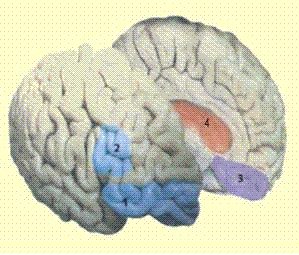 They found that when processing the emotionally-neutral syllogisms, activation in the lateral / dorsal lateral prefrontal cortex (labeled #2 in the picture, from this website), a large area associated with "executive functions," or higher-order cognition, showed increased activation, while activation in the ventral medial prefrontal cortex (labeled #3), an area associated with emotion regulation, decreased. When processing the emotionally-salient syllogisms, activation in the ventral medial prefrontal cortex, along with the fusiform gyrus, increased, while activation in the lateral/dorsal lateral prefrontal cortex decreased. Thus, the cold system activates areas associated with logical reasoning, and suppresses activity in areas associated with emotion, while the hot system activates the areas associated with emotion, and suppresses activity in the areas associated with logical reasoning. It's important to note the word "suppresses." It's important to remember this, then: the hot system doesn't shut off the logical reasoning system, it just decreases the level of activity there, perhaps to give primacy to the activity in the areas associated with emotional processing.
That should be enough information to allow you to understand Westen's work. So I'll talk about that in the next post.
1Kunda, Z. (1990). The case for motivated reasoning. Psychological Bulletin, 108(3), 480-498.
2Arrowood, A. J. & Ross, L. (1966). Anticipated effort and subjective probability.
4Kunda, Z. & Sanitioso, R. (1989). Motivated changes in the self-concept. Journal of Experimental Social Psychology, 25, 272-285.
5Sanitioso, R., Kunda, Z. & Fong, G. T. (1990). Motivated recruitment of autobiographical memory. Journal of Personality and Social Psychology, 59, 229-241.
6 Kunda (1990).
7Lodge, M. & Taber, C. (In Press). Three steps toward a theory of motivated political reasoning. In A. Lupia, M. McCubbins, & S.Popkin (Eds.), Elements of Political Reason: Understanding and Expanding the Limits of Rationality. London: Cambridge University Press.
8Lodge & Taber (In Press); Redlawsk, D.P., & Hubby, C.R. (2002). Hot cognition or cool consideration? Testing the effects of motivated reasoning on political decision making. Journal of Politics, 64, 1021-1044; Morriss, J.P., Squires, N.K., Taber, C.S., & Lodge, M. (In Press). The automatic activation of political attitudes: A psychological examination of the hot cognition hypothesis. Political Psychology.
9Goel, V., & Dolan, R.J. (2003). Reciprocal neural response within lateral and ventral medial prefrontal cortex during hot and cold reasoning. Neuroimagine, 20(4), 2314-2321.
Subscribe to:
Posts (Atom)