Wednesday, May 17, 2006
Mixing Memory on the Road


More Linguists on Starlings and Recursion
The Gentner experiment may help us understand animal pattern recognition and learning abilities, some of them possibly prerequisites for linguistic abilities; but the implications are being considerably exaggerated, especially in popular media accounts with headlines like "Songbirds May Be Able to Learn Grammar."Ray Jackendoff is definitely someone to take seriously when discussing issues related to the evolution of language (which is not to say that the others aren't; I'm just less familiar with their work). His book Foundations of Language is one of my favorites in cognitive science, largely because of the incredibly lucid and level-headed discussion of the evolution of language in Chatper 8. It may be the only evolution of language discussion out there with those qualities. It helps, of course, that Jackendoff backs it up with 7 chapters of theoretical discussion, clear even to a nonlinguist (though I wouldn't recommend it for people with no background in linguistics). So, when Jackendoff speaks on this topic, I listen.
Tuesday, May 16, 2006
Experimental Philosophy: Morality, Intentionality, and Values (Oh My!)
Before I get into Knobe's work, and the Knobe and Roedder paper, let me tell you a story. When I was in graduate school, I went to see a talk (that sounds weird, doesn't it?) by a pretty well-known philosopher of mind. I won't mention his name, but as a hint, I will say that you can wear him with a dress shirt, and if you're wearing a tuxedo, you're probably wearing him in a bow. I've forgotten the exact topic, but it had something to do with the unity of conscious experience. The talk was filled with counterfactuals, hypotheticals, and little thought experiments. In other words, it was pretty much everything you'd expect from "conceptual analysis." By the end of the talk, it was all I could do to stay awake. I wasn't just sleepy, though; I was frustrated and sleepy, and those two states do not work well in combination. I was sleepy because conceptual analysis is, well, boring. I was frustrated because he was talking about an issue that I felt, and still feel, would be better addressed through empirical, rather than conceptual analysis. And that's not simply because I'm coming at it from the usual scientific perspective, which amounts to, "Yes, but where's the data?" It's also because the unity of consciousness is an empirical topic, and questions about it are empirical questions. So they should be asked and answered that way. When I stood up to ask a question about the potential empirical implications of his position, I probably looked like a raving narcoleptic, and I wouldn't be surprised if most of the philosophers in the room dismissed them. The speaker certainly didn't seem to find them very interesting. But I think they were important questions, nonetheless.
The point of my telling this story is that even before I had heard of experimental philosophy, I was a fan of it. I felt that there were many philosophical questions, especially those pertaining to problems of mind and psychology, that could best be answered by conducting experimental investigations. When I learned of experimental philosophy, I was very excited. Finally, philosophers who recognize that empirical investigation is essential. Then I started to read some experimental philosophy, at first by accident; I stumbled upon a Stich paper in the journal Cognitive Psychology, without realizing he was a philosopher, or that he was doing experimental philosophy. It turns out, they weren't doing quite what I had in mind. They were doing conceptual analysis, and attempting to answer questions that only arise out of conceptual analysis, but they were doing it with an n larger than 1. That's better than doing it with an n of 1, but it still doesn't feel like it's quite right.
The point of my telling you that is this: the one experimental philosopher I've read whose work feels like it is, or at least could be, an example of the empirical approach to philosophy that I've always envisioned, is Joshua Knobe. In fact, he's already used his experimental work to say something about problems that arose out of empirical psychology, and not conceptual analysis in philosophy (see this paper). So that's why I find Knobe's work to be the most interesting in experimental philosophy, and also why I was eager to read his OPC paper. Now I'm eager to talk about it, and since I have a blog, that's what I'm going to do.
Let me start (I say "let me start" in the 4th paragraph; that's funny) by describing some of Knobe's older work on intentionality. His most well-known experiment used the following scenarios (from this paper, p. 3):
Scenario 1: The vice-president of a company went to the chairman of the board and said, 'We are thinking of starting a new program. It will help us increase profits, but it will also harm the environment.'After reading one of these scenarios, participants were asked whether the chairman had intentionally harmed/helped the environment. Eight-two percent of the participants who read scenario 1 said that the chairman had intentionally harmed the environment, while 77% of the participants who read scenario 2 said that the chairman had not harmed the environment. Using this, and several follow up experiments (check out Knobe's homepage for links to his many papers on this topic), Knobe has argued that morality plays a role in our use of the concept of intentionality. I'll say more about these experiments in a moment, but for now, let's move on to the OPC paper.
The chairman of the board answered, '‘I don'’t care at all about harming the environment. I just want to make as much profit as I can. Let'’s start the new program.'
They started the new program. Sure enough, the environment was harmed.
Scenario 2: The vice-president of a company went to the chairman of the board and said, 'We are thinking of starting a new program. It will help us increase profits, and it will also help the environment.'
The chairman of the board answered, 'I don't care at all about helping the environment. I just want to make as much profit as I can. Let's start the new program.'
They started the new program. Sure enough, the environment was helped.
The OPC paper is, as the title suggests, on valuing. It's a short paper, so you should probably just go read it yourself. Go on, I'll wait. OK, back? Since you've just read the paper, you know that it presents an argument against a view of the concept of valuing in the philosophical literature that Knobe and Roedder put thusly (p. 1):
[T]he concept of valuing can be defined in purely descriptive, non-normative terms.They argue that, contrary to this view, "moral considerations actually play a role in the concept [of valuing]." They don't claim that moral features are the only, or even the primary features of our concept of valuing, but that, when other features are absent, moral features can determine whether we believe a person does or does not have a certain value. As evidence for their position, they present the results of two experiments. Since you've read the paper (you haven't? Go, now! I'll wait again), you don't need me to describe the experiments, but because I'm a nice guy, I'll do so anyway. In their first experiment, they use these two scenarios (p. 3-4):
Scenario 3: George lives in a culture in which most people are extremely racist. He thinks that the basic viewpoint of people in this culture is more or less correct. That is, he believes that he ought to be advancing the interests of people of his own race at the expense of people of other races.In the Scenario 3, George consciously harbors values that most people in our society would consider to be morally bad, but "feels a certain pull" towards values that we would consider morally good. In Scenario 4, the opposite is true. George consciously believes he values something we would consider morally good, but "feels a certain pull" towards values that we would consider morally bad. After reading the scenario, the participants were asked whether they agreed with these statement: "Despite his conscious beliefs, George actually values racial equality" (for Scenario 3) or "Despite his conscious beliefs, George actually values racial discrimination" (for Scenario 4). They rated their agreement on a 6-point scale (-3, disagree strongly, +3, agree strongly). Participants' were significantly more likely to agree with the statement for Scenario 3 than for Scenario 4. In other words, they were much more likely to believe that the man in Scenario 3 really did value something they thought to be morally good than they were to believe that the man in scenario 4 valued something they thought to be morally bad.
Nonetheless, George sometimes feels a certain pull in the opposite direction. He often finds himself feeling guilty when he harms people of other races. And sometimes he ends up acting on these feelings and doing things that end up fostering racial equality.
George wishes he could change this aspect of himself. He wishes that he could stop feeling the pull of racial equality and just act to advance the interests of his own race.
Scenario 4: George lives in a culture in which most people believe in racial equality. He thinks that the basic viewpoint of people in this culture is more or less correct. That is, he believes that he ought to be advancing the interests of all people equally, regardless of their race.
Nonetheless, George sometimes feels a certain pull in the opposite direction. He often finds himself feeling guilty when he helps people of other races at the expense of his own. And sometimes he ends up acting on these feelings and doing things that end up fostering racial discrimination.
George wishes he could change this aspect of himself. He wishes that he could stop feeling the pull of racial discrimination and just act to advance the interests of all people equally, regardless of their race.
In their second experiment, Knobe and Roedder used this scenario:
Situation 5: Susan grew up in a religious family, but while she was in college, she started questioning her religious beliefs and eventually became an atheist.They gave this scenario to two groups: members of a Mormon Bible study group, and people in Washington Square Park in New York. As you might expect, members of the Mormon Bible study believed that refraining from premarital sex was morally good, while the Washington Square Park participants didn't really care about premarital sex. And consistent with the results from their first experiment, those who thought that refraining from premarital sex was morally good were much more likely to believe that Susan valued it as well than those who didn't value premarital sex.
She will be getting married in a few months to her longtime boyfriend. Recently, the subject of premarital sex has come up.
Susan definitely has a desire to have sex with her boyfriend, but whenever she thinks about doing so, she remembers what her church used to say about premarital sex and feels terribly guilty. As a result of these feelings, Susan has not had sex yet.
Because she is no longer religious, Susan believes there is nothing wrong with premarital sex.
So, from these two experiments, it really does appear that, "people's intuitions about an agent'’s values depend in part on moral considerations" (p. 6). The commenter on the Knobe and Roedder paper, Antti Kauppinen, has a different interpretation, appealing to Donald Davidson's "principle of charity." I won't get into that, but you can read the commentary here. Instead, I'm going to argue that the studies don't tell us much about valuation.
Here is the problem I see with both experiments. One of many proper control conditions for these studies would involve a scenario like this:
Scenario 6: Susan lives in Atlanta, where most people are Braves fans. She thinks these people are basically correct. That is, she enthusiastically roots for the Braves, regardless of who they're playing.
Nonetheless, Susan sometimes feels a certain pull in a different direction. She often finds herself feeling like the Cubs are a better team to root for. And sometimes she ends up acting on these feelings and rooting for the Cubs.
Susan wishes she could change this aspect of herself. She wishes that she could stop feeling the pull to root for the Cubs and just root for the Braves.
 You'd then give this scenario to people in Atlanta and people in Chicago, and ask them how much they astatementh the statment: "Despite her conscious beliefs, Susan is actually a Cubs fan." You might predict that Chicagoans (who would be Cubs fans, for the most part) would believe that Susan was really a Cubs fan, while Braves fans in Atlanta wouldn't. Presumably Cubs and Braves fans don't have moral reasons for valuing one team over the other (unless they live in Boston), so if this prediction was confirmed, it wouldn't be a result of moral considerations. OK, I know that's pretty silly, but I threw it together as I typed it. If you don't like it, substitute it with a scientist who's feeling a pull towards a rival theory. The point is, if you're going to argue that moral considerations at work, you have to test similar scenarios in which morality is not an issue. It may simply be that people are inclined to believe that people agree with them, and all they need is one piece of evidence to confirm that belief. In that case, it's just motivated cognitionbias my-side bias, an illusion of common ground, or something similar at work. Sure, that could still mean that moral considerations would be at play in intuitions about valuation, which might result in the same philosophical implications knobe and Roebberson believe their position does, but it could also mean that other considerations based on evidence of other common belief could influence those intuitions as well. The problem Knobe and Roedder's experiments is that they don't test any potential psychological mechanisms, and thus we don't know the extent, or the cause, of their results.
That problem's not unique to these studies, either. Knobe's intentionality studies (e.g., the one using Scenario 1 & 2, and those linked at Knobe's homepage) don't test different possible mechanisms, either. One might be able to explain the results of the experiment using Scenario 1 & 2 by reference to research on counterfactual thinking, for example. We know, for instance, that people are much more likely to counterfactually mutate negative events/outcomes. Counterfactual reasoning is also associated with attributions of blame and experiences of guilt and regret. Perhaps people are more likely to attribute intentionality to the chairman in Scenario 1 because they're more likely to reason about it counterfactually (simply because it involves a negative outcome; negative for moral reasons, for sure, but it would be more likely to be mutated if it were negative for any other reason), and thus to assign blame (which might require intentionality), whereas Scenario 2 involves a positive outcome that is not likely to be counterfactually mutated. If counterfactual reasoning is involved in that way, then the implications for our intuitions about intentionality is much different. It's still related to morality through blame, which wouldn't be very surprising, but morality would play an indirect role in the assigment of intentionality through the mutability of negative outcomes. That explanation might not work, but we don't know, because no psychological mechanisms have been tested. And thus, we don't really know how to interpret the data.
As I've arrived at the end of this post, I feel like I've been overly critical of Knobe's (and Roedder's) work. The truth is, I find his experimental designs to be ingenious, and his results often surprising, at least at first glance. And as I said earlier, I think his work is really the most promising in experimental philosophy. Still, there's one more step to take: connecting these experiments more directly with the larger literature on concepts and reasoning, and then testing the predictions of different possible psychological mechanisms in order to tease out the ways in which morality plays a role in intuitions about intentionality and values. Once researchers begin to do that, I'll be the biggest fan of experimental philosophy out there. And if that's not motivation enough, then this might be. Understanding the mechanisms involved will help us to develop a much greater understand our intuitions related to important philosophical issues. If understanding those intuitions is as important to philosophy as experimental, then such work would be of great importance to philosophy.
UPDATE: If you read this post before this update was added, you may have noticed some weird things going on. You can thank Blogger's spell check for that. Hopefully most of them are gone, now.
Wow
And [Bush] will be lying, again, just as he lied when he said: "Massive deportation of the people here is unrealistic – it's just not going to work."When I read this in the Good Math, Bad Math post, I couldn't believe it. Vox Day, the author of the statement, had to have provided a context that made it clear he wasn't really comparing Germany's forceful deportation of Jews, Gypsies, Poles, political dissidents, gays, and the disabled to concentration camps to our current situation with undocumented immigrants. But no such context was to be found in the article. Desperate, I looked to Day's blog, where I found that not only was he comparing the two situations, but he is proud of doing so, and feels it's the only reasonable comparison. He writes (all emphasis, in the form of capitalization, is his):
Not only will it work, but one can easily estimate how long it would take. If it took the Germans less than four years to rid themselves of 6 million Jews, many of whom spoke German and were fully integrated into German society, it couldn't possibly take more than eight years to deport 12 million illegal aliens, many of whom don't speak English and are not integrated into American society.
But apparently today's column gave numerous double-digit IQs the vapors, as they were unable to ascertain that the IDENTIFICATION, FORCED TRANSPORTATION and MURDER of six million Jews in four years by the National Socialists proves that President Bush was absolutely incorrect - and presumably lying - when he stated that IDENTIFYING and FORCIBLY TRANSPORTING twelve million illegal aliens was not possible.When the Nazis regime is the only regime you can think of to compare to your present situation, red flags should go up. It's hard to separate the lesson Vox thinks we should learn from the Nazis from all of the other "lessons" that led to this one. And if we're really learning the lesson of Nazi deportations, then we'd have to pay attention to how they did it: placing people in cattle cars so crowded that it was not possible to sit, much lay down, and transporting them for days, sometimes even for weeks, without food or water. Sure, we've learned the lesson, Vox: if you want to deport millions of people over a few years, you have to do it the dirty way, and you're going to kill a lot of people in the process.
Quite clearly, it is. As for those who find all mention of the National Socialists or the Holocaust inherently beyond the pale, I am certainly open to hearing any suggestions that similarly prove the case. Has anyone else besides the National Socialists been identifying and transporting millions of people lately? Does anyone else put the lie to Dear Jorge? And if not, do we simply pretend that it never happened and that there are no lessons to be learned from it? Wasn't the whole point of the Shoah documentaries and the survivor recordings and the Holocaust museums to make sure that no one ever forgot?
Also, I think Vox might be happy to know that the Nazis weren't the only ones to use forced deportations. The Soviets, under Stalin, did it by the millions as well, deporting Germans, political dissidents, Jews, and anyone else they didn't like, to the gulag. So, mass deportations over a short period of time are possible. Hitler and Stalin did it, therefore we can do it too! That may be a rational argument, but I can't imagine it's one anyone wants to make.
Sunday, May 14, 2006
The Unbear... I Mean, Automatic Social Thinking
[E]very representation of a movement awakens in some degree the actual movement which is its object.I've described the Bargh studies at length before (here), so I won't do so again, but I'll quickly summarize a couple of them. In two of the studies, researchers presented participants with a scrambled sentence task, which consists of giving them a set of words and asking them to use those words to form a sentence. In one experiment, half of the words primed the concept RUDE, and half primed the concept POLITE, while in the other experiment, one version had words associated with the concept ELDERLY, and the other words that were age-neutral. When the concept RUDE was primed, participants were quicker to interrupt an experimenter than when the concept POLITE was primed, and when the concept ELDERLY was primed, participants walked more slowly than when they had been presented with age-neutral words. So far, no one has actually tested an explanation of these interesting demonstrations, though Bargh now at least recognizes that it's time to start trying to do so. But each time I've read about these sorts of effects, I've thought about studies showing the reverse effect -- action priming thought (e.g., performing avoidance actions priming negative evaluations). So I wondered if performing stereotyped actions might prime stereotyped thinking.
Well, Thomas Mussweiler wondered that as well, but instead of resting on his laurels like me, Mussweiler actually did the research1. In his first experiment, he "unobtrusively induced" half of the participants to move in a way associated with obesity. I'll let Mussweiler describe the method for inducing this sort of movement "unobtrusively":
The first study was introduced as part of a research project conducted in collaboration with the local lifeguards. The ostensible purpose of this study was to examine how well people are able to move in emergency situations. Participants were asked to perform a number of movements designed to simulate typical movements on board a ship and in water. The instructions were carefully worded to avoid any reference to concepts associated with portliness. Experimental participants were asked to put on a life vest and a set of four gymnastic weights that were wrapped around their wrists and ankles. The experimenter explained that the weights were used to simulate water resistance. The life vest and weights unobtrusively induced participants to move in a portly manner. (p. 18)The participants then performed a series of actions, like climbing onto a chair. The other half of the participants, the control group, performed the same actions without wearing the vest or weights.
After completing the movement portion of the study, participants were told they were also going to participate in a second, unrelated study on "person perception." The study involved reading a description of a person in "ambiguous terms," and then rating the person on fifteen dimensions, seven of which were associated with obesity stereotypes (based on previous research, e.g., healthy, insecure), and eight of which were not (e.g., musical, articulate), using a nine-point scale. The results are in the pretty graph I made from Mussweiler's Table 1, below:
 As you can see, the people whose movements were stereotyipically "portly" rated the person described in "ambiguous terms" higher on traits associated with the obesity stereotype than on traits not associated with that stereotype, and their ratings on the stereotypic traits were also higher than those of the control ("Normal," in the graph) participants. So it appears that performing "portly" movements primed "portly" stereotypes.
In the second study, participants were placed on a stationary bicycle and instructed to either pedal very slowly (experimental group), or pedal at a normal speed (control group). They then read an ambiguously worded description of a person, as in the first experiment, and were asked to rate her on one stereotypic (forgetfulness) and one nonstereotypic (friendliness) dimension. Once again, participants who had performed the stereotypic action, pedalling slowly in this case, rated the person higher on the stereotypic trait than participants in the control group, though it should be noted that the ratings for the stereotypic trait (7.11 and 6.22, on a 9-point scale, for the experimental and control group respectively) were much higher than for the nonstereotypic trait (2.68 and 2.84) in both groups. And one has to wonder whether moving slowly primes only the elderly stereotype, if it primes a stereotype at all. Hell, moving slowly is associated with obesity, too. Might these participants have rated the person higher on obesity-stereotypic traits as well? Why the elderly stereotype specifically? And was the description really neutral with respect to the person's forgetfulness if both the experimental and control groups both thought the person was pretty forgetful (an average rating of 4 or 5 would mean an average level of forgetfulness, but both groups average ratings were over 6)? Unfortunately, the description isn't included in the article, so we can't judge for ourselves.
The third study was almost the exact reverse of Bargh's study. Participants were first instructed to walk in a circle for five minutes (listening to a story on headphones) at either a slow pace (30 steps per minute) or a fast one (90 steps per minute). When the five minutes were up, participants completed a lexical decision task. In lexical decision tasks, letter strings are presented, and participants are told to indicate whether the strings are words or not as fast as they can. Lexical decision tasks are often used as measures of priming. In this study, the participants were presented with 40 letter strings, eight of which were words associated with the elderly stereotype, 8 of which were words not associated with the elderly stereotype, and 24 of which were nonwords. Participants who walked slowly responded to elderly-stereotypic words significantly faster than did participants who walked at a normal speed, once again indicating priming of the elderly stereotype. The data are in the graph below (created by yours truly from Mussweiler's Table 3; latencies are in milliseconds).

So, here we have three demonstrations, using two different stereotypes and two different measures of priming, that the effects Bargh and his colleagues have observed in actions after priming stereotypical thoughts can also be observed in reverse, by having people perform stereotypical actions and thereby priming stereotypical thoughts. At least, that's the standard interpretation. As I indicated in my reaction to Mussweiler's second experiment, I'm somewhat skeptical of this interpretation. It's clear that priming is occurring, but what, exactly, is doing the priming (the movement, the level of arousal, or what)? And what's being primed (single stereotypes, multiple stereotypes, whole stereotypes or just parts, etc., etc.)? As with the Bargh studies, no explanations are actually tested in Mussweiler's studies, so we don't really know the answer to any of the questions raised by the demonstrations. But it does seem to provide another piece of evidence for the tight coupling of action and thought that James mentioned over 100 years ago, as well as for the largely unconscious nature of that coupling. If nothing else, then, these studies provide yet more evidence for my belief that you can find everything we've learned in modern cognitive science in James' writing.
1Mussweiler, T. (2006). Doing is for thinking! Stereotype activation by stereotypic movements. Psychological Science, 17(1), 17-21.
Sunday, May 07, 2006
Friday, May 05, 2006
On Death and Dread and Doom
Neurobiological Substrates of DreadThere's good discussion of the article at BRAINETHICS, here, and uh... metadiscussion at The Neurocritic, here and here.
Given the choice of waiting for an adverse outcome or getting it over with quickly, many people choose the latter. Theoretical models of decision-making have assumed that this occurs because there is a cost to waiting—i.e., dread. Using functional magnetic resonance imaging, we measured the neural responses to waiting for a cutaneous electric shock. Some individuals dreaded the outcome so much that, when given a choice, they preferred to receive more voltage rather than wait. Even when no decision was required, these extreme dreaders were distinguishable from those who dreaded mildly by the rate of increase of neural activity in the posterior elements of the cortical pain matrix. This suggests that dread derives, in part, from the attention devoted to the expected physical response and not simply from fear or anxiety. Although these differences were observed during a passive waiting procedure, they correlated with individual behavior in a subsequent choice paradigm, providing evidence for a neurobiological link between the experienced disutility of dread and subsequent decisions about unpleasant outcomes.
And while we're on the subject of pain, you might enjoy this post at Eide Neurolearning Blog (via Omni Brain), on the role of "sensory-motor incongruence" in certain types of pain. Here's an excerpt:
"In 66% of health volunteers, abnormal sensations of pain (“numbness, pins and needles, moderate aching and/or a definite pain”) or other sensations (“perceived changes in temperature, limb weight, altered body image, disorientation”) were reported following artificially-induced sensory-motor incongruence."Reading about their methodology, I can't help but be reminded of the famous rubber hand experiment ("Rubber hands 'feel' touch that the eye sees"), though that had nothing to do with pain.
And while we're on the subject of Omni Brain, check out this post on research demonstrating (un)importance of neurogenesis. From the post:
Hen's team zapped mice with a focused dose of radiation to halt neurogenesis in a portion of the animals' hippocampuses. They then placed half the animals in regular cages and half in enhanced environments for 6 weeks before testing their anxiety and spatial memory. To the researchers' surprise, the animals with better accommodations had improved spatial memory skills and were less anxious than mice in smaller confines, despite not having any new neurons in their hippocampuses. "We thought we would see a dependence on neurogenesis in some of the behaviors we saw in the enriched environment, but that's not what we found," says Hen.By the way, isn't it hoppocampi?
And while we're on the subject of a bunch of blogs by neuroscientists, where are the cognitive psychologists? Are Cognitive Daily and Mixing Memory alone in the blogosophere?
Tuesday, May 02, 2006
Craving a Cigarette Warps Your Sense of Time
Anyway, warped perceptions of cigarette length, and the devaluation of money, are cool, but this post is about time perception. I'm sure everyone who's smoked has experienced minutes feeling like hours while craving a cigarette. Apparently inspired by stories of this experience from smokers (or having experienced it themselves), Sayette et al2 recently set out to explore the relationship between cigarette cravings and time perception. In their first experiment, participants were divided into nicotine-deprived and non-deprived conditions, and during the initial screening session, participants in the nicotine-deprived condition were told not to smoke for 12 hours before the experimental session, while non-deprived participants were told to smoke as they usually would (to test whether they complied with these instructions, participants' carbon monoxide levels were tested during screening and at the beginning of the experimental session, and the two tests were compared). Upon arriving for the experimental session, participants in the two conditions were given one of two kinds of cues. For the non-deprived participants, a box was placed on the table in front of them, and they were instructed to open it. Inside was a roll of tape, and they were instructed to pick it up and hold it in their hands. The nicotine-deprived participants weren't so lucky. A box was placed on the table in front of them, and they were told to open it. Inside was a pack of cigarettes (their own pack, which they had given the experimenter upon arriving) and a lighter. In an act of unprecedented sadism, the experimenters told the participants to pick up the cigarettes and the lighter, light a cigarette without putting it in their mouth, and then hold it (without smoking it). This was meant to increase their cravings.
While the participants were holding their objects (the roll of tape or the lit cigarette), they completed a 12-item questionnaire, and were then asked how long they had been holding the item (a "retrospective" estimation). After that, they were all told that they could smoke in exactly 2 1/2 minutes, and were then told to indicate to the experimenter when they believed 45 and 90 seconds had passed (a "prospective" estimation).
As every smoker would expect, participants in the deprived condition slightly overestimated the amount of time that had passed in the retrospective estimation, and indicated that 45 and 90 seconds had passed before they actually had, in the prospective condition. Their estimates were different from the non-deprived participants, who actually tended to underestimate the amount of time that had passed. Interestingly, the deprived participants' estimates were more accurate, overall, than those of the non-deprived participants. This is likely because, in the time-estimation literature, people tend to underestimate the amount of time that has passed, just as the non-deprived participants did. The fact that the non-deprived participants were more accurate, and even overestimated how much time has passed, is an indication that the cravings really did affect their time perception. However, the difference between the deprived and non-deprived conditions was statistically significant only in the 45-second estimate, but in each case, the deprived participants' estimates were longer than those of the non-deprived participants.
In their second experiment, a new group of participants (which were called the "experience group") who'd also gone 12 hours prior to the experimental session without a cigarette were shown the box, opened it, picked up the cigarette, lit it, but were not able to smoke it even after the 2 1/2 minute period. They were then asked to sit quietly in the experiment room after 5, 10, 15, 25, 35, and 45 minutes, were asked to rate their "urge to smoke" on a 100 point scale. The nicotine-deprived participants from the first experiment had been asked, right after they had begun to hold their newly lit cigarette that they could not smoke, to estimate their "urge to smoke" at the same time intervals. For this second experiment, these participants were called the "anticipate group."
The comparison of interest is between the ratings over time for the experience group, and the estimate ratings for the anticipate group over the same time period. For the experience group (black bars in the graph below), the "urge to smoke" ratings did not change significantly over the 45 minutes. The anticipate group (white bars), however, predicted that their cravings would increase dramatically over time. The difference between the two groups was significant. Here is the graph of the data (from Figure 1, p. 91):

Now these are experienced smokers, so you would think that they'd have a good handle on how their cravings act over time, but obviously something about having the craving in at this moment distorts your perception of how it will change over time if you do not smoke a cigarette.
The importance of this study for counseling is pretty clear. As the authors note, smoking relapses are closely related to cravings, and if people believe that their cravings will increase over time, and furthermore, actually perceive time as going by more slowly, they will have a harder time resisting those cravings. What's important, then, is to educate people about the actual behavior and effects of cravings, showing them that cravings don't actually get worse over time (though notably, they don't appear to get any better, either). As someone who had to go through the process of quitting smoking, I can definitely appreciate the value of that knowledge. One of the more difficult aspects of quitting is an intense craving that overwhelms your ability to think about much of anything besides cigarettes, and the fear that not only are you going to suffer more, but that if you don't do something about this craving right now, it's going to get worse, and you're not going to get anything accomplished. Of course, this information alone isn't going to get people to quit smoking, but it may help them when they try. And from the experiment I described at the beginning of this post, we also know that offering them raffle tickets for cash won't help, and that really big cigarettes will look extra attractive.
1Brendl, C.M., Markman, A.B., & Messner, C. (2003). The Devaluation Effect: Activating a Need Devalues Unrelated Objects. Journal of Consumer Research, 29, 463-473
2Sayette, M.A, Loewenstein, G., Kirchner, T.R., & Travis, T. (2005). Effects of smoking urge on temporal cognition. Psychology of Addictive Behaviors, 19(1), 88-93.
Potential Move
Anyway, the reason I'm writing this is that since I started this blog, I've relied heavily on the suggestions and advice from readers, and I wouldn't want to make a big move like this without asking for comments. So, what do you think? Let me know in comments or, if you prefer, drop me an email.
P.S. If you're wondering, the meme post is coming (it's probably going to be a few posts), and so is one on theory-theory, though I haven't yet decided whether to do theory-theory generally, or focus on a couple applications, like theory of mind (theory-theory vs. simulation theory, in a 12 round bout) and/or causal reasoning.
Sunday, April 30, 2006
Linkage
What Morris's team found is that although the amygdala showed more activity during unseen fear-inducing faces, other areas of the brain associated with conscious visual activity were more active when the faces were seen. The mask [the effect making it difficult to consciously perceive the faces] appeared to disrupt the conscious visual process, but not the process that led to the fear reaction. The masked images were sensed -- detected by the eye -- but not perceived. The researchers identified a separate neural pathway which activates the amygdala, independently of visual cognition.On to something more recent, there's an interesting post by John Hawks on culture, communication (animal and human), and the relationship between human culture and other animals. It's very thought-provoking.
At Brainethics, there is a post with a link to and discussion of a paper by Fisher and Marcus on the evolution of language. Here is the paper's abstract:
The human capacity to acquire complex language seems to be without parallel in the natural world. The origins of this remarkable trait have long resisted adequate explanation, but advances in fields that range from molecular genetics to cognitive neuroscience offer new promise. Here we synthesize recent developments in linguistics, psychology and neuroimaging with progress in comparative genomics, gene-expression profiling and studies of developmental disorders. We argue that language should be viewed not as a wholesale innovation, but as a complex reconfiguration of ancestral systems that have been adapted in evolutionarily novel ways.On a non-cognitive science related note, Brandon has two posts over at Siris about the Texas revolution, the first on Lorenzo de Zavala, and the second on Juan Seguín. It had been a while since I'd thought about Seguín's story, but I'm glad Brandon reminded me of it. Seguín was at the Alamo, but after Santa Anna's army had laid siege to the mission, Travis sent him to Goliad to get reinforcements. He returned after the battle, and was charged with burying the dead defenders. After the revolution, he went into politics, but when Texas became a state, he was forced to return to Mexico, where he was arrested and forced to fight in the Mexican-American war on the Mexican side. What I find so interesting about his story is that it's one among many that shows how complicated the story of the Texas revolution, and Texas' subsequent independence and annexation, really were. Instead of the clean elementary school textbook picture of brave men fighting for freedom against a crazed (and cowardly) military dictator, it was actually a big mess of social, political, and ethnic conflicts.
This post at blac(k)ademic, inspired by discussion of the Duke rape case, takes the position that gender does not trump race. The post is very thought-provoking in itself, but it also reminds me of one of the issues on which I've been meaning to actually explore empirically (as in running actual experiments; anyone want to help with the design?). The issue is this: people who are not the subjects of racism, sexism, homophobia, and other forms of oppression on a regular basis tend to have a more difficult time perceiving instances of those forms of oppression, especially when those instances are subtle, as they so often are. In the extreme, this leads to white people actually believing that racism is no longer a problem, and men believing that sexism is dead, and straight people being ignorant of the very idea of heteronormativity. This probably seems obvious to some of you, but as far as I can tell, there is no empirical research on the issue. In her post, blac(k)ademic is discussing the tendency for white feminists to ignore, or at least de-emphasize race when gender is also at issue. In the post, and the comments, you'll find many frustrated exhortations about the race-unconsciousness of mainstream, white-dominated feminism. I wonder whether this is an instance of what I just described: white women, who are subject to pervasive discrimination themselves for reasons of gender, being less sensitive to issues of race because they simply don't have to deal with them in their own lives. One might think that being the object of discrimination would make people more sensitive to discrimination in general, but if my own theory is right, that wouldn't be the case, and it would mean that even for white feminists and others fighting discrimination against groups to which they belong, a great deal of dilligence is required to perceive and take into account other forms of discrimination.
Oh, and I almost forgot, at Crooked Timber, you can read a passage from Karl Marx's one attempt at fiction (written when he was 19). I have to say, it makes me feel a little better about my own youthful attempts at fiction writing.
LATE ADDITION: The Neurocritic discusses a new study on video game violence.
Online Philosophy Conference
Saturday, April 29, 2006
Is It OK To Laugh at Rush?
Chomsky's Take on Starling Grammar
"The article is based on an elementary mathematical error," said Chomsky, professor of linguistics at Massachusetts Institute of Technology. "They are overlooking the fact that there are many intermediate systems that are ignored in mathematical linguistics because their properties are empirically irrelevant.I wonder, as I did with the counting explanation, whether a simple short-term memory explanation (and one based on outdated work, apparently, though I suspect Chomsky merely mentioned Miller, and the reporter ran with it) could account for the generalization. Maybe it could, but to do so, I think you'd still have to say something about pattern recognition. The question, ultimately, is whether the pattern they're pattern recognition has anything to do with context-free insertion (self-embedding, in the paper).
"Based on other work done 50 years ago by George Miller, Chomsky thinks further research would show that the birds are not grasping linguistics in the way the new study concludes. "It has nothing remotely to do with language; probably just with short-term memory," Chomsky told LiveScience.
The ability for the starlings to sort through the patterns may also just be a benefit of natural selection, a process responsible for the origin of new species and the adaptation of organisms to their environments, as proposed by Charles Darwin.
"That aside, if someone could show that other animals had the basic property of human language, it would be of very little interest to the biology of language, but would be a puzzle for general biology," Chomsky said. "It's expected that if a species has some ability that has real selectional advantage, it will use it."
Also, I feel a little bit better about my post now that I've seen Chomsky express a similar conclusion to mine: the ability, if it exists, didn't evolve in birds (or, in all likelihood, any other nonhuman species) for linguistic purposes, so if the starlings really do recognize context-free recursion, the question is, what do they use that ability for?
Friday, April 28, 2006
Starlings and Recursion
UPDATE II: A really good discussion (much better than mine, and no, I'm not just being modest), and critical evaluation of the experiments can be found here. The one thing I wonder is whether the explanation there (simple counting) would account for the generalization to A3B3 sequences. It might, but I'd have to think about it a bit more.
A few years ago, Hauser, Chomsky, and Fitch wrote a paper in which they argued that the "only uniquely human component of the language faculty" is recursion, and on top of that, recursion is the only component of the language faculty that is not co-opted from other perceptual systems (though they believe that even recursion evolved for other purposes). It turns out that recursion recursion may not be uniquely human after all. A paper by Gentner et al. published in yesterday's issue of Nature shows that, in the authors' words:
European starlings (Sturnus vulgaris) accurately recognize acoustic patterns defined by a recursive, self-embedding, context-free grammar.What does that mean? I'll try to explain. Since I'm not a linguist, I'll probably get something wrong. Feel free to point out my errors.
In Aspects of the Theory of Syntax, Chomsky specifies a hierarchy of grammars for formal languages, with those at the top being the most inclusive grammar, called Type-0, or unrestricted grammars, and at the bottom, the least inclusive, called Type-3 or finite-state grammars, which are grammars that can be decided by a finite-state machine. In essence, a finite-state grammar includes rules that allow you to add elements (words, morphemes, phrases, or whatever) either at the beginning of a string or at the end. For example, you could start with the word "Chris," and at each step add a new word after the last word in the sequence, perhaps based on a rule specifying which word you should choose based on the last word, and come up with a sentence, like say, "Chris should stick to psychology."
Two steps up from finite-state grammars in the hierarchy is the Type-2 grammar, or the context-free grammar (the next level up is context-sensitive, at Type-1). Context-free grammars can have rules that add elements (again, these can be any linguistic element) at the beginning and end of strings, but also in the middle of strings. So, a context-free grammar would allow you to produce the sentence, "Chris should stick to psychology," and then add, in the middle of the sentence, "Chris really should stick to psychology."
One of the important arguments in Aspects is that the grammars of natural languages are not finite-state grammars. In order to model natural languages, you need at least a Type-2, context-free grammar. It's upon that argument (and the work done based on it between 1956, when Aspects was published, and 2002) that Hauser, Chomsky, and Fitch are building. The type of recursion they're talking about is the type that is possible in context-free grammars. They are arguing that the only uniquely human component of the language faculty is the recursion of context-free grammars.
If that description doesn't make sense, then check out this graphic presentation from the Gentner et al. paper (Figure 1):
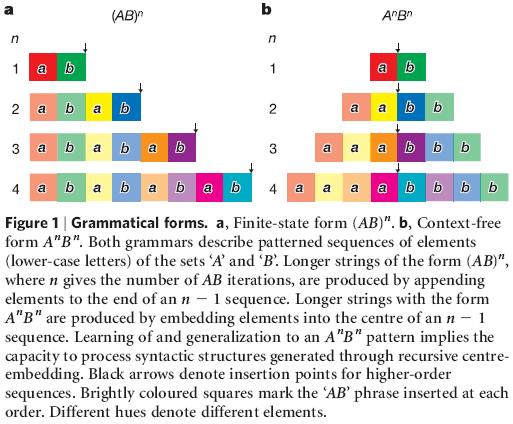
Gentner et al. used two elements of starlings' songs, rattles and warbles (here's a recording of a starling song, which also contain whistles not used in the stimuli), and produced two grammars, one finite-state grammar defined as ABn in the figure above, and the other a context-free grammar, defined as AnBn in the figure (an example sequence might be rattle-warble-rattle-warble). They then used operant conditioning to train half the birds to respond to the A2B2 (e.g., rattle-rattle-warble-warble ) sequences, and half to the AB2 (e.g., rattle-warble-rattle-warble) sequences. If the starlings could tell the difference between the two grammars, and thus can accurately respond to one or the other, it would mean that humans are not unique in this ability. And though it took the birds bit longer (about 3000 trials) than it usually takes for starlings to be trained to classify songs, nine out of the eleven birds they trained did learn to classify the two types of grammars. Furthermore, all nine of the birds who learned to classify the two types of grammars were also able to classify A3B3 (e.g., rattle-rattle-rattle-warble-warble-warble) and AB3 (e.g., rattle-warble-rattle-warble-rattle-warble) sequences, though not A4B4 or AB4. This implies that the birds who had learned to recognize the grammars were able to generalize that learning, and recognize longer strings. So there were memory limitations (most humans can recognize strings with more than 6 elements).
What does this mean for Hauser, Chomsky, and Fitch's claims? Well, here's what Gentner et al. concluded:
Although uniquely human syntactic processing capabilities, if any, may reflect more complex context-free grammars or higher levels in the Chomsky grammatical hierarchy, it may prove more useful to consider species differences as quantitative rather than qualitative distinctions in cognitive mechanisms. Such mechanisms (for example, memory capacity) need not map precisely onto strict formal grammars and automata theories. There might be no single property or processing capacity that marks the many ways in which the complexity and detail of human language differs from non-human communication systems.In other words, the Hauser et al. claim that the recursive component is unique to the human language faculty needs to be qualified. The recursive component itself is not unique to humans, though the complexity of that component may be. This may mean that the language faculty (in Hauser et al.'s narrow sense) involves more than just recursion.
While the authors don't address it, I think their research might also say something about one of the other major claims of Hauser et al. It's unlikely that starlings use context-free recursion in their everyday singing and song recognition, as evidenced by the fact that it took them longer than usual to learn to recognize the context-free grammar sequences. So it's also unlikely that starlings evolved the ability to recognize recursion for the purposes of singing/song-recognition. Instead, the ability probably evolved for some other reason. Hauser et al. suggest that it may have evolved in humans for faculties other than language as well, and give as possible examples number computation, navigation, and social relations. I don't really know anything about European starling social relations, or their ability to compute numbers, but navigation certainly seems like a possibility for the evolution of recursion in birds. While it's not direct evidence, the fact that recursion may have evolved in birds for reasons other than language production and comprehension means that, even if it evolved separately in humans (and it likely did, as Fitch and Hauser found no evidence that cotton-top tamarins could recognize context-free grammar sequences), it could have evolved for use by faculties other than language in our evolutionary history too.
Thursday, April 27, 2006
And Now for Some Good Research
Does geometry constitute a core set of intuitions present in all humans, regardless of their language or schooling? We used two nonverbal tests to probe the conceptual primitives of geometry in the Mundurukú, an isolated Amazonian indigene group. Mundurukú children and adults spontaneously made use of basic geometric concepts such as points, lines, parallelism, or right angles to detect intruders in simple pictures, and they used distance, angle, and sense relationships in geometrical maps to locate hidden objects. Our results provide evidence for geometrical intuitions in the absence of schooling, experience with graphic symbols or maps, or a rich language of geometrical terms.I figure math people, and those interested in cross-cultural research, will find this interesting. Unfortunately, the paper contains no cute pictures of monkeys playing with toys, though.
Wednesday, April 26, 2006
Monkeys Playing With Boys and Girls Toys: One for the Annals of Really Bad Research
 I've been known to be critical, perhaps overly so, of the media's bad science reporting, because it's, well, bad. But what is the media to do when the science itself is really bad? Since my advice to the media (which no one in the media has actually read, of course) is usually to listen to scientists, I don't really have an answer to that question, because when there's bad science, there's a scientist doing it. If the media listens to that scientist (and it's his or her work, so why wouldn't they?), they're probably not going to know it's bad science, even when it's really bad, as in the case of the study I'm about to describe (really, really, really bad). I suppose they could contact other scientists who are not involved with the research, and ask them about it, but that means finding a person who's not only read the study, but also works in an area close enough to that of the study to actually be able to evaluate it. And that's just too much work when you have deadlines.
Inevitably, then, we'll get bad science reporting that's not actually the fault of reporters. Like this (via Omni Brain), which can also be found here (via Ozarque). The article reports on this study by Gerianne Alexander and Melissa Hines. First, what does the press article say? Things like this:
Just like human boys and girls, male monkeys like to play with toy cars while female monkeys prefer dolls, a research project has shown.This intriguing discovery is one of many signs of deep-rooted behavioral differences between the sexes that scientists are exploring with the latest tools of genetics and neuroscience.
The differences apparently date far back in evolutionary history to the time before humans and monkeys separated from their common ancestor about 25 million years ago, said Gerianne Alexander, a psychologist at Texas A&M University in College Station, who led the experiment published in the journal Evolution and Human Behavior.and
Now that's some pretty provocative stuff! Though the paper was published in 2002, the press articles are pretty timely, coming soon after Larry Summers' remarks about his daughters' behavior upon being given toy trucks to play with. The findings would seem to confirm Summers' generalization from his own experience. When a scientists says something that bold, based on findings he or she has published, I feel duty-bound to go check out the paper itself. So I did. And in it the claims are no less provocative. Take this, from the abstract:"Vervet monkeys, like human beings, show sex differences in toy preferences," Alexander wrote in the report. "Sex-related object preference appeared early in human evolution."
Alexander speculated that females of both species prefer dolls because evolution programmed them to care for infants. Males may have evolved toy preferences that involve throwing and moving, skills useful for hunting and for finding a mate.
The results suggest that sexually differentiated object preferences arose early in human evolution, prior to the emergence of a distinct hominid lineage. This implies that sexually dimorphic preferences for features (e.g., color, shape, movement) may have evolved from differential selection pressures based on the different behavioral roles of males and females, and that evolved object feature preferences may contribute to present day sexually dimorphic toy preferences in children.Wow! I don't know about you, but I can't wait to read more. But before I get to the experiments themselves, consider the motivation. The problem the paper is attempting to address is this: why do human boys and girls tend to prefer different toys, as several previous studies have shown? There are two general classes of answers: the essentialist position, which says that gender is largely biological, or based on genetic differences interacting with the environment (including culture); or the constructionist position, which says that gender is largely cultural, or a product of socialization. Based on the quotes above, Alexander and Hines obviously lean towards the essentialist position. And I have to applaud them for their choice of approach. If they were Evolutionary Psychologists, they'd have done a survey, but as actual scientists, they adopted a comparative approach. The idea behind the study, then, is that if gender differences in preferences are due largely to evolved differences in gender roles, then we might find similar preferences in other primate species, because they exhibit similar differences in gender roles. So they look at another primate species.
 Here's what they did. They picked six different toys based on previous research on male and female preferences in human children. Two of the toys are "masculine" toys (an orange ball and a toy police car), two are "feminine" (a human baby doll and a red cooking pot) and two are gender neutral (a stuffed toy dog and a picture book). Fourty-four male and 44 female vervet monkeys were then individually presented with each toy in two or three sessions (the first being used to familiarize the monkeys with the toys). Each item was presented by itself, for five minutes, to each monkey in each trial. The experimenters recorded the number of times each individual approached the toys, and the number of times they came into contact with them (which counts as playing with the toys).
Consistent with the prediction of their essentialist hypothesis, the male vervets played with the ball and the car more than the female vervets, and the females played with the doll and pot more than the males. Furthermore, dominant males played with the "masculine" toys more frequently than less dominant males, and less dominant males played with the "feminine" toys more frequently than the more dominant males. Here are the graphs from the paper (from Figure 1, p. 471):

So it's pretty straightforward, right? Boy monkeys like boy toys, and girl monkeys like girl toys. The findings lead Alexander and Hines to conclude:
Our data suggest that this interest varies with the sex of the animal and across sex-typed toy categories derived from empirical studies (Berenbaum & Hines, 1992; Connor & Serbin, 1977; Maccoby & Jacklin, 1974) of sex differences in children's object play. Children's toys, therefore, appear to have differential value for males and females of at least two primate species, vervets and humans. (p. 473-474)and thus:
In view of this evidence, our findings suggest that object features or functions associated with human sex-typed toy categories may have adaptive significance for males and females. In addition, evolved, specialized recognition systems for these object characteristics may direct object preferences in some primate species. (p. 474)But before we get all excited, let's take a step back. First, we need to take a closer look at the data. Notice that it's in percent of total contacts. This is because male vervets had many more "contacts" than females. We don't get the absolute data, though, so we can't tell whether males actually played with the female toys less often, or just at a lower frequency relative to their overall amount of playing. Furthermore, males appear to have played with the two "masculine" toys and the cooking pot, a "feminine" toy, with about the same frequency, and with the furry dog only slightly more than these three. They played with the baby doll less than the two "masculine" and other "feminine" toys, but about as frequently as they played with the picture book. So it appears that, with the possible exception of the doll, the males didn't really care whether the toys were "masculine," "feminine," or "neutral." Do only female vervets have specific sexual preferences for toys (objects)? That's not what the authors concluded, but it would be hard to say otherwise based on their data, wouldn't it?
And then what about the toys themselves? The "feminine" toys include a baby doll and a red cooking pot, and the "masculine" toys an orange ball and a police car. Wait a minute, a cooking pot and a police car? What the hell do these have to do with evolved gender roles in vervet monkeys (putting aside, for a moment, the same questions about a human baby doll and a ball)? I suppose one could argue that cars have been designed to appeal to men, and thus have masculine forms (though I recall reading several years ago that the engineers at Jaguar based their body designs on the female body), but a cooking pot? It's shape is a product of cultural evolution, designed to afford holding the to-be-cooked substance, and handling without coming into contact with the part directly exposed to the heat. But vervets don't cook! So what is it about the pot that could possibly be consistent with vervet gender roles? Vervets don't drive, either, so the same question could be asked about the police car. And as Katherine noted in the comments at Omni Brain, there were two types of dolls, a dog and a human baby, neither of which are of the same species as the vervets, so why would they prefer one over the other (do they perceive the human doll as more like vervets than the dog doll? that's an empirical question that their data does not address)? The male vervets appear to have preferred the dog, while the female vervets played with both dolls about equally. What does that mean? I don't know, but I do now that it's more than a bit of a stretch to say that it means "that object features or functions associated with human sex-typed toy categories may have adaptive significance for [male] and [female]" vervets.
Given these problems, what do the authors have to say about the specific object preferences? For the female preferences, they write:
Female rhesus monkeys have been found to show a preference for the characteristic "reddish-pink"’ facial coloration of infant vervets compared to yellow or green. Consistent with this female color preference, girls are also more likely than boys to prefer warmer colors (i.e., pink and red) to cooler colors (i.e., blue and green) (Minamoto, 1985 cited in Iijima, Arisaka, Minamoto, & Arai, 2001). A preference for red or reddish pink has been proposed to elicit female behaviors to infants that enhance infant survival, such as contact (Higley, Hopkins, Hirsch, Marra, & Suomi, 1987). The hypothesis that reddish pink or red may be a cue signaling opportunities for nurturance and thus eliciting female responsiveness could explain our finding of greater female contact with both the doll (with a pink face) and the pot (colored red). (p. 475)And for males:
Toys preferred by boys, such as the ball and police car used in this research, have been characterized as objects with an ability to be used actively (O'Brien & Huston, 1985) or objects that can be propelled in space (Benenson, Liroff, Pascal, & Cioppa, 1997). Preferences for such objects may exist because they afford greater opportunities for engaging in rough or active play In humans, these characteristics have in turn been suggested to relate to targeting or navigating abilities (for discussion, see Alexander, in press) that might be particularly useful for males for purposes of hunting or locating food or mates (Eals & Silverman, 1994; McBurney, Gaulin, Devineni, & Adams, 1997; Silverman & Eals, 1992). As suggested for females in regard to object that signal nurturance, males may therefore have evolved preferences for objects that invite movement.Call me crazy, but it looks like their own explanations for their data actually undermine the conclusions they derived from it. According to them, the females weren't playing with the cooking pot and baby for any reason associated with the objects' human "femininity," but for reasons associated with species-specific gender roles (nurturing infant vervets with reddish faces). Furethermore, their explanations don't actually explain anything. They argue that males may enjoy moving things like cars and balls. But wait, the males also liked the pot and the stuffed dog. Is it easier to move stuffed dogs than baby dolls? I don't think so. And the females played with the brown dog as often as they played with the pink-faced baby doll. Why is that?
By the time I reached the end of the paper, I was forced to conclude that the authors' conclusions had absolutely nothing to do with their data whatsoever. While the female preference for "feminine" toys is obvious, the males don't seem to have a gender-preference at all. Furthermore, the female preference can't be explained by reference to any features of the objects themselves, and even if it could, it would be a result of feature preferences that are species-specific (e.g., the pink face of the baby and the red color of the pot), and thus wouldn't tell us anything about the origins of human gender-specific preferences. In short, the data tells us zilch, zero, nada, nothing. It's a terrible experiment, but in the hands of the press, with some overly-eager scientists who ran a silly experiment and then came to conclusions that had nothing to do with it giving the press quotes, this research becomes a profound revelation into the origins of human gender. Ugh.
Cognitive Comedy
Monday, April 17, 2006
To Parents
ABA4Autism.com and the Psychology Department at the University of Tennessee at Martin are conducting a second survey on the causes of Autism Spectrum Disorders (ASD). This survey is for mothers of children with ASD as well as mothers of normally developing children who are ten years of age or younger. Mothers who participate in the survey will receive a free ABA program to teach their child to follow directions as well as free ABA mini programs for common problems like sharing. To take the survey please go to http://www.aba4autism.com. Thanks
Dr.Gary Brown
Professor and Chair
Psychologist/HSP
Sunday, April 16, 2006
Links, Easter Edition
Fascinating work.Furthermore, observations of Peep biochemistry indicate a molecular structure unlike any other terrestrial organisms yet encountered, leading to the obvious conclusion that Peeps are not of this world (Mulder & Scully, et. al. 1996). In addition, while early evolutionary biologists have suggested that the lack of variation in the peep population was due to an ancient bottleneck event, we suggest the more likely scenario of the founder effect phenomenon during terrestrial colonization.
OK, that's all the Easter I can stomach. Next up are two posts from John Hawks, the first of which links to a 1947 article on chimpanzee economics. The second is a link to this post at Afarensis on new world origins.
Then there's this post at Neurofuture, which links to a whole bunch of interesting science podcats, including one of V.S. Ramachandran discussing his work on aesthetics (which I blogged about long ago here, here, and here), and an interview with Michael Gazzaniga on "Ethics in the Age of Neuroscience."
And finally, I got an email the other day asking me about representation and memory retrieval. The email was from someone who works with two prominent cognitive scientists, who both work on representation and memory retrieval, so I suspect the emailer knows a little about the topic, and can learn about it from people who know a whole hell of a lot more about knowledge representation and memory than I do (or than just about everyone else, for that matter, since their work defines one way of modeling retrieval). Still, I think it might make for an interesting post, because how you theorize information is represented in memory, to a large extent, how you theorize information gets retrieved from memory, and that means it defines how you think about memory period. It would take several posts to lay out all of the issues, but I thought I might also approach it a different way. I'd been thinking about linking to classic or otherwise important papers in cognitive science, and seeing if people wanted to discuss them (perhaps over at the Yahoo group). So the first paper I'll try is John R. Anderson's "A spreading activation theory of memory." Anderson was the 2004 winner of the Rumelhart Prize, largely for his work on ACT cognitive architecture, and its later variants, and this paper presents the ACT theory of memory. If you want to read it and talk about it, then head on over to Yahoo.
Wednesday, April 12, 2006
Updated Blogroll
Oh, "The Lesser Sciences" is a joke, so I don't want to get any nasty emails from physicists.