Tuesday, August 16, 2005

A Short Connectionism Primer

So I started to write the third post on moral cognition, in which I wanted to include a short section on the connectionist approach to moral cognition of people like the Churchlands (Paul and Patricia), Andy Clark, and William Casebeer, when I realized that I would either have to assume knowledge of connectionism on the reader's part, or write out an explanation of connectionist models, which would make the post too long. So I decided to give a short description of connectionism in a separate post. If you haven't guessed it yet, this is that post. I'm just going to go over the very basics, but that's really all you need to get a sense of what the intersection of connectionism and moral psychology is all about.


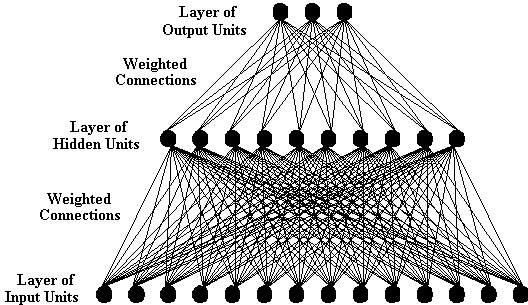
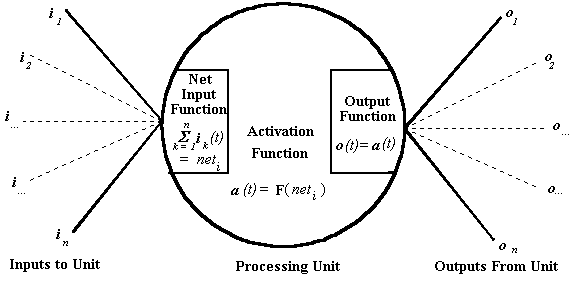
That figure (which I stole from this website) is pretty self-explanatory, right? I can probably just leave it at that and say nothing more. OK, maybe if I add this one (from the same website):


There, that should do it. Can you tell I'm not overly excited about the prospect of talking about connectionism? It reminds me of my undergraduate course in matrix algebra, among other unpleasant things. But I'll suck it up and get on with it.

Actually, most of what you need to know really is contained in those diagrams. Connectionist models are essentially pattern detectors. They involve layers of units that send signals to each other (in the simplest case, the signals only move in one direction, but in more complex models, they can go backwards and forwards), with the aim of producing an output pattern that corresponds to the input pattern the model received. In the simplest models, there are three layers of units: a layer of input units, a layer of hidden units (the second diagram calls a unit in this layer a "processing unit"), and a layer of output units. Between the three layers are connections, running from the input layer to the hidden layer, and from the hidden layer to the output layer. There are two important features of the connections: their sign and their strength, or weight (in more complex models, the direction that the signal moves on a connection is also important). A connection with a positive sign is excitatory, i.e., when a signal is sent down that connection between two units, it increases the level of activation in the receiving unit; a connection with a negative sign is inhibitory, which just means that a signal sent down it decreases the level of activation of the receiving unit. The strength of a connection determines how much the activation level of the receiving unit is increased or decreased by a particular signal. In simple models, the strengths usually vary between 0 to 1.

As the second figure above indicates, even in a simple model, things are a little more complicated than the last paragraph made them out to be. This is because a unit in the hidden layer or output layer generally doesn't receive one signal from one input unit. Instead, it receives a bunch of signals at the same time from multiple input/hidden layer units, and it has to combine them in some way to determine how active it should be. In the simplest models, the receiving unit just sums all of the signals it receives at one time, and then computes an activation level. If the sum of all is inputs are positive, it will become more active for a period of time (the activation function in the second figure usually contains within it a decay function that determines how long it will stay active after receiving input), and if it is negative, it will become less active. You can think about the units as neurons which are just minding their own business, firing away at their baseline rates (the rates they fire when they're not receiving any signals), when all of the sudden a rush of input from several other neurons comes in. Some of the input is excitatory, and some of it inhibitory, so the neuron has to combine all of the signals from multiple other neurons together, and if the net input is excitatory, it raises its activation level above the baseline, while if it is negative, it drops its activation level below the baseline. After a short time, if it doesn't receive any more input, it will return to the baseline (or below the baseline, if it was excited and there is a refractory period). Of course, the units in connectionist models aren't neurons, so they don't actually fire, and they don't really have a resting level. Instead, the level of activation of a unit in a model determines how strong the signal it sends down stream to the next level of units will be.


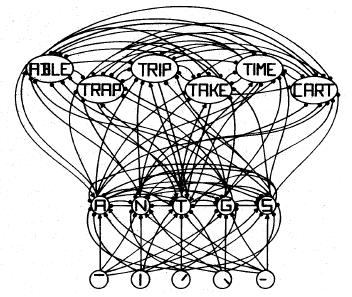
Consider an example model. If you've ever taken a course in cognitive science, you've probably seen this third figure. It's from a classic paper by McClelland and Rumelhart1 on perceiving letters and words. At the bottom are the input units, which detect oriented lines in the first letter of a word that the model receives as input. In the middle are the hidden units which represent the possible first letters. Take, as an example, the T unit (the one in the middle of the hidden layer). When the upper horizontal line input unit (far left) and the vertical line input unit (second from the left) are activated, they send excitatory signals to the T unit. When the angled line input units (middle and second from right) are activated, they send inhibitory signals to the T unit. The other hidden units work the same way (but with the excitatory and inhibitory connections coming from the input units with the components of their letters). The hidden units then send a signal to the output units, based on how active they've become. These signals also have connection weights and signs. The output units work pretty much like the hidden units. The output that wins and gives the models "answer" is the one that ends up with the highest sum of input signals from the hidden units. Obviously, to get whole words (like in the model above), you have to have input units, and perhaps hidden units, for the letter in each position in the word, and the winning output unit gets the most activation from all of those units.

So that is a highly oversimplified explanation of how a connectionist model recognizes a pattern (in this case, a word). But at the start, a model can't recognize any patterns. It has to be trained. To do that, you have to include some method for giving it feedback, and for that feedback to affect the connection strengths between the different layers. First, you randomly assign connection weights between each of the nodes. Then you give the model an input. Inevitably, the output will not be the desired input (the pattern the model is supposed to recognize), so you adjust the weights on each of the connections. The simplest way to do this is to compare each weight to the weight that would yield the correct pattern, and adjust the weight based on the difference. After a lot of training, this method will leave you with a model that can recognize the patterns on which it was trained with a high degree of accuracy. Some models can even generalize to novel patterns (e.g., new words with the same letters that were used to train the model).

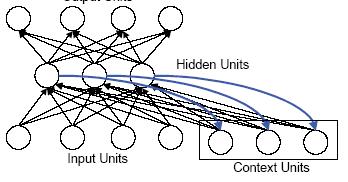
In more complex models (which would include most of the models used today), things get, well, more complex. The simple model I described above is a strictly feed-forward model: the input layer sends signals to the hidden layer, which sends signals to the output layer. However, other models use recursion to allow forward layers to influence backward layers. Some also include another type of layer, a "context layer," that receives input from the hidden layer and records the state of that layer at a given time. When another set of inputs comes in to the hidden layer, the context layer then sends a signal back to the hidden layer. Thus the hidden layer's last state serves as the "context" for its interpretation of the new input. Here's a diagram of such a model (from this paper):

As you can see, the context units have two different kinds of connections: those coming in from the hidden units, which will have one set of connection strengths, and those going back to the hidden units, which will have another set of connection strengths. Things can get pretty messy, mathematically, when you include this and other sorts of recursion in a network. God knows, I can't do the math.

When you look at these models (the simple or the complex) more formally, what you will see is that deep down, they don't really look like the above figures. Instead, the connection strengths and weights are represented as vectors in a multidimensional space (a state space, or vector space -- hence the matrix algebra that makes me shudder). Individual patterns occupy a part of that space. This allows you to use connectionist models to do all sorts of things, like determining the similarity of different patterns. The closer together two patterns are in the space, the more similar they are. It also leads to problems, because spatial representations are somewhat limited. What connectionist models, and spatial representations, can do, and perhaps cannot do, or at least cannot do without looking a lot like their alternatives, the symbolic models, has caused a great deal of debate over the utility and epistemological status of connectionist models over the years (see this article for a short account of the controversies).

But you won't need to know anything about that to understand what connectionism means for moral psychology. Hopefully what's in the preceding paragraphs does give you what you need to know for that. I'm sure you can already guess the basic idea: when you get down to it, moral judgment is just a form of pattern recognition. That makes it sound very noble, doesn't it?

1 McClelland, J.L., & Rumelhart, D.E. (1981). An interactive activation model of the effect of context in letter perception: Part 1. Psychological Review, 88(5), 375-407.

Monday, August 15, 2005

Hahahahaha!

Is it wrong that I find this funny? I especially loved the diagram. (Warning, strong language repeated over, and over, and over, and over, and over again.)

Sunday, August 14, 2005

The Effects of Color Names on Color Concepts, or Like Lazarus Raised from the Tomb

After I finally finished Language in Mind, about which I posted the other day, I went back and looked at some of the literature on linguistic relativity that I had read over the years, but had mostly forgotten. And since linguistic relativity has always been a favorite topic of mine, I thought I'd post a little more about it (it may not be a favorite topic of yours, but hey, this is my blog!). In the early days of cognitive science, the majority of the studies designed to test the Sapir-Whorf hypothesis, or other linguistic relativity hypotheses, looked at the effects of color terms on color concepts. Early on, much of this work produced promising results for supporters of the S-W hypothesis. But in 1972, E.R. Heider published a paper titled "Universals in color naming and memory" that effectively killed the Sapir-Whorf hypothesis1. Heider compared memory for colors in speakers of two different languages, English and the language of the Dugum Dani. The Dugum Dani is a remote hunter-gatherer tribe in New Guinea that has had little exposure to western culture. They have two basic color terms, compared to 11 in English. Thus, the comparison between the two presented a particularly strong test of the Sapir-Whorf hypothesis: if the speakers of a language with 2 color terms and the speakers of a language with 11 both have the same or highly similar color concepts, then we're justified in dropping the idea of linguistic relativity, at least for color. And that's what Heider found: English speakers and members of the Dugum Dani tribe displayed highly similar color memory. Other researchers found similar evidence in the comparisons of speakers of several other languages with varying numbers of color terms, but for all intents and purposes, linguistic relativity was dead after Heider.

Until the 1990s, that is. Looking at color terms presents a test of a particularly strong version of linguistic relativity. Color is a concrete, physically-defined category with a well-known neural basis. Thus, the explanation for Heider's data, which was widely accepted, was that color concepts are determined not by color names, but by the physiology of color perception. However, in the 90s, researchers began to think color was too strong a test, and that for more abstract domains, language does play a constraining role. Over the last several years, a growing body of evidence has shown that this is in fact the case. For abstract domains like time, number, space, and substance, language can be highly influential. But anyone who's really interested in linguistic relativity always has color in the back of his or her mind. If evidence for universal color categories can kill the Sapir-Whorf hypothesis, then evidence for cultural variance in color categories can bring it back to life.

But there are difficulties in studying cultural variation in color. You can't just study the speakers of languages spoken by people in industrialized nations, because there has been a lot of interaction between the speakers of those languages. You can't even study languages spoken exclusively by people in unindustrialized nations who have had a lot of exposure to western culture, because speakers of those languages tend to adopt color terms from western languages (especially from English). So, you have to find remote tribes that speak languages that have had relatively little outside influence. That takes money and time. Furthermore, there is always the problem of running the same experiment in multiple languages. You never know whether the experiment is exactly the same to speakers of different languages (and if you're an adherent of some version of linguistic relativity, you have to believe that it isn't!). That's a particularly big problem when you're studying members of remote hunter-gatherer tribes. Psychology experiments seem weird to American undergraduates who are taking a course about psychology and its experiments. Imagine how odd they must seem to hunter-gatherers who've never heard of psychology. But Heider's experiments suffered from these problems, too, so if there's reason to doubt any cross-cultural research on color concepts, then there's reason to doubt Heider's. For some, that doubt is all the motivation they need to do more research.

Enter Debi Roberson, and her colleagues. Roberson believes that there is evidence in Heider's data that Heider's conclusions may have been a bit hasty. For instance, Dani color memory was much worse than that of English speakers, even though the error patterns were highly similar. Heider has no explanation for this. Perhaps it is an indication that Dani color concepts really are different from those of English speakers. Armed with her doubt of Heider's data, Roberson set out to replicate his results, and further test the effects of color names on color concepts using new methods. For this post, I'll describe two of her methods: color memory, which attempts to replicate Heider's findings, and categorical perception.

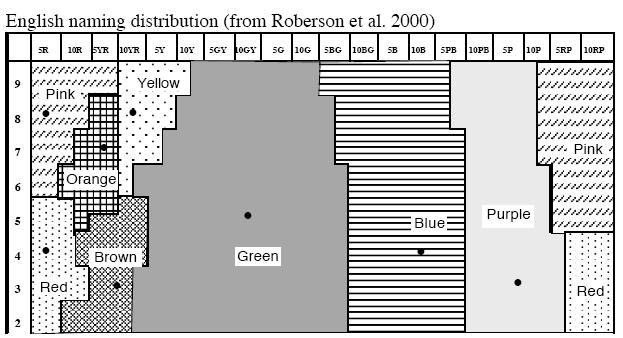
The experiments on color memory go like this. First, you have to determine the number of basic color terms in a language. You do this by having people name Munsell color chips, which depict colors across the visible spectrum. You then determine the color names that were used to describe the bulk of the spectrum. In doing so, you get graphs that look like the following for English-speakers (from Roberson et al. 20002:

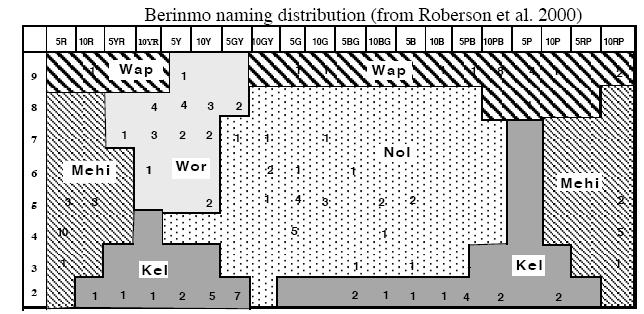
The numbers at the top and on the side (which are hard to see, I know) are the numbers and labels for the Munsell chips. While you're eliciting color names, you also ask the participants to indicate the best example of each color (the most common answer to this question for each name is represented in the above graph by the dots). Roberson and her colleagues have done this for three cultures, English (in the graph above, which gives 10 basic color terms, as compared to the 11 that Heider found), as well as the Berinmo tribe, which is also from New Guinea, and the Himba tribe from Namibia. Both the Berinmo and Himba tribes have had very little exposure to western culture, and their languages lack any color terms borrowed from other languages. Both of them have five color terms. Here are the graphs of their color names, which you can compare to the graph of English color names above3:


The Berinmo and Himba graphs look somewhat similar, but are different enough for comparison. The numbers on these two graphs indicate the number of participants who said that that chip was the best example.

After you've got the naming data, you can do the memory task. The materials for the task include low saturation color chips (i.e., chips that are near naming boundaries, or otherwise far from the best examples of a color name) from the English color categories. The participants are shown a chip by itself for five seconds, and then the chip is covered. After thirty seconds, the participants are shown a full array of chips (40 total) and asked to identify the color they had just seen. The low saturation chips are chosen because they will produce high error rates. The key data is what sorts of errors participants make. If they tend to mistakenly choose other chips from the same color category in English, as English participants do, then we can infer that color categories are universal. However, if there errors tend to involve choosing chips that have the same name in Berinmo or Himba, then we can reason that color terms affect color perception and memory, and thus that color categorization is not universal. This would be strong evidence for linguistic relativity in color concepts. And that's what Roberson and her colleagues found. Berinmo participants tended to make errors consistent with their color names, while Himba participants made errors consistent with theirs. Neither made errors consistent with English color names (the correlations between naming and memory for Himba participants were r = .559 for memory and Himba names and r = .036 memory and English names; the correlations were similar for Berinmo vs. English for Berinmo speakers).

To provide further evidence that color names affect color categories, Roberson et al. (2000) and Roberson et al. (2005) conducted an experiment on categorical perception with the Berinmo and Himba. In categorical perception, within-category exemplars tend to be treated as more similar than between-category exemplars, even when the between-category exemplars are more similar physically. This is particularly interesting in color perception: a color exemplar classified as red will be more similar to other exemplars of red, particularly the best examples of red, than it will be to examplars of neighboring colors, even if the exemplar falls on the physical boundary between the two colors and is thus closer, physically, to exemplars from the neighboring colors than it is to the best example of red. If Berinmo and Himba speakers demonstrate categorical perception effects consistent with their labels, but not with other labels (particularly English), then we can conclude that their color naming affects their color concepts.

To test this with Berinmo speakers, they tested participants on a category distinction present in English, but not Berinmo (green-blue) and one present in Berinmo, but not English ("nor" and "wor," as in the graph above). They presented participants with three Munsell color chips, and asked them which two were the most similar to each other. Two of the chips were highly physically similar, i.e., they were close to each other in the physical color space. One of those two chips also shared the same label as the third chip. Thus, you might have two "wor" chips, and one "nor" chip, with the "nor" chip being physically more similar to one of the "nor" chips than the other "nor" chip. If participants consistently answer that the two "nor" chips are more similar than the physically similar "nor" and "wor" chips, then they will have exhibited a categorical perception effect. Furthermore, if they do not exhibit a categorical perception effect for the green-blue distinction (i.e., they pick the more physically similar chips when the choices are two classified as green and one as blue), then we can conclude that it is the naming, rather than any universal physiological aspect of color perception, that is driving the categorical perception effect. And that's what Roberson et al. (2000) found for Berinmo. Roberson et al. (2005) found similar categorical perception effects for the Himba speakers.

It's interesting that the Berinmo and Himba tribes have the same number of color terms, as well, because that rules out one possible alternative explanation of their data. It could be that as languages develop, they develop a more sophisticated color vocabulary, which eventually approximates the color categories that are actually innately present in our visual systems. We would expect, then, that two languages that are at similar levels of development (in other words, they both have the same number of color categories) would exhibit similar effects, but the speakers' of the two languages remembered and perceived the colors differently. Thus it appears that languages do not develop towards any single set of universal color categories. In fact, Roberson et al. (2004) reported a longitudinal study that implies that exactly the opposite may be the case4. They found that children in the Himba tribe, and English-speaking children in the U.S., initially categorized color chips in a similar way, but as they grew older and more familiar with the color terms of their languages, their categorizations diverged, and became more consistent with their color names. This is particularly strong evidence that color names affect color concepts.

It appears, then, that Roberson and her colleagues have laid their hands on the Sapir-Whorf hypothesis and raised it from the dead with their experiments using members of the Berinmo and Himba tribes. We should, of course, take these results with a healthy dose of skepticism, because it does involve testing people in very different languages and cultures and comparing their results, which, as I said earlier, is a big problem. However, the growing body of evidence from Roberson and her colleagues' experiments is hard to deny. I don't know about you folks, but I find the revival of Sapir-Whorf incredibly exciting.

1 Heider, E.R. (1972). Universals in color naming and memory. Journal of Experimental Psychology, 93, 10-20.
2 Roberson, D., Davies I. & Davidoff, J. (2000) Colour categories are not universal: Replications and new evidence from a Stone-age culture. Journal of Experimental Psychology: General , 129, 369-398.
3 The Himba graph is from Roberson, D., Davidoff, J., Davies, I. & Shapiro, L. (2005) Colour categories in Himba: Evidence for the cultural relativity hypothesis. Cognitive Psychology, 50, 378-411.
4 Roberson, D., Davidoff, J., Davies, I.R.L. & Shapiro, L. R. (2004) The Development of Color Categories in Two languages: a longitudinal study. Journal of Experimental Psychology: General, 133, 554-571.

Friday, August 12, 2005

The Cultural Origins of Human Cognition: Introduction and Context

In many of the great responses I received to my initial email to the reading group, people indicated that they would like to see me introduce books by placing them in historical and theoretical context. So that's what I plan to do in this post. My plan is to avoid discussing the book directly, because I think that should wait until everyone's started reading it. Hopefully this post will serve as a good launching point for subsequent discussions of Tomasello's positions as he lays them out in the book, though. At the end of this book, and probably each book, I'm going to solicit feedback (sort of like course evaluations, but since you're not getting grades, I assume that there won't be any really nasty feedback from people who know they're getting F's), so if what I post in this introduction doesn't seem sufficient to you, you will be able to let me know. I've never conducted an online reading group, or a reading group with people with so many different intellectual and professional backgrounds, so this will be as much of a learning experience for me as it will be for everyone else.

The Overall Context

In the book, Tomasello discusses a wide variety of research, from human language acquisition to the nesting behaviors of orangutans, but he does a good job of discussing the findings of much of that research, so I won't go into most of it in the introduction to the book. However, there are three things that it's important to understand in order to fully grasp the concepts in the book: the two most prominent contrasting views, namely the Chomskyan universal grammar paradigm in linguistics and Evolutionary Psychology, and what is perhaps the most important concept in the book, the concept of theory-of-mind. So in this post, I'll briefly discuss both the Chomskyan view of language and the basic beliefs of Evolutionary Psychology, and briefly define theory-of-mind. At the end, I'll provide a list of links that provide further discussion of each.

Evolutionary Psychology

As you can probably tell from the title of the book, Tomasello believes that many aspects of modern-day human cognition evolved culturally, rather than biologically (i.e., through changes in our genetic makeup caused by the mechanisms of biological evolution, most notably natural selection). This means that we are born with a fairly plastic mind that is shaped through experience, and the experiences that modern humans have benefit from the experiences of the humans who have come before us in the form of cumulative culture. In the terminology of philosophy, Tomasello is a fairly radical empiricist. He's not a tabula rasa empiricist, but he's about as close to that as people in cognitive science come these days. His position is particularly interesting because, at the same time Tomasello began to espouse it, a group of psychologists, anthropologists, philosophers, and neuroscientists who called themselves Evolutionary Psychologists was becoming more prominent. Evolutionary Psychologists are nativists, people who believe that much of our modern-day cognition is the result of innate, biologically evolved, domain-specific mechanisms in the brain. In other words, Tomasello and Evolutionary Psychologists are in many respects polar opposites, theoretically.

While Evolutionary Psychology is not widely respected among cognitive scientists (Evolutionary Psychologists get a lot of popular press, while Tomasello gives a plenary speech at the most prestigious cognitive science conference), some of its basic ideas, in less extreme and absurd forms, are. The extreme contrast between Tomasello's work and that of Evolutionary Psychologists can therefore serve as an illustration of the generally more subtle contrasts between Tomasello and the beliefs of most cognitive scientists. To understand this contrast, then, it's important to understand the basic tenets of Evolutionary Psychology.

Here is how Stephen Pinker, one of the foremost proponents of Evolutionary Psychology, describes its purpose:
The goal of research in evolutionary psychology is to discover and understand the design of the human mind... Evolutionary psychology often investigates the adaptive functions of cognitive and emotional systems -- how natural selection "engineered" them to solve the kinds of problems faced by our ancestors in their struggle to survive and reproduce... Complex organs like eyes have many precise parts in exacting arrangements, and the odds are astronomically stacked against their having arisen fortuitously from random genetic drift or as a by-product of something else. Second, the brain, like the eyes and the feet, shows signs of good design. The adaptive problems it solves, such as perceiving depth and color, grasping, walking, reasoning, communicating, avoiding hazards, recognizing people and their mental states, and juggling competing demands in real time are among the most challenging engineering tasks ever stated, far beyond the capacity of foreseeable computers and robots. Put the premises together -- complex design comes from natural selection, and the brain shows signs of complex design -- and we conclude that much of the brain should be explained by natural selection.
The idea that the brain evolved through natural selection is not a controversial one, and is part of Tomasello's view as well, but even in this short description Pinker hints at what makes Evolutionary Psychology interesting and controversial: the idea that the brain evolved, through natural selection, specific abilities to perform specific tasks, like theory-of-mind ("recognizing people and their mental states"). This is how Leda Cosmides and John Tooby put it:
[T]he reason we have one set of [brain] circuits rather than another is that the circuits that we have were better at solving problems that our ancestors faced during our species' evolutionary history than alternative circuits were. The brain is a naturally constructed computational system whose function is to solve adaptive information-processing problems (such as face recognition, threat interpretation, language acquisition, or navigation). Over evolutionary time, its circuits were cumulatively added because they "reasoned" or "processed information" in a way that enhanced the adaptive regulation of behavior and physiology.
There are two important parts to these claims, against which Tomasello will argue: 1) The neural circuits that evolved did so in response to (highly) specific adaptive problems, and 2) these problems were the ones faced by our evolutionary ancestors that existed in the time between our common ancestor with modern apes. The argument for the first of these is pretty simple and intuitive. In essence, it says that there was no such thing as a "domain-general" problem in our evolutionary environment, and therefore, we could not have evolved brains that were designed with domain-general problem solving mechanisms. Our evolutionary ancestors' environment involved many specific problems that, if they were to survive, they would have to deal with adaptively. This would require the brain to develop specific mechanisms designed to deal with those specific problems. The problems that Evolutionary Psychologists often discuss in this vein include the problems of detecting cheaters and rewarding cooperators (reciprocal altruism), the problems of selecting and procuring mates, the problem of detecting when your mate is mating with others behind your back (so that, if you're male, you can know whether her offspring are actually yours), and the problem of figuring out what's going on in other people's minds (theory-of-mind).

The idea that we evolved several specific brain mechanisms that are designed to deal with specific adaptive problems that were faced by our ancestors leads to a view of the makeup of the mind that is sometimes called "massive modularity," the view that the mind is made up of a bunch of individual modules, or tiny computers, that selectively process information that is relevant to the problems they were designed to solve. The various circuits then work together to produce complex adaptive behaviors in complex environments. Here is the substance of the massive modularity view in the words of Cosmides and Tooby:
We have all these specialized neural circuits because the same mechanism is rarely capable of solving different adaptive problems. For example, we all have neural circuitry designed to choose nutritious food on the basis of taste and smell -- circuitry that governs our food choice. But imagine a woman who used this same neural circuitry to choose a mate. She would choose a strange mate indeed (perhaps a huge chocolate bar?). To solve the adaptive problem of finding the right mate, our choices must be guided by qualitatively different standards than when choosing the right food, or the right habitat. Consequently, the brain must be composed of a large collection of circuits, with different circuits specialized for solving different problems. You can think of each of these specialized circuits as a mini-computer that is dedicated to solving one problem. Such dedicated mini-computers are sometimes called modules. There is, then, a sense in which you can view the brain as a collection of dedicated mini-computers -- a collection of modules. There must, of course, be circuits whose design is specialized for integrating the output of all these dedicated mini-computers to produce behavior. So, more precisely, one can view the brain as a collection of dedicated mini-computers whose operations are functionally integrated to produce behavior.
Claim two makes involves an argument about when these domain-specific abilities evolved. We humans have only been hanging around in civilizations for about 10,000 years. That's not enough time for complex problem-solving mechanisms to evolve. So, they must have evolved earlier than that. We know that modern apes, with whom we share a common ancestor that lived about 6 million years ago, don't have the cognitive and behavioral repertoire that Evolutionary Psychologists are interested in. So, they have to have evolved within the last 6 million years. We also know that until about 2 million years ago, our ancestors were mostly various Australopithecine species that don't appear to have had many of the cognitive traits of modern humans that Evolutionary Psychologists believed have evolved through natural selection either. Therefore, most of the evolutionary work had to have been done between 2 million and 10,000 years ago, a time period called the Pleistocene. Furthermore, because most of the work was done in the Pleistocene, our brains are composed of a bunch of mini-computers, or modules, that were designed to handle the problems faced by our ancestors, but which we no longer face, or which have, in the modern world, changed so dramatically that they no longer resemble our Pleistocene problems. In the words of Cosmides and Tooby, "our modern skulls house a stone age mind."

Tomasello will argue that, in fact, the two million years in which humans have had to evolve these complex, domain-specific modules is simply not enough time. Instead, he believes that a single, fairly simple adaptation that built onto capabilities that were already present in our primate relatives. In a paper published just before the book, he wrote:
If we are searching for the origins of uniquely human cognition... our search must be for some small difference that made a big difference, some adaptation, or small set of adaptations, that changed the process of primate cognitive evolution in fundamental ways.
For him, the most likely "adaptation, or small set of adaptations" are those that created in our ancestors the ability to learn and transmit cultural knowledge.

Chomsky, Universal Grammar, and the Evolution of Language

Most of you are probably familiar with Noam Chomsky, and have some level of knowledge of his contributions to linguistics. Chomsky is one of the founding fathers of cognitive science, and his work, including his criticisms of behaviorism, constituted one of the driving forces behind the cognitive revolution in the 1950s and 60s. It would be impossible to give a sufficiently detailed account of Chomsky's theories over the years, and I'm not really qualified to do that anyway. However, for the purposes of situating Tomasello's book, it will be sufficient to briefly discuss one of the foundations of Chomsky's views, the idea that humans possess an innate language faculty that house's knowledge of the underlying rule-based structure of all languages (a universal grammar). On top of that, I'll also mention some of the views of how that language faculty came to be.

The primary argument for the existence of an innate language faculty is that there simply isn't enough information in the environment to learn the complex set of rules required to be a competent user of human language. Here's a simplified version of the argument:
i. A complex set of principles and rules (grammar) underlies all human languages.
ii. The only information that a child receives from his or her environment about these principles and rules comes from observing people use language.
iii. There is not enough information in those observations to learn the complex set of principles and rules required to acquire a human language. The utterances a child hears are incomplete, ungrammatical, and more importantly, only a tiny fraction of the set of possible utterances (which is infinite).
iv. Therefore, in order to acquire a language through observation, the human child must come to the table equipped with an innate set of principles and rules that can be tweaked through exposure to instances of language in his or her environment.
Put another way, the evidence to which a child is exposed in his or her linguistic environment can be accounted for by a large, if not infinite number of possible sets of principles and rules. Figuring out which is the correct set (which one allows you to learn and use the language correctly) requires that the language faculty already contain the basics of that set. From what I can tell, the most popular version of this approach, today, is the "principles and parameters" approach that Chomsky first laid out in Lectures on Government and Binding. According to this version, we are born with a set of principles and parameters which underlie the syntax of all languages. What children learn through experience is the content of the language's lexicon, along with the values of the parameters. It is differences in these that produce the variations we see across different languages.

After establishing that there is a universal grammar, it becomes important to understand how it came to be. Understanding its origins may help us to understand the specifics of its content. Thus, it becomes important to understand the evolution of the language faculty. Chomsky himself has insisted that it is unlikely that the language faculty evolved through natural selection, and that if it did, it is impossible to know under what conditions, and in response to which adaptive problems, it evolved. He, along with Marc Hauser and Tecumseh Fitch articulated this position in this paper. Others within the Chomskyan tradition, most notably Derek Bickerton, Stephen Pinker, and Ray Jackendoff, disagree. Each has argued for his own version of language evolution. For Bickerton, language evolved out of a protolanguage which resembled, in some ways, modern pidgin languages. For Pinker and Jackendoff, there were a series of steps leading from the use of Saussurean signs (signs that bear only arbitrary relationships to the signified, like the word "dog" bears no nonarbitrary relationship to dogs) to complex rules for the combination of phonetic, syntactic, and semantic information into the complex utterances of human languages. There doesn't appear to be any single dominant theory of language evolution yet, but most of them assume that what evolved was some form of the Chomskyan language faculty.

The idea that humans are born with a universal grammar is pretty uncontroversial within linguistics, though it is still questioned by many outside of linguistics (especially in psychology and computer science). The poverty of stimulus argument, in particular, is still widely questioned outside of linguistics (see, e.g., this recent paper on machine learning). Tomasello himself has devoted much of his professional career to developing an alternative account of language acquisition, which he's laid out in a separate book titled Constructing a Language: A Usage-Based Theory of Language Acquisition. In that book, as well as in The Cultural Origins of Human Cognition, he argues that there is in fact sufficient information in the child's linguistic environment to acquire language. This acquisition is done not through a faculty specific to language, but using the same mechanisms that enable other forms of cultural learning. In other words, there is no innate universal grammar, and because of this, there is no need for a highly evolved language faculty. Instead, most of what constitutes modern languages evolved culturally. As you can probably imagine, this is a pretty controversial position, and it is not widely accepted, even among those who doubt the validity of the poverty of stimulus argument and the existence of a universal grammar.

Theory of Mind

The one area in which Tomasello is in agreement with most other cognitive scientists, including Evolutionary Psychologists, is in the belief that the basic capacities that allow us to infer the thoughts, beliefs, feelings, and intentions of other human beings is evolved. These capacities are generally discussed under the heading "theory of mind." The most often used test for theory of mind is the false-belief task. In a typical version of this task, a child sits in a room with two experimenters, with a pair of boxes in front of them. One of the experimenters takes an object (a toy, candy, or something else that will interest the child), shows it to the child and the other experimenter, and places it into one of the boxes. The other experimenter then leaves the room. While he or she is gone, the first experimenter takes the object out of the box, and places it in the other box (or somewhere else in the room, out of sight). The child is then asked where the experimenter who left will look for the object. The logic of the experiment is that if the child is able to reason about the mental states of other people, he or she should be able to understand that other people can have false beliefs. Therefore, if the child has theory of mind abilities, he or she should answer that the other experimenter will look in the box into which the first experimenter originally placed the object. If the child does not have theory of mind abilities, he or she will answer that the experimenter who left the room will look in the place that the object was placed after he or she left the room. Human children are able to perform this task by age 3 or 4, while most nonhuman primates are not able to perform it without extensive training.

The false belief task has many problems, and may not test for all of the aspects of theory of mind. In fact, other experimental paradigms demonstrate evidence for theory of mind abilities in nonhuman primates as well as human infants. However, there are definite differences between the theory of mind capabilities of nonhuman primates and those of young human children (perhaps even infants). Tomasello's account of the evolution of modern human cognition centers around these differences. He will argue that it is the faculties that underlie these differences that allow humans to develop, through cultural learning, a wide range of cognitive abilities, including the use of language, that no other animal has developed.

Once again, this is a very controversial position, and it has not been widely accepted, though it is garnering more and more attention in psychology and cognitive anthropology (I'm not sure what linguists think of it). I think this means that Tomasello's book, which is controversial pretty much from page 1, will spark a lot of great discussion, and will thus make for a great first book for our group. I hope this introductory post helps to situate the book. As we go along, I will try to define the concepts and explain Tomasello's positions in more depth, and may go in to more detail on the differences between his and other views in the field.

Wednesday, August 10, 2005

The Systematizing Moon and the Empathizing Sun

In German, a young lady has no sex, while a turnip has. Think what overwrought reverence that shows for the turnip, and what callous disrespect for the girl. See how it looks in print--I translate this from a conversation in one of the best of the German Sunday-school books:

"Gretchen. Wilhelm, where is the turnip?

"Wilhelm. She has gone to the kitchen.

"Gretchen. Where is the accomplished and beautiful English maiden?

"Wilhelm. It has gone to the opera." -Mark Twain in A Tramp Abroad

You've probably heard of the Sapir-Whorf hypothesis, which posits that the grammar and other aspects of a language can affect cognition. Various versions of this hypothesis were extensively studied by cognitive scientists in the early days of the field, but after the 1960s, most felt that linguistic determinism and linguistic relativity were untenable as scientific hypotheses. Over the last decade or so, however, cognitive scientists have been revisiting linguistic relativity (linguistic determinism is probably gone for good). They've discovered that language does in fact constrain the way we perceive and conceptualize a wide variety of things, including time, space, number, events, and perhaps even color1 (see this article for a short and accessible summary of some of the research, along with a nice reference section). In 2003, a collection of essays describing much of the research on linguistic relativity was published under the title Language in Mind: Advances in the Study of Language and Thought. It's an excellent book (and it includes a chapter by Michael Tomasello, for those of you who are in the reading group), presenting many interesting ideas and experiments. I highly recommend it for people who are interested in the topic. To give you a taste, I thought I'd post on one chapter, which I chose both because I find it very interesting, and because the chapter is available, in its entirety, online. Oh, and because it quotes from that great passage by Mark Twain, too.

The chapter, titled "Sex, Syntax, and Semantics," and written by Lera Boroditsky, Lauren Schmidt, and Webb Phillips, presents data from a series of experiments (some of which were also written up in papers that you can find here and here) designed to test the influence of the grammatical gender categories found in some languages on the way speakers of those languages think. The chapter has a great opening paragraph (a rarity in cognitive psychology), so I thought I'd quote it in its entirety:
Speakers of different languages must attend to and encode strikingly different aspects of the world in order to use their language properly (Sapir 1921; Slobin 1996). For example, to say that "the elephant ate the peanuts" in English, we must include tense--the fact that the event happened in the past. In Mandarin, indicating when the event occurred would be optional and couldn't be included in the verb. In Russian, the verb would need to include tense, whether the peanut-eater was male or female (though only in the past tense), and whether said peanut-eater ate all of the peanuts or just a portion of them. In Turkish, one would specify whether the event being reported was witnessed or hearsay. Do these quirks of language affect the way their speakers think about the world? Do English, Mandarin, Russian, and Turkish speakers end up thinking about the world differently simply because they speak different languages?
In general, there are two ways that language can influence thought. It can influence what Dan Slobin calls "thinking for speaking," which is the thinking involved in producing speech, or it can influence the way we perceive and conceptualize things even when we're not speaking about them2. The former is pretty straightforward and uncontroversial. Clearly, the language we speak influences how we produce language. It is the latter, however, with which discussions of linguistic relativity and the Sapir-Whorf hypothesis are concerned. Boroditsky et al. describe several studies that imply that grammatical gender can affect thought, but note that these previous studies failed to differentiate between "thinking for speaking" and the nonverbal influences of language. Furthermore, some of the studies suffer from obvious demand characteristics that may have led people to use their knowledge of grammatical gender even in the nonverbal tasks. The experiments described in the chapter are designed to avoid both of these problems. In addition, to avoid the problem of comparing across languages, all of the studies were conducted in English (a language that doesn't have grammatical gender, as I'm sure you know).

The first experiment involved a memory task. Participants, all of whom were native speakers of either Spanish or German, but who were fluent in English, first memorized associations between proper names (e.g., Patrick or Patricia). Half of the proper names were male, and half female. The words were chosen because they were grammatically masculine in one language and feminine in the other (e.g., the sun is masculine in Spanish, but feminine in German, while the moon is feminine and Spanish and masculine in German). For each participant, half of the grammatically masculine words were paired with masculine nouns, and the other half with feminine. This was also the case for the feminine words. Thus, half of the word pairings were gender-consistent and the other half were not. Boroditsky et al. hypothesized that if grammatical gender influences how people conceptualize objects, then it should be easier to remember them when they are paired with proper names of the same gender. This would result in opposite patterns for the German and Spanish speakers, because the languages differed on the grammatical gender of each object. And that's what they found. Both German and Spanish speakers remembered words-name pairings that were gender-consistent in their language better than those that were gender-inconsistent, meaning that German speakers were more likely to remember a pairing with "sun" when the proper name was Patricia (or another feminine name), while Spanish speakers were more likely to remember it if it was paired with Patrick.

In another experiment, also using German and Spanish speakers, the participants were asked to rate the similarity of pictures of objects to pictures of people. As in the memory experiment, each object had a different grammatical gender in the two languages. Half of the pictures of people were of males, and half females. If grammatical gender affects how we conceptualize objects, then on average, objects with a masculine grammatical gender should be rated as more similar to pictures of males than pictures of females, while grammatically female objects should be rated as more similar to the pictures of females. Once again, because the objects have opposite genders in the two languages, we should expect opposite patterns in the Spanish and German speakers. And once again, their findings were consistent with the predictions: same-gender comparisons received higher similarity ratings than opposite-gender pairings, resulting in the Spanish and German participants assigning higher similarity ratings to opposite pairings.

In a third study, they asked German and Spanish speakers to list the first three adjectives that came to mind for each object. As in the previous two studies, the objects each had opposite genders in the two languages. After the participants had completed this task, raters who were unaware of the purpose of the study, who had listed each particular adjective, or for which objects the adjectives had been listed, rated whether the adjectives were more masculine or feminine. If grammatical gender affects conceptualization, then we would expect that objects that are assigned masculine genders would be conceptualized as having more masculine properties, while feminine objects would have more feminine properties. Consistent with this, they found that more masculine adjectives were listed for masculine objects, and more feminine adjectives for feminine objects. Furthermore, the objects for which the Germans speakers listed masculine adjectives were assigned mostly feminine adjectives by the Spanish speakers, and the mostly feminine objects for German speakers were mostly masculine for Spanish speakers.

Out of these three experiments, only the last one seems to be good evidence for the position that grammatical gender affects conceptualization. In the first experiment, it's not unlikely that people used verbal mnemonics which may have led to the effects of grammatical gender on memory for the object-name pairings. The second experiment is difficult to interpret. Comparing objects to people is a bit strange anyway, and it's possible that people noticed that the only thing some of the objects and people had in common was gender. Similarity tasks are strange, anyway. How often do we rate the similarity of objects in the world on Likert scales? Given a strange task like this, it wouldn't be surprising if people were trying to figure out what the experimenter was looking for rather than trying to determine the actual similarity between two dissimilar objects. In other words, this experiment likely suffered from demand characteristics that influenced its results. The third experiment, though, is very compelling. I'm not sure how participants could have figured out what the purpose of the study was, so demand characteristics were probably not an issue. If grammatical gender affects conceptualization, then concepts that posses more features associated with their gender is exactly what we would expect. So we have good evidence, in the form of the types of adjectives that people assign to objects, that grammatical gender affects the way people think about those objects.

None of these studies demonstrates that it is language is directly affecting conceptualization, though. It could be that culture mediates the influence of language, because cultures that assign a particular grammatical gender to an object tend to assign gender-consistent features to that object. Children growing up in that culture will learn not from the language directly, but through the culture, that the object is either more masculine or more feminine. In an attempt to tease apart the influences of language and culture, Boroditsky and her colleagues conducted their strangest experiment. Using native English speakers, they taught participants about a fictional language called Gumbuzi. In Gumbuzi, there is a distinction between oosative and soupative objects. The participants were shown pictures of people, and told that each person was either oosative or soupative. For each participant, the photos of one gender were oosative, and the other soupative (to which gender the labels were given was counterbalanced across participants). Thus, oosative and soupative applied to different genders. The participants were also told that some objects were oosative, while others were soupative. After learning which objects were oosative and which were soupative, the participants rated the similarity to the objects to photos of people (as in the experiment above). Just as the German and Spanish speakers had, gender-consistent object-person pairs were rated as more similar than gender-inconsistent pairs. For example, if spoons and males were oosative, then a photo of a spoon was rated as more similar to a photo of a male than a photo of a female.

They also conducted an experiment in which they taught English speakers the oosative-soupative distinction in Gumbuzi, associated each with one gender, and then with a set of objects, and then asked them to list the first three properties of those objects that came to mind, as in the adjective-listing study that used German and Spanish speaking participants. As in that study, they found that the adjectives given for an object were more likely to be gender-consistent than gender-inconsistent. Boroditsky et al. take these two experiments as evidence that language is directly affecting conceptualization. If cultural factors were mediating these effects, we wouldn't expect people who learned gender distinctions for objects over the course of an experiment to demonstrate them. I've got to be honest with you, though. I find these last two experiments even more unconvincing than I found the first two. Honestly, these are just weird tasks, and the oosative-soupative gender associations must be pretty damn obvious to the participants. I don't think I'm alone in being unconvinced, either. These experiments appeared in a conference precedings paper 3 years ago, but have yet to make it to the pages of a peer reviewed journal3. If I were a betting man, I'd say that if a write up of these experiments has been submitted to a journal (and after three years, they probably have been), reviewers voiced similar concerns. It might have been better to use native English speakers who had learned German or Spanish in high school or college. These individuals would be aware of the language's grammatical gender distinctions, but would not have experienced the cultural influences that native German or Spanish speakers would. Maybe someone's running those experiments right now (in order to answer reviewers objections, or to avoid such objections in blog posts).

Despite my qualms about the first two and last two experiments, taken together the experiments do present a compelling case for the hypothesis that grammatical gender affects conceptualization. When you add the adjective-listing experiment with German and Spanish speaking participants, the case gets even better. In fact, I think that experiment could stand alone, though it would be necessary to run an experiment with non-native speakers to determine the role of language separate from culture. Even if you're not convinced by the set of experiments, they certainly make further research worthwhile.

1 The research on color is particularly interesting because one of the main arguments against the Sapir-Whorf hypothesis in the late 1960s was built on the evidence that even across cultures that have widely different numbers of color terms, color perception was highly similar.
2 Slobin, D.I. (1996). From "thought and language" to "thinking to speaking." In J. J. Gumperz & S. C. Levinson (Eds.), Rethinking Linguistic Relativity, (pp. 70-96.). Cambridge: Cambridge University Press.
3 They were published in a peer-reviewed conference precedings, but that doesn't really say much. The reviewers of papers submitted for conferences are much more lenient, because people present works in progress at conferences, and because each reviewer is reviewing a buttload of papers for the conference. Reviewers usually write a paragraph or two on a conference preceding paper, while they might write pages on a journal submission. (I've received reviews that were damn near as long as the paper itself! By the way, if you're wondering, no, that didn't bode well for the paper.)

Monday, August 08, 2005

Reading Group Members On the Sidebar

I added a category on the side bar with the blogs of people who've joined the reading group. If you plan on participating and sent me your blog's url and I left it out, or haven't sent me your blog but would like me to link it over there, let me know.

Sunday, August 07, 2005

Danse Russe

OK, I just got off a plane, and I'm exhausted, but I was in the mood to post something, so I'll post a poem. It's one of my favorites, by William Carlos Williams (of "beside the white chickens" fame):
Danse Russe

If I when my wife is sleeping
and the baby and Kathleen
are sleeping
and the sun is a flame-white disc
in silken mists
above shining trees,—
if I in my north room
dance naked, grotesquely
before my mirror
waving my shirt round my head
and singing softly to myself:
"I am lonely, lonely.
I was born to be lonely,
I am best so!"
If I admire my arms, my face,
my shoulders, flanks, buttocks
against the yellow drawn shades,—

Who shall say I am not
the happy genius of my household?
I've always seen this as a portrait of the artist being an artist, with all of the self-reflection and self-observation that goes along with it, while separately being an ordinary family man (or woman). I think this portrait could be painted of many philosophers -- the "I am lonely, lonely, I was born to be lonely, I am best so" line reminds me of something that Nietzsche said: "In order to live alone, one must be an animal or a God - says Aristotle. There is yet a third case: one must be both - a philosopher..." -- and scientists as well, once again indicating the similarities between the three.

Saturday, August 06, 2005

And the Winner Is...

The Cultural Origins of Human Cognition by Michael Tomasello will be the reading group's first book. The voting was close, and I'll be sure to include the books that did well in the voting for the second book, but for now, Tomasello's the man.

For those of you who are not familiar with Dr. Tomasello, he is in the Department for Developmental and Comparative Psychology at the Max Planck Institute for Evolutionary Anthropology in Leipzig, Germany. The bulk of his research is on human language development, and language and culture in nonhuman primates. Here is a list of his publications, and here is a recent paper in which he presents experiments that are designed to test the theories he discusses in the book we'll be reading. This paper, published 2 years before the book, touches on many of the ideas in it, and might be a good place to start while you're waiting for the book. Tomasello has other papers online that might be of interest as well, and I'd be happy to point anyone to them.

I will post a little introduction and background in the next week. If you have questions about the book before then, feel free to email them to me.

Thursday, August 04, 2005

Book Voting

OK, the four choices for the first book are... drumroll please:
  • The Feeling of What Happens by Antonio Damasio
  • The Cultural Origins of Human Cognition by Michael Tomasello
  • In Gods We Trust by Scott Atran
  • The Illusion of Conscious Will by Dan Wegner
I created a poll on the yahoo group for votes, but if you can't vote there, then you can send me a vote via email (please don't vote both ways). Get your votes in by noon central time on Saturday.

Tuesday, August 02, 2005

Another Reading Group Update

MOVED TO THE FRONT: Book voting will end at 5pm tomorrow (Wednesday, August 3), so get your votes in ASAP.

To anyone interested in participating in the reading group. I've gotten a lot of great responses to the email I sent out on Monday, and I think we can start selecting a book now. I will soon send out an email with a list of books that you've suggested or that I think fit the interests people indicated in their responses. I'll include short descriptions of the books, or links to descriptions. I'll post the list on the yahoo group as well (the link to the group is at he bottom of this post).

If you are interested in participating in the group, but haven't yet told me or joined the yahoo group, feel free to do so at any time. If you do so quickly, you can help us select the book. Also, if you've thought of anymore books you'd like to throw into the list, let me know soon. We'll vote on the books over the next few days, and then we can get started.

Yahoo group: http://groups.yahoo.com/group/cogbloggroup/


UPDATE to the Update: Votes are coming in fast, and that's good. I want to ask that if you plan on voting for a book this round, please do so in the next day or two, so that we can get started. Some people in the group are in countries far, far away (including way, way down under), and it may take a bit longer for them to get the books, so if we want to start soon, we should decide on a book soon.

Also, for most of the administrative stuff, I'm going to post to the group instead of the blog. I'll still post the major stuff (like the books we've chosen) here, and for now, I'll also send out emails in case some of you haven't joined the group. If you don't want to join the group (I know doing so might mean a lot of emails when the discussions start), let me know, and I'll put you on a list to email you any administrative stuff I post to the group.

Intelligent Design, Democracy, and the Scientific Division of Labor

So President Bush has explicitly endorsed the teaching of Intelligent Design in public schools, according to this article (via Pharyngula). My first reaction to that is, "Wow, big surprise!" The man who endorsed the teaching of creationism as governor (not ID creationism, but hardcore 6 days and a smoke break creationism) is now endorsing the watered down version. Who'da thunk it? If there's any surprise in this, it's that he didn't throw in any comments about young earth creationism being taught too. I'm sure there are some on the religious right who see this as Bush wussing out. Really, Bush's endorsement of teaching ID, by itself, seems unimportant to the supporters of science. I doubt it lends any more legitimacy to the ID movement among any of its detractors, and those who will be heartened by the endorsement were already firmly in the ID camp anyway. I don't even think it represents a troubling political maneuver. The people who would be likely to vote for a candidate because he or she endorses the teaching of ID or creationism in public schools were probably going to vote Republican anyway. It just doesn't seem like a very big deal.

But, and that's a big but, there does seem to be something somewhat disturbing going on here, of which Bush's remarks are only a symptom. What's disturbing is where, and how, the Intelligent Design community is promoting its ideas. They've avoided the scientific literature almost without exception, and gone straight to the public. The idea behind this, which I have seen expressed on occasion, seems to be that if they convince the public, then they can get it taught. This implies that in a democracy like ours, the views that the majority wants to be taught in public schools should be taught. And there's some intuitive appeal to this idea. I mean, public schools are publicly funded, by our money, so why shouldn't those of us who are paying for the schools have a say in what gets taught in the biology classroom, or any classroom? If most of us think Intelligent Design should be taught, then shouldn't it be? This is a democracy, after all!

The answer, of course, is no. In most cases, majority opinion shouldn't determine what is taught in science classrooms, or pretty much any classroom. For one, there are all sorts of things that are publicly funded, but about which the public should have no say. We shouldn't have a say on the interpretation of classified intelligence reports, for instance, even if the majority of us would disagree with the official interpretation. The reason is, interpreting intelligence requires a certain degree of expertise, and it's better for all of us if we leave it up to the people who possess that expertise. The same goes for most areas of education, especially science education. It's best for all of us if our schools teach the best knowledge we have, and the best knowledge we have about scientific issues comes from scientific experts. There is such a thing as a scientific division of labor. People who spend their entire adult lives studying something are simply better prepared to determine what is currently the best knowledge available in their fields than people who learned about evolution from the Discovery Channel or the Discovery Institute. Of course, experts will disagree, but science itself is a lot like a democracy within a democracy. The best knowledge available is determined by a consensus among the experts. The consensus will often be wrong, but that is, after all, what science is: better and better wrong ideas. But it will be closer to right than any idle speculation or propaganda-induced skepticism.

What's disturbing about Bush's endorsement, then, is that he feels justified in giving it because in doing so he is representing his constituency. This is exactly what the Intelligent Design public disinformation campaign is designed to do. The scary thing is that it might make other elected officials, particularly those who can directly influence public school curricula, feel that they too can endorse the teaching of Intelligent Design to represent those who elected them. But deciding what should be taught based on public opinion not Bush's job, and it's not their job either. Their job is to provide our children with the best possible education, and that means going with the experts, not the people who elected them, on issues of course content. Hopefully, enough of the men and women on school boards and in state legislatures will realize this and keep Intelligent Design, and other scientific nonsense, out of our children's science classrooms.

There's Some Lint in My Navel

I know because I'm gazing at it. July was Mixing Memory's biggest month, visitor-wise, thanks in large part to links from people like Lindsay Bayerstein and Amanda Marcotte. Thanks to them, and to everyone who visited (even if you only visited once, and therefore won't be reading my thank you). As always, if you have any comments, suggestions, or requests, they will be greatly appreciated.

Oh, and if you like what you see here, join the reading group, so that you can get all the cognitive science your heart desires, and discuss it with a bunch of intelligent people who are really interested in the field.

Moral Psychology II: The Life and Death of Moral Rationalism


WARNING: This post is long and, compared to the last one at least, quite boring. Read at your own risk.

The neuroscientific evidence in the previous post clearly suggests a moral psychology built around affect, theory of mind, and social schemas. The picture it paints is of a complex of unconscious, automatic processes combining to produce moral judgments. If you read the post carefully, though, you might have noticed that none of the works I cited were published prior to 1994. This is because within the empirical study of moral psychology, a change has been taking place for about a decade, inspired in part by the work of people like Antonio Damasio in neuroscience, as well as behavioral research that I'll discuss in a subsequent post. The change is from a Kantian or rationalist paradigm to a Humean, moral intuitionist one. The change is not total, in that there are still plenty of rationalists, but the intuitionist view is now the dominant one, at least outside of developmental psychology. But in order to really understand the change, it's important to understand what is being changed. That means understanding the rationalism that dominated the empirical study of moral psychology for decades, and the philosophical treatment of moral judgment at least since the late 18th century, if not since Plato. So in this post, I'm going to describe the more prominent reason-based theories of moral psychology.

A responsible blogger would start with a fairly detailed summary of Kantian moral psychology, both as it's found in Kant and in its contemporary formulations, because as Kant's picture hangs over this post, his philosophical legacy has hovered over moral psychology for decades. I, however, am not a responsible blogger, and am simply not qualified to provide such a summary anyway. If you're really interested, you might check out Patrick Smith's posts on the topic at Philosophy, et cetera (here, here, here, and here). Otherwise, you can make do with a couple quotes that illustrate quite well the aspects of the Kantian perspective that are present in the rationalist view of moral psychology today:
The Kantian approach to moral philosophy is to try to show that ethics is based on practical reason: that is, that our ethical judgments can be explained in terms of rational standards that apply directly to conduct or to deliberation. -Christine Korsgaard1

If the requirements of ethics are rational requirements, it follows that the motive for submitting to them must be one which it would be contrary to reason to ignore. -Thomas Nagel2
In other words, within the Kantian approach, moral psychology consists of the deliberate adherence to rationally-conceived rules, or standards, of behavior. Central in this account is moral reasoning, in which we attempt to retrieve and use the appropriate rule in a given moral context. There is also another key element of Kantian moral philosophy that has been central to the empirical study of moral psychology, but which has extended into the new intuitionist approaches. It concerns the very definition of "moral." For moral psychologists, as for Kant, the distinction between the "moral" and other social or interpersonal conventions and behaviors comes from the fact that they are not strictly self-serving. They are in some way other-directed.

Both the emphasis on moral reasoning and the other-based definition of mature moral reasoning are reflected in the early but influential moral psychology of Jean Piaget. For Piaget, there were two stages in the course of moral development, characterized by the type of reasoning that children used when they were in them. The first was characterized by what Piaget called heteronomous reasoning, or self-centered reasoning. During this stage, children consider the consequences of their behavior for themselves, and act on that reasoning. The second stage, which occurs sometime between 7 and 9 years of age, involves what Piaget called autonomous reasoning, which is cooperative or altruistic. But Piaget's theory was never itself widely accepted. Instead, it was a student of his thought (though not an actual student of Piaget's), Lawrence Kohlberg, one of the members of the cognitive revolution, whose work gave shape to the empirical study of moral psychology until the intuitionists began to take over. So for the rest post, I'll discuss Kohlberg and those who came after him.

Lawrence Kohlberg

Like Piaget, Kohlberg theorized that moral development took places in stages. Also like Piaget, he believed that this development was strictly progressive (i.e., once a child had transitioned to a higher stage, he or she could not go back to the kind of reasoning used in an earlier stage), and that children always transitioned from their current stage to the next stage (i.e., they never skipped stages). Kohlberg also believed that these stages were universal, and conducted studies in a variety of cultures to demonstrate this. His theory also involved a transition from heteronomous to autonomous moral reasoning. However, his theory included six stages, divided into three levels. Here is a short description of each stage3:
  • First Level: Peconventional (Ages 2-8)
    • Stage 1: Obedience and Punishment Orientation. As the title of this stage suggests, children's explanations for following rules in this stage largely concern the consequences of breaking the rules for themselves. During this stage, they see rules as unquestionable and immutable.
    • Stage 2: Instrumental Exchange Orientation. During this stage, children's reasoning considers what's in it for them. During this stage, moral rules are not immutable and unquestionable, but subjective. Different self-interests will yield different rules. Punishment is still important, but in a different way. Here is how one author put it:
      At stage 1 punishment is tied up in the child's mind with wrongness; punishment "proves" that disobedience is wrong. At stage 2, in contrast, punishment is simply a risk that one naturally wants to avoid.
  • Second Level: Conventional (Ages 9-11)
    • Stage 3: Interpersonal Conformity Orientation. This stage contains elements of the more mature stages to follow, such as the belief that morality involves a sense of community, and duty, but also contains elements of the previous stages. In particular, it involves conformity to family or community standards in order to gain approval.
    • Stage 4: Law-and-Order Orientation. During this stage, moral reasoning involves considering what's best for the community. Laws are designed to maintain order, and keep society together. This is where you get comments like, "What would happen if everybody did it?" In other words, we're getting more Kantian by the year, now.
  • Third Level: Postconventional (Ages 12 and Up)
    • Stage Five: Prior Rights and Social Contract Orientation. From Crain (1985):
    • Stage 5 respondents basically believe that a good society is best conceived as a social contract into which people freely enter to work toward the benefit of all They recognize that different social groups within a society will have different values, but they believe that all rational people would agree on two points. First they would all want certain basic rights, such as liberty and life, to be protected Second, they would want some democratic procedures for changing unfair law and for improving society.
    • Stage Six: Universal Ethical Principles Orientation. During this stage, people reason about ethical rules from an individualist, democratic perspective. Ethical rules are a product of individual reasoning, rather than handed down from an authority. Justice and fairness are the guiding principles.
Interestingly, according to Crain (1985), Kohlberg at least temporarily stopped using the sixth stage. Stage six reasoning might be limited to the writings of certain philosophers or Lisa Simpson.

To develop and refine his theory, Kohlberg relied almost exclusively on one research instrument, the Moral judgment Interview (MJI). This involves presenting participants with moral dilemmas in which two different principles are in conflict, and recording their resolution as well as their justifications for their position. The following is a typical dilemma (known as the Heinz dilemma) from the actual MJI5:
In Europe a women was near death from cancer. There was one drug that the doctors thought might save her. It was a form of radium that a druggist was charging ten times what the drug cost to make. He paid $200 for the radium and charged $2,000 for a small dose of the drug. The sick woman’s husband, Heinz, went to everyone he knew to borrow the money, but he could only get together about $1,000. He told the druggist his wife was dying, and asked him to sell it cheaper or to let him pay later. But the druggist said, “No, I discovered the drug and I’m going to make money from it.” So Heinz got desperate and began to think about breaking into the man’s store to steal the drug for his wife.
For each answer to each dilemma (there are three dilemmas on each the test), researchers code the participants reasoning into one of the six stages, using a standard list of answers. While Kohlberg required extensive training for researchers on the MIJ, and interraterrator reliability has tended to be high, you can probably imagine that the subjective coding scheme has led to some skepticism about the measure itself. As a result, James Rest developed the Defining Issues Test (DIT)6. This test includes six moral dilemmas, all taken from the MIJ, along with twelve questions for each dilemma. The questions contain examples of reasoning from each of the six stages, and participants are asked to rate on a scale of 1 to 5 how much they will take the issues in the statement into consideration. Thus, the scores are more quantitative, and less subjective. Rest has developed a developmental stage model using the DIT that is similar to Kohlberg's, but which allows for reasoning at multiple stages at one time. So for example, according to Rest, people may reason at stage 4 for some problems, and stage 5 for others.

While neither Kohlberg nor Rest's theories are widely accepted today, at least outside of developmental psychology, they serve as good illustrations of the important points I want to make about rationalist views of moral psychology. First, moral reasoning is central. The stages themselves are defined by the types of reasoning that people use to justify moral decisions. People are consciously aware of this reasoning, and can articulate it. In fact, the tests of mreasoningining (the MJI and the DIT) rely entirely on participants' articulations of their reasoning, and thus on their conscious awareness of that reasoning. Another important point, which I haven't yet mentioned, is the Kohlbergian view of the mechanisms underlying mjudgmentement. These mechanisms are not innate, but they are not learned through socialization either. Instead, they are offshoots of the cognitive abilities that people have at various stages of development. In other words, moral reasoning is a subtype of more general reasoning mechanisms, and comes about through the interaction of these mechanisms and social contexts and rules. Moral reasoning is part of a larger practical reasoning system.

Turiel & Gilligan

As with any dominant paradigm, it didn't take long until the Kohlbergian view of moral development began to be challenged, but as is also the case with most dominant paradigms, the first challenges primarily came from within the paradigm itself. One of the most interesting and controversial challenges came from a student of Kohlberg's named Carol Gilligan. In her 1982 book In a Different Voice7, she argued that the fact that the vast majority of Kohlberg's research subjects were male biased his theory toward an ethic of justice. Females, she claimed, were more inclined to reason from an "ethic of care." As you might imagine, her claim that there were sex differences in moral reasoning was highly controversial, and the evidence hasn't borne it out. As one author put it in a review of the literature, sex huge sex differences in moral reasoning that Gilligan claimed are "mythic"8 but she was right about one thing: the emphasis on justice and fairness, to the exclusion of things like empathy and care, limited Kohlberg's theory.

A separate critique of Kohlbergian theories came from another school of rationalists, headed by Elliot Turriel. Over the years, researchers like Rest began to notice that some children, even at a very young age (e.g., ages in which they should be squarely within the first two Kohblergian stages) used justifications that spanned multiple stages. Some theorists, particularlyTurriel, argued that this meant that a graduated stage model, even a loose one like Rest's, is insufficient. Instead, he and others developed what they call the domain theory of moral reasoning, or what some are calling the social interactionist view.. Central to this theory is the distinction between moral rules and mere social conventions. Turriel and his colleagues have argued that children are able to recognize the distinction between the two at a much younger age (as young as 3 years) than Kohlberg or Rest's theories allow. In a typical experiment9, Turriel would present children with different situations (not dilemmas), some of which involved violating moral rules or laws (such as "thou shalt not steal"), and others that involved social conventions (such as "do not talk loudly in the library"). Children were then asked whether it would be OK to commit the acts that would break the rule (steal or talk loudly in the library) even if there were no such rule. Children who recognize the moral-social convention distinction answer no for moral rules, and yes to mere social distinctions (no, it wouldn't be OK to steal if there were no rule against it, but yes, it would be OK to talk in the library without a rule prohibiting it). Turiel argued that this indicates that from a young age, moral reasoning and nonmoral social reasoning are distinct, and thus utilize different mechanisms. Moral reasoning concerns justice and fairness beginning early in development (recall justice and fairness don't appear in Kohlberg's model until the last level), and children recognize that violations of moral rules have negative consequences even when the rules are not explicitly stated. Also in contrast with Kohlberg, then, Turiel believes that the sense of justice and fairness that underlies children's moral reasoning is learned, primarily through social interactions and observations. It is through social interaction that children learn the consequences of certain actions, and therefore recognize that those actions are wrong even when there are no rules against them.

While both Gilligan and Turriel diverge from Kohlberg in some ways, the central themes remain the same. Their concepts of what morality is, and how mjudgmentement takes place, is still firmly rationalist. But as I said at the beginning of this post, and as the previous post indicates, things have been changing over the last decade or so. One might even say that outside of developmental psychology, rationalism is no longer the majority view. However, there are hybrid theories that contain some elements of rationalism, but with affect and intuition playing large roles as well. I'll quickly describe two, as a transition into the next post.

Blair & Nichols

James Blair, a neuroscientist, has taken an interesting approach to moral psychology. He studies psychopaths. From this research, he's come to view moral reasoning as insufficient to account for the differences between psychopaths and normal individuals in mjudgmentement. In particular, psychopaths are unable to distinguish the moral from the conventional (they have other relevant deficits, but this is the most illustrative one), which most children can do around age three. Their deficits appear to lie in affect, rather than reasoning. Their emotional responses to moral violations are no different than their emotional responses to conventional ones. Blair argues that to account for this, we need an affective mechanism that directly influences moral judgment. He calls this mechanism the Violence Inhibition Mechanism10, which is designed to cause an emotional reaction to human suffering that inhibits aggression and, perhaps, promotes empathy. However, the Violence Inhibition Mechanism doesn't do it alone. There's still something like reasoning going on in what Blair calls "meaning analysis." Now, it's not clear from Blair's writing what, exactly, meaning analysis is, and it could be something more like the automatic, schematic processes involved in intuitionist theories, but from discussions of it, I get the impression that it is more conscious and deliberative. It involves the interpretation of the situations in which the Violence Inhibition Mechanism is activated, and from what I can tell, Blair believes that this can be done consciously and deliberatively, which means that his theory contains at least some elements of the rationalist school.

The second hybrid account comes from the experimental philosopher Shaun Nichols. He has argued that Blairs Violence Inhibition Mechanism can't explain Blair's data, and has produced data of his own to support his own account, in which disgust and other emotions play a key role. For example, in one experiment, he presented participants with three types of violations: moral (e.g., a person hitting another person), conventional (e.g., someone drinking soup from the bowl at a dinner party), and conventional but disgusting (e.g., someone spitting in his drink and then drinking it)11. He argued that if affect plays a key role in the moral-conventional distinction, then disgust-inducing conventional violations should resemble moral violations more than conventional violations. This is, in fact what he found. As for moral violations, the disgust-inducing violations were rated as worse violations than the merely conventional, and participants said they would have been wrong even if an authority figure said they were OK.

According to Nichols, then, affect plays a central role in moral judgment. (By the way, this is the end of my second long post on the topic, and I still put two e's in judgment every time I type it!!!!) But affect doesn't do it alone. Moral reasoning is still central. At least I think that's the case. Like Blair, and pretty much every "cognitive" account of moral judgment (i.e., any account that's not by a neuroscientist or a social psychologist), things get pretty vague after the talk about affect. Nichols has explicitly argued against what he calls "empirical rationalism"12, which encompasses the views of Kohlberg, Turriel, Gilligan, and the like, but it also requires the "understanding" of normative rules governing moral behavior (and distinguishing the moral from the disgust-inducing), and he even calls this understanding a "normative theory." That sounds like it involves reasoning to me. In fact, since it is the theory-like knowledge view of moral reasoning that the intuitionists are rebelling against, calling it a "normative theory" seems pretty straightforward. He also uses the sorts of evidence that rationalists, but not intuitionists, would use in his experiments, asking people "why" it violations were bad. If moral reasoning isn't important, than moral reasoning data isn't important. Still, this is clearly different from strict rationalism. If affect is involved, and even guiding reasoning, then moral reasoning is no longer the arbiterbitor of moral decisions. That makes Nichols a hybrid theorist.

It's no longer controversial to claim that affect is involved in moral judgment, and that it must be central in any theory of moral psychology. The neuroscientific work, along with that of Blair, Nichols, and many others, has ensured this. It's safe to say that strict rationalism is dead as a viable view in the field. Yet, the view that I will talk about in the next post, Jonathan Haidt's social intuitionism, is a radical departure from rationalism. You won't read anything about "theories" or "understanding" in Haidt's work. If you're a moral rationalist at heart, Haidt's work is going to be a wild ride, and you may get nauseated. I just want to warn you up front.

1 Korsgaard, Christine (1986). Skepticism about practical reason. Journal of Philosophy, 83(1), 5-25. I found this quote, in the next, in this paper: Nichols, S. (2002a). How psychopaths threaten moral rationalism, or is it irrational to be amoral? The Monist, 85, 285-304.
2 Nagel, T. (1970). The Possibility of Altruism, Princeton, NJ: Princeton University Press.
3 Crain, W.C. (1985). Theories of Development: Concepts and Applications, 2nd Edition. Englewood Cliffs: Prentice-Hall
4 Kohlberg, L., & Turiel, E. (1971). Moral development and moral education. In Gerald Lesser (ed.), Psychology and Educational Practice, Glenview, IL: Foresman, pp. 410-465.
5 White, R.D. (1997) Ethics and hierarchy: The influence of a rigidly hierarchical organizational design on moral reasoning, Pennsylvania: Pennsylvania State University.
6 Rest, J. (1979). Development in Judging Moral Issues, Minneapolis: University of Minnesota Press.
7 Gilligan, C. (1982). In a different voice: Psychological theory and women's development, Harvard University Press: Cambridge.
8 Brabeck, M. (1983). Moral judgment: Theory and research on differences between males and females. Developmental Review, 3, 274-291.
9 Turiel, E. (1983). The Development of Social Knowledge: Morality & Convention, New York: Cambridge University Press.
10 Blair, R. (1995). A cognitive developmental approach to morality: Investigating the psychopath”. Cognition, 57, 1-29.
11 Nichols, S. (2002b). Norms with feeling: Towards a psychological account of moral judgment. Cognition, 84, 221-236.
12 Nichols, S. (2002a). See footnote 1.