Tuesday, December 07, 2004

By Request: Time Perception I

In response to my last plea for requests, Brandon writes:
One thing that might be interesting is something our subjective sense of time (I've had that on the brain since I recently wrote on Augustine on the subject, and have been wondering what the current research suggests on the specifics of how our sense of time works).
Like reasoning, there is a whole hell of a lot of research on time perception, and I've tossed around several ideas about how to approach the topic in a blog post. There are so many issues, and almost all of them are very interesting, that I am still not exactly sure what I want to do. More than likely, it's going to take a series of posts, but I've got to start somewhere, so I'll start with the neuroscience. In a subsequent post, I'll talk about different factors that affect the cognitive perception of time. God only knows what comes after that.

The neuroscience of time perception has recently become a hot area of study. So far, several brain regions have been found to be involved in different aspects of time perception. The most widely studied are the cerebellum and the basal ganglia, but other non-cortical regions, such as the inferior parietal lobes, and cortical regions such as the inferior prefontal cortex, dorsolateral prefrontal cortex, anterior cingulate gyrus, and the supplementary motor area also play roles. I'll take each of these regions in order, and in no particular order.

Cerebellum

The cerebellum is best known for its role in movement, but since movements often involve intricate timing, within very short intervals, it's not surprising that the cerebellum also plays a role in time perception. We know this because lesions to parts of the cerebellum can wreak havoc with patients' ability to perform motor tasks that require short-interval timing1, as well as with their ability to estimate very short time intervals2 as well as slightly longer intervals (in seconds)3. Imaging studies have also shown cerebellum activity during tasks that require the perception of intervals that are less than 1 second4. It's likely that the cerebellum is divided into areas that control movement, and areas that are specifically for temporal processing, and imaging research has suggested that medial regions of the cerebellum control movement, while lateral regions and the cerebellar vermis process temporal information5.

Basal Ganglia

Like the cerebellum, the basal ganglia is an important part of the brain's motor system. Also like the cerebellum, it has been shown to be closely involved in time perception. Different areas of the basal ganglia, including the supralenticular white matter, right and left putamen, globus palidum, and caudate nucleus have been shown to be active during temporal tasks including sensorimotor synchronization tasks, time discrimination tasks, and rhythm discrimination tasks of different time scales (ranging from milliseconds to seconds)6.

Supplementary Motor Area

Another motor area associated with temporal processing is the Supplementory Motor Area, or SMA. Lesion and imaging studies have shown this region to be important for motor timing at short and long intervals, as well as non-motor temporal perception with longer (seconds, minutes) intervals7.

Anterior Cingulate Gyrus

Neuroscientific research has consistently shown activation in the anterior cinculate gyrus (ACG) during motor tasks (mostly tasks with intervals on the order of seconds) that involve some sort of temporal processing, including most of those during which the basal ganglia and SMA are active as well. However, the consensus seems to be that instead of being involved in temporal processing directly, the ACG is instead involved in "motor attention functions," where it controls the allocation of attention during motor tasks, as well as the switching of attention8.

The regions (cerebellum, basal ganglia, SMA, and ACG) discussed so far hav traditionally been associated with movement, but have more recently been shown to be involved in temporal processing, especially in motor tasks. Each of these regions has also been shown to be involved in non-motor, cognitive tasks that involve temporal perception. This has led some to believe that the motor system is integral for what is sometimes called "automatic timing" (see here).What is interesting about all of this is that there seems to be a close association between movement and event timing. This implies that embodiment is important for time perception, and may mean that different body plans/sizes yield differences in the processing of temporal information. For instance, one psychologist (sorry, no paper available) has argued that the dynamics of an organism's gait may influence its perception of duration, and in particular its perception of a single moment. This would have interesting implications for James' concept of the specious present.

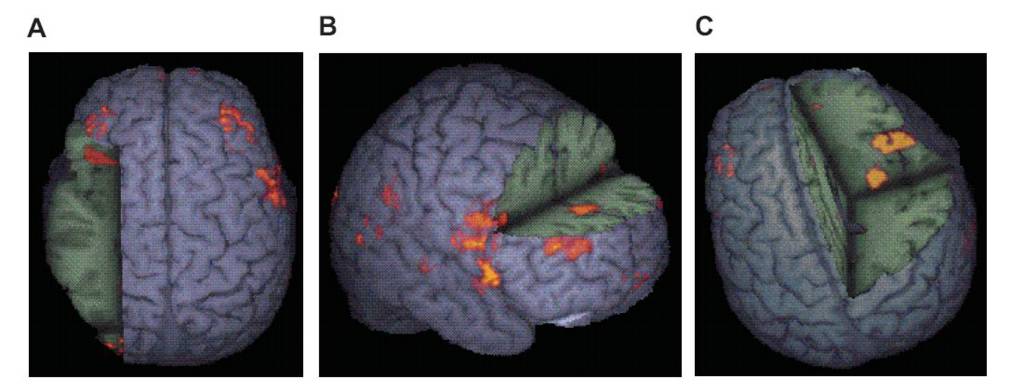
Click for larger view. From Rubia & Smith (2004), p. 331. Posted by Hello

Fig. 1. Generic brain activation map of 8 right-handed male adults (aged 22 to 40 years; mean age 29 years) while performing a sensorimotor synchronisation task of 5 s, after contrasted with a sensorimotor synchronisation task (finger tapping) of 0.6 s in a block design fMRI study. Subjects were instructed to time their motor response to the regular appearance of the visual stimuli on the computer screen. For good sensorimotor timing subjects had to monitor the time interval elapsed since the presentation of the last visual stimulus. The long event rate condition imposes a higher load on time estimation and motor timing compared to the short event rate condition. Areas shown are brain regions that showed significant greater activation during the synchronisation task of 5 s in contrast to finger tapping, presumably reflecting both time estimation and motor timing (corrected P<0.003).

Prefrontal Cortices


Prefrontal regions in both hemispheres have been associated with temporal processing of time scales up to minutes
9. Two regions of the prefrontal cortex, the dorsolateral and inferior prefrontal cortices, seem to be involved in different types of time-perception tasks. The dorsolateral appears to be active in both motor and non-motor tasks, while the inferior prefrontal cortex is largely associated with non-motor tasks. Rubia and Smith provide one explanation for the role of the prefrontal cortex in temporal estimation and motor timing tasks of longer intervals, writing:
Regions of the prefrontal cortex [may] have the function of a hypothetical accumulator within an internal clock model, which is required only with durations of more than several seconds. Indeed, prefrontal activation in timing tasks of durations of several seconds has often been related to other underlying functions besides pure timing processes, such as sustained attention to the time interval or working memory components. (p.332)
This view is confirmed by activity in the dorsolateral prefrontal cortex, an area associated with working memory and attention, during time perception. Other evidence comes from animal studies. Rubia and Smith write:
Single cell recordings in prefrontal cortex in monkeys have been shown to be in line with this hypothesis. In an attempt to disentangle timing and working memory processes in delayed response tasks, Fuster (1973) found that different neurons in the DLPFC of monkeys were cue-coupled, presumably related to the mnemonic content, while others were showing sustained activity, presumably reflecting temporal processes. (p. 333)
Thus, it appears that one of the primary roles of the prefrontal cortex in temporal processing is the interaction of working memory, attention, and timing. This close association between these three things will become important, in the next post, when we begin to look at the role of things like attention in the subjective perception of time.So, stay tuned until next time, when I'll get all cognitive on time.

1 Ivry, R.B., Keele, S.W., & Diener, H.C.(1988). Dissociation of the lateral and medial cerebellum in movement timing and movement execution. Experimental Brain Research, 73, 167–180, 1988.
2 Ivry R. B. & Diener H. C .(1991). Impaired velocity perception in patients with lesions of the cerebellum. Journal of Cognitive Neuroscience, 3, 355-366.
3Casini L., Ivry R.(1999). Effects of divided attention on temporal processing in patients with lesions of the cerebellum or frontal lobe. Neuropsychologia, 13, 10-21.
4 Coull, J.T., Frith, C.D., Buchel, C., & Nobre, A.C. (2000). Orienting attention in time: behavioural and neuroanatomical distinction between exogenous and endogenous shifts. Neuropsychologia, 38, 808–819; & Coull, J.T. and Nobre, A.C.(1998). Where and when to pay attention: the neural systems for directing attention to spatial locations and to time intervals as revealed by both PET and fMRI. Journal of Neuroscience, 18, 7426–7435, 1998.
5 Rubia, K. & Smith, A. (2004). The neural correlates of cognitive time management: a review. Acta Neurobiologica, 64, 329-340.
6 Riecker, A., Wildgruber, D., Mathiak, K., Grodd, W., Ackermann, H. (2003). Parametric analysis of rate-dependent hemodynamic response functions of cortical and subcortical brain structures during auditorily cued finger tapping: a fMRI study. Neuroimage, 18, 731-739; Rubia & Smith (2004).
7 Rubia & Smith (2004).
8Rubia, R., Overmeyer, S., Taylor, E., Brammer, M., Williams, S., Simmons, A., Andrew, C., Bullmore, E. (1998). Prefrontal involvement in ‘temporal bridging’ and timing movement. Neuropsychologia, 36, 1283-1293.
9 Casini, L., Ivry, R. (1999). Effects of divided attention on temporal processing in patients with lesions of the cerebellum or frontal lobe. Neuropsychologia, 13, 10-21.

Don't Blame Me, I'm Canadian

No, I'm not actually Canadian, but when I visit Europe, no one has to know that, thanks to these t-shirts. I'm definitely going to buy a couple for the next time I have to go to England.

Monday, December 06, 2004

Philosophers' Carnival VI: The Aussie Connection

The 6th Philosophers' Carnival is now up at Melbourne Philosopher. I can't really tell you which posts I like, because I haven't had time to read any except the ones I had read pre-carnival, including the one by Siris (which is good, as usual) and the one by Jason Stanley at the Leiter Reports. Jason's is interesting not for what it says, because what it says is bullshit, but for what the commentators (who include David Chalmers and Alva Noë) have to say about it. It's also interesting from a psychological perspective, for while someone studying philosophy of mind (like, say, David Chalmers or Alva Noë) will have noticed that philosophy of mind is thriving like it never has before, and with an ever-expanding focus to boot, a person who studies philosophy of language, as Jason does, may be so wrapped up in his own area that he fails to notice this. You can't really blame Jason for his myopia, though. That's the way things usually work when you spend most of your time reading the literature of a specialized area of a larger discipline (I suspect there are plenty of philosophy of mind people who think that philosophy of language has been on the decline since the 1970s).

Reasoning: Domain-General vs. Domain-Specific

One of the questions raised by the issues discussed in the first post on reasoning was: Is human reasoning domain-general or domain-specific? If you can answer this question definitively, you will be world famous, and I imagine someone will find a way to get you a Nobel Prize (they managed to get Daniel Kahneman one!). Obviously, I can't answer that question definitively, and the empirical research and theoretical arguments are a long way from being conclusive. In fact, the domain-general vs. domain-specific problem tends to rear its ugly head in all areas of reasoning, not just what traditionally falls under the rubric of "reasoning," and for the most part, it remains unsolved everywhere. However, since this is a series of posts on reasoning, I'm just going to focus on theories of domain-specific or domain-general reasoning mechanisms in reasoning research. While the domain-general view is the older view, I'm going to start with different domain-specific theories. After that, it's domain-general's turn. So, let's get started.

Domain Specific

The impetus for the development of domain-specific accounts of reasoning is not limited to errors and reasoning like those in the Wason selection task. The content of reasoning tasks can influence the way we reason in many different ways. For example, in one study, when asked to write addition and division word problems, the type of problem they wrote (either addition or division) depended on the content they were asked to include. If they were to use items from the same category, participants were more likely to write addition problems, while if the items were thematically related, they were more likely to write division problems. It's very difficult for traditional domain-general accounts of reasoning to explain thesephenomena. Thus, over the last couple decades, domain-specific accounts have begun to gain prominence.

There are a few different views of how and why reasoning is domain-specific. Perhaps the oldest (in cognitive science, at least), is the embodied cognition view, which is closely related to the phenomenology of philosophers like Edmund Husserl and Maurice Merleau-Ponty. A related view of domain-specific reasoning is the situated cognition perspective, which arose out of education theory and computer science. Finally, the most prominent domain-specific account of reasoning today comes from evolutionary psychology, which posits domain-specific modules that have evolved to solve specific types of problems. I'll briefly talk about these three different domain-specific perspectives individually.

I. Embodied Cognition

Embodied cognition is a pretty sweeping label for various views of cognition that see cognition as involving a tight coupling between an embodied organism and its environment. This view implies that environmental conditions, goals, and bodily makeup influence the structure of cognitive processes. Thus, there are few, if any domain-general reasoning mechanisms. For example, in J. J. Gibson's ecological approach to perception has been used by some theorists to explain how people learn and reason about objects in their environment. In particular, the concept of affordances is applied to reasoning situations, such that the way we reason about different objects in our environment depends on our goals and the actions that those objects afford. Another example, from empirical research, is the use of movement or the sensory-motor areas of the brain in solving what were previously seen as problems requiring abstract rules. For instance, when people complete a spatial reasoning task, movements consistent with the task facilitate performance. Thus, when performing tasks involving reasoning about routes between two points, people do better if they perform the movements involved in following the routes, and when performing tasks involving pointing to the location of an object after rotating away from the object, participants do better when they are blindfolded and allowed to actually rotate than when they are not blindfolded and mentally simulate the rotation1.

There are more than a few problems with the embodied cognition approach as it is currently formulated. One problem is that it is currently formulated in several different ways2, most of which are fairly vague. Another is that, while research like that on spatial reasoning described in the previous paragraph has shown that embodiment is important, and that we use our sensory-motor systems to aid in the solution of many types of reasoning problems, there has been very little research, and no non-linguistic research, attempting to show that all or even most cognition is "embodied" in the various senses that the embodied cognition approach posits. In fact, outside of spatial reasoning, the sort of reasoning likely to be most closely coupled with the sensory-motor system, there's almost no evidence outside of linguistics that reasoning is embodied.

II. Situated Cognition

The situated cognition approach is similar to the embodied cognition approach, but places more emphasis on the social environment. This perspective is heavily influenced by the work of Lev Vygotsky, and is similar to the pragmatism of people like Dewey. There are four primary features of the situated cognition view3:
(1) Action is grounded in the concrete situation in which it occurs.
(2) Knowledge does not transfer between tasks.
(3) Training by abstraction is of little use.
(4) Instruction must be done in complex, social environments.
Examples meant to demonstrate (1) often involve people being able to perform a certain task in the context in which it was learned, or is often used, but not in other (usually abstract) contexts. For instance, Carraher et al.4 reported that there were street children in Brazil who could perform complex calculations rapidly and accurately when selling items on the street, but were unable to perform the same types of calculations in the classroom environment. However, (1) is problematic because children are, in fact, able to use skills learned in school in non-school contexts. Thus, it does appear that learning can be tightly coupled with the learning context, but that this is not always the case, and it is possible to use knowledge in more than one type of situation. A similar criticism applies to (2) as well. While transfer between tasks is not always possible, there is a large body of research in which such transfer is demonstrated5.

Where (3) is concerned, it is true that in some cases, specific, task-oriented instruction is better than abstract instruction. However, abstract instruction is also valuable in many contexts, and task transfer is much more likely when instruction is abstract than when it is situation-specific. Finally, (4) claims that learning should be done with hard problems, in natural social situations. This is particularly true for tasks that are difficult and/or social to begin with, such as the distributed navigation tasks studied by Hutchins and his students6. However, this is not true for all situations. Often, particularly with children, overly complex problems cause frustration and a lack of motivation, which get in the way of learning. Similarly, there are benefits to both individual and social learning, and which type works better often depends on the type of information to be learned and the learner's goals.

III. Evolution and Modularity

The third, and currently most popular domain-specific view of cognition is the one that arose out of evolutionary psychology, and posits that different types of tasks activate different evolved modules. The most widely studied and discussed module is the cheater-detection module hypothesized in social exchange theory7. The primary evidence for the existence of a cheater-detection module comes from the Wason selection task research described in the first post. In addition to this empirical research, there are game-theoretic simulations and evolutionary stories that support the existence of cheater-detection modules. As Sugiyama, et al. wrote8:
Pressures favoring social exchange exist whenever one organism (the provisioner) can change the behavior of a target organism to the provisioner’s advantage by making the target’s receipt of a provisioned benefit conditional on the target acting in a required manner. This mutual provisioning of benefits, each conditional on the other’s compliance, is what is meant by social exchange or reciprocation.

Evolutionary biologists have shown through game-theoretic techniques that adaptations for social exchange can be favored and stably maintained by natural selection, provided they include design features that (i) enable them to detect cheaters (i.e., those who do not comply or reciprocate), and (ii) cause them to channel future benefits to reciprocators, not cheaters. (p. 11537)

There is also some neurological evidence, based on a patient with a severely damaged limbic system, for the neurological basis of a cheater-detection module9.

While both the embodied and situated cognition views seem to provide at least some insight into the nature of cognition, and indicate that in some cases, cognition is domain-specific, it's not clear that the social exchange theory can say the same. Almost all of the research on social exchange in human psychology involves either the Wason task or game-theory simulations. Given that Cosmides and her colleagues have been repeatedly criticized for completely misunderstanding the nature of the Wason task, and since it has been shown that relevance, rather than cheater-detection, maybe what creates improved performance in the task, it's hard to believe that the social exchange theory is still around, much less as popular as it is today. The evolutionary story described above is somewhat compelling, but it's just that, a story.

There is another view, which is not necessarily derived from evolutionary psychology, that agues for a modular, domain-specific view of cognition. This view, independent of the social exchange theorists, is championed by Sperber, who gives the following examples of domain-specific modules:
Avoidance of vertical drops: Human infants (and other baby animals also) perceive and avoid vertical drops in terrain, even if they have had no experience of falling before, as demonstrated by means of the well-known “visual cliff” experiments initiated by Gibson & Walk (1960). This is an obvious modular adaptation to a serious hazard facing animals moving on the ground. To be efficient, this particular module had better not depend on learning. It is as good an example of an innate cognitive module as one may ever hope to find.

The Garcia effect: Rats and other animals are innately equipped to develop an aversion to whatever type of food seems to have made them sick. This is a highly specialised one-pass-learning module. The outcome of such learning is a novel capacity, that of reacting with aversion to a specific kind of food. If the rat develops, say, three such aversions, then it has three distinct abilities. It could be that the learning process and each specific aversive reaction are all carried out by the same module: learning consisting in adding to the initially empty proprietary data-base of the module data about specific foods to be avoided. Or it could be that the learning process results each time in the setting up of a new module or sub-module dedicated to a specific aversive food. So, which is it: one general food-aversion module with a growing data-base, or a learning module producing as many micro-modules as there are aversions? This is an empirical issue that might be decided by answering questions such as the following: Do aversive reactions to different foods employ different detection procedures (as opposed to the same procedure using different data)? Does a new aversion recruit distinct brain tissues? Can the more general ability to generate new aversions and each of the more specific aversions be selectively impaired? Positive answers to such questions would suggest that to each new aversion corresponds a new mini-(sub)-module.

Face recognition: I assume that face recognition is modular (which is controversial, but see Kanwisher & Moscovitch 2000). If so, we are dealing, as in the case of the Garcia effect, with two types of modular abilities: a general learning ability to form specific abilities to detect specific faces. Is there a general face-recognition module that performs both functions or are individual-face-detectors developed as autonomous mini-(sub)-modules? This is an empirical question to which we do not have an answer. As in the case of the Garcia effect, these are nevertheless genuinely distinct possibilities involving subtle differences in the way these abilities may be carried out and impaired.

Language faculty and linguistic competences: The language faculty is a complex learning module that, given proper linguistic and contextual inputs, yields one or, in the case of plurilinguals, several mental grammars. Each of these grammars is itself a complex module subserving both verbal coding and decoding in a given language. Each mental grammar has a distinct developmental story, and can selectively decay or be impaired. It is plausible that, say, the two mental grammars of a bilingual individual are sub-modules of a more general mental universal grammar and, as such, share some resources (Dehaene et al. 1997, Kim & al. 1997).

Reading : Reading is too recent a cultural skill for a specialized innate module to have evolved. Yet reading systematically involves the same brain site located in the left occipito-temporal sulcus and sometimes described as the “visual word form area.” Dehaene speculates that “the human brain can learn to read because part of the primate visual ventral object recognition system spontaneously accomplishes operations closely similar to those required in word recognition, and possesses sufficient plasticity to adapt itself to new shapes, including those of letters and words. During the acquisition of reading, part of this system becomes highly specialized for the visual operations underlying location- and case-invariant word recognition. … Thus, reading acquisition proceeds by selection and local adaptation of a pre-existing neural region, rather than by de novo imposition of novel properties onto that region” (Dehaene, forthcoming). Reading skill can be viewed as resulting from a process of ad hoc modularisation of already specialised brain tissues.

As Sperber notes, some of the modules he posits are controversial. This is particularly true of certain views of the language module, and the face-recognition module, though neuroscientific research unequivocably indicates that face-recognition is occuring in brain regions that don't perform general object recognition (e.g., the right middle fusiform gyrus)10. Still, it's not clear from the research cited by Sperber and others just how modular the mind is (Sperber believes that it is massively so), or whether there are some domain-general rules for reasoning. It's also not clear that the evolutionary explanations offered for other modules are needed to understand the sorts of modules Sperber discusses.

Domain General

As the previous section makes clear, even if the current domain-specific theories of reasoning and cognition in general are lacking in many ways, theorists who believe that reasoning uses domain-general processes have a lot of data to explain. One way to do this is to posit that domain-specific differences that appear to be differences in processes are actually representational differences. For instance, in one of the most prominent computational models of reasoning, the ACT-R model11, reasoning performance is partially determined by the structure of semantic memory. Furthermore, research on schematic memory has shown often that the types of inferences that we can make about things is largely determined by the structure of our representations of those things.

Another way to explain domain-specific effects in the literature is to refer to the distinction between active processing and automaticity12. When people are learning how to perform a particular task, or to solve a particular type of problem, they tend to use domain-general processes. However, as they repeatedly encounter the same type of task, it becomes economical to store successful solutions as a whole. After these solutions are stored, people no longer need to use domain-general processes to solve those problems. Instead, they can simply retrieve the previously stored solution. There is a great deal of evidence for the the shift from active processing to automaticity, though it may not explain all of the instances of domain-specific processing. Furthermore, this shift isn't always helpful. Sometimes, this shift can be counterproductive, as when previous solutions make it difficult to discover new solutions to similar problems.

Thus, we're back where we started. There are cases that seem to entail domain-specific processing, but there may be domain-general explanations of those cases. Furthermore, domain-specific processes may actually be learned by using domain-general processes and storing specific solutions derived with them. Certainly there are some domain-specific modules in the brain, including some of the ones Sperber described in the passage quoted above. However, because there is no conclusive evidence for a general view of cognition from either perspective, and since both tend to be able to explain the bulk of the data available, we're just going to have to wait for anything like a definitive answer.

You may be thinking that I paid a lot more attention to domain-specific views than to domain-general ones. One reason for this is that I wanted to get in the criticisms of domain-specific views, which come from the domain-general camp. The other is that the next two posts, the one on categorical and analogical reasoning, and the one on mental models, will be largely from the domain-genera lperspective, and thus will in essence be lengthy descriptions of domain-general theories. So, if you waded through all that domain-specific stuff just to get to the domain-general theories, I'm sorry, but you're going to have to wait.

1 Glenberg, A. (1997). What memory is for. Behavioral and Brain Sciences, 20(1), 1–55.'
2 See this paper by Margaret Wilson for a description of 6 different senses of "embodied cognition."
3 Quoted from Anderson, Reder, & Simon(1996). Situated learning and education. Educational Researcher, 5-11.
4 Carraher, T. N., Carraher, D. W., & Schlieman, A. D. (1985). Mathematics in the streets and in the schools. British Journal of Developmental Psychology, 3, 21-29.
5 Anderson, et al. (1996); Perkins, D. N., & Solomon, G. (1989). Are cognitive skills context-bound? Educational Researcher, 18(1), 16-25.
6 See here for a short description of this research.
7 Cosmides, L. & Tooby, J. (1992). Cognitive adaptations for social exchange. In J. Barkow, L. Cosmides, & J. Tooby (Eds.), The adapted mind: Evolutionary psychology and the generation of culture. New York: Oxford University Press.
8 Sugiyama, L., Tooby, J. & Cosmides, L. (2002).Cross-c ultural evidence of cognitive adaptations for social exchange among the Shiwiar of Ecuadorian Amazonia.
Proceedings of the National Academy of Sciences, 99(17), 11537-11542.
9 Stone, V., Cosmides, L., Tooby, J., Kroll, N. & Knight, R. (2002). Selective impairment of reasoning about social exchange in a patient with bilateral limbic system damage. Proceedings of the National Academy of Sciences, 99(17), 11531-11536.
10 Rossion, B.; Schiltz, C., Robaye, L., Pirenne, D., Crommelinck, M. (2001). How does the brain discriminate familiar and unfamiliar faces: a PET study of face categorical perception. Journal of Cognitive Neuroscience, 13, 1019-1034.
11 Anderson J. R.. 1993. Rules of the Mind. Hillsdale, NJ: Erlbaum; Anderson J. R.; & Lebiere C., eds. 1998. The Atomic Components of Thought. Mahwah, NJ: Erlbaum.
12 See e.g., Markman, A. B. & Gentner, D. (2001). Thinking. Annual Review of Psychology, 52, 223-247.

Sunday, December 05, 2004

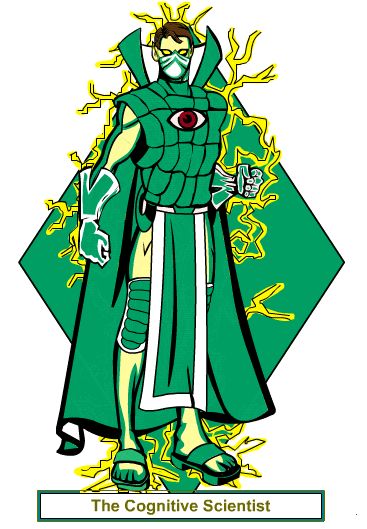
The Cognitive Scientist

After seeing Dr. Pharyngula, I had to make my own superhero using the Hero Machine. I got a little carried away, though, and instead of having a down-to-earth, scientist-like superhero like Dr. Pharyngula, or one that resembles me in the least. It probably doesn't help that I don't read comic books, so I really don't have a comic book superhero image schema to work with, but who cares? So without further ado, I present to you (drum roll)... The Cognitive Scientist!

Posted by Hello


For more blog superheroes, check out Super Majikthise, and the links she provides.

Saturday, December 04, 2004

By Request: Reasoning

In my most recent plea for requests, Richard asked:
How does reasoning work?
What a question! You could pretty much reword it as, "How does cognition work?" Clearly, I'm not prepared or qualified, much less capable of answering that question sufficiently. Fortunately for me, Richard got more specific, writing:
For example, from beliefs that P, and that P->Q, what causes us to then believe Q?
and
Other stuff about the gap between normative logic and how people *actually* reason would be interesting too - ya know, all those fallacies and such that we fall for.
He also referenced this good little post from Jonathan Ichikawa, which raises a whole other set of issues. So, my task isn't an easy one, but I'm going to try to post on reasoning as best I can. The different topics that these short questions envoke are numerous, and I don't think I can write about them all, at least not in the near future. Obviously, there's the difference between deductive and inductive reasoning, then there are issues and subissues like domain-general vs. domain-specific processes, mental models (which Jonathan's post alludes to, consciously or not), causal and counterfactual reasoning, heuristics and biases, analogical reasoning, categorical inference, probabilistic reasoning, conditional reasoning, etc. It's hard to know exactly how to touch on all of these, or even most of them, in a blog post (or series of posts), and I've spent some time trying to decide how I should do it. The solution I've come up with is to basically wing it. However, I have decided on a definite starting point. The starting point is Richard's last request, the one about errors in reasoning. I think that if we start here, we'll start to see many of the other issues emerging, and the ones that don't emerge we can get to eventually. So, let's get started.

Wason Selection Task

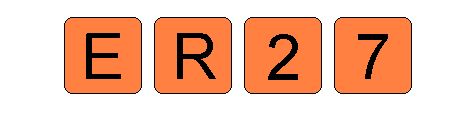
An interesting and informative place to start, when looking at errors in human reasoning, is the Wason selection task1. Imagine you are given the following two-sided cards:

Posted by Hello


You are then given the this rule: If there is a vowel on one side of a card, then there is an odd number on the other side. If you are asked to select the minimum number of cards, which cards would you need to check to determine if this rule is true? Almost everyone picks the "E" card, when given this task. However, what other card(s) should you check? Ninety percent of participants select either only "E," or select "E" and "7." Almost no one selects the R. Those of you with a background in logic will immediately notice the problem with both of those elections. Yes, you should check "E," because if there is an even number on the other side of "E," then the rule is false. This is a simple instantiation of modus ponens. Also, participants are correct in not selecting the "R." The rule says nothing about what should be on the other side of a consonant. However, "7" is irrelevant. If there is a vowel on the other side, then the rule can still be true, but if there is a consonant on the other side, then we haven't learned anything. Participants who select the "7" are committing the common fallacy of affirming the consequent. Instead, people should select the "2," because if there is a vowel on the other side of the "2" card, then the rule is false. This is the rule modus tollens.

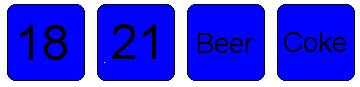
Why are people so bad at this task? A common answer, when this task was first used, involved modus ponens being an easier rule to learn than modus tollens, a fact to which anyone who has ever taught a logic course can attest. Some even hypothesized that modus ponens is an innate rule, while modus tollens is not. However, the picture gets muddier. Imagine the problem had been given with the same structure, but different content. For instance, imagine you had been given the following cards instead:

Posted by Hello


Then you receive the following rule: If a person is under 21, she cannot drink beer. Given that you have to select the fewest possible cards to make sure that the rule is being followed, which cards would you select? When given this task, almost all participants select "18" and "Beer," and very few select "21" or "Coke." Why is it that, when the content is changed to a familiar rule, participants are able to select the correct cards, utilizing both modus pollens and modus tollens? This certainly calls the learnability and innateness hypotheses into question.

Some have argued that the differences in performance on the two versions of the Wason selection task indicate a need for a focus on domain-specific theories of reasoning, rather than the traditional domain-general theories that are embodied in the abstract rules of deductive reasoning. For instance, Cosmides and her colleagues2 have theorized that in the sort of thematic version of the Wason task in the second example above, a cheater detection module, developed through evolution, is activated. Under their view, people are innately programmed to detect deception in situations where cheating is likely, and when this ability is activated in the Wason task, people are easily able to reason correctly. However, this view has been heavily criticized from several directions. Some3 have argued that Cosmides and her colleagues misunderstand the Wason task, and the second version (ages and beer) is actually a different type of task altogether. Furthermore, research has shown that even when cheater detection scenarios are not involved, people perform much better at the Wason task when the content is thematic, or familiar, than when it is abstract or unfamiliar4. This suggests that instead of activating a domain-specific module (e.g., a cheater detection model), the thematic Wason tasks activate background knowledge, and this makes the task much easier. Still, the exact reason for the differences in performances is still being hotly debated, and touching on the debate foreshadows a lot of what I will talk about in future posts.

Before we move on, there's one more interesting fact about performance on the Wason selection task that is worth mentioning. Imagine the first version of the selection task, with the letters and numbers, but with a "reduced array." In this case, the two choices that participants have no problem with, namely the "E," which they almost always select, and the "R," which they almost never select, are removed. In this case, participants do very well, almost always selecting the "2." One explanation for this result is that participants aren't viewing the task as an abstract, deductive reasoning task at all. Instead, they are viewing it as a categorization task. Here is a more thorough description of this explanation, from Margolis:
This odd, even bizarre, improvement can be explained if subjects are seeing the cards not as particular cards but as indicating categories of cards. If explicitly asked, subjects understand the intended meaning of the question. But their responses make logical sense only with respect to a drastic misreading of the question. The question is misread as being about which categories of cards should be examined; for example, any cards with a [vowel] on either side; rather than about the particular card shown with a [vowel] on its upside.
This misperception, Margolis argues, is a product of the "pragmatics of language," writing:
In everyday conversation, even logicians rarely use phrasing like "if and only if" (iff) to distinguish this "if/then" relation from "if but not only if" (if). Distinguishing between "if" and "iff" is almost always left to context. But the basic Wason problem provides so little context that if/then here could be interpreted
either way.
Another explanation comes from decision theory. For instance, some have argued that using a Bayesian decision making process, participants' selections make sense in terms of information gained5. Here's a description of this view:
Care selected on the basis of their informativeness. The informativeness of each card is a function of the probability of the items mentioned in the rule. Under an assumption of rarity, i.e. that P(p) and P(q) are low, the A and 3 cards are most informative, the 7 card is less informative and the D card provides no information whatsoever. The approach captures the intuitive judgement that it is more sensible to look for ravens or black things when testing the rule "All ravens are black" in the classic Ravens Paradox.
The message to take away from both these views is that contrary to previous explanations, people aren't actually behaving irrationally when they select the "incorrect" answers in the original Wason task. These views are still not widely heald among cognitive scientists, but they are certainly worth noting.

Heuristics and Biases

Throughout history, humans have been seen as rational beings. This ability to use reason, it has long been believed, is one of the major distinctions between humans and the other animals. Most economic theory has traditionally been based on this assumption. However, in the 1940s and 50s, researchers began to notice that people didn't always behave rationally (and in fact, when rationality is equated with optimality, as it usually is in economics, they rarely behaved rationally)6. Several different theories were derived to attempt to account for human irrationality, without leaving behind the assumption that humans really are rational (e.g., Bayesian decision theories and the still popular bounded rationality perspective). Then came a couple guys by the name of Amos Tversky and Daniel Kahneman. They argued that the old view of human rationality could not be salvaged, given all the examples of suboptimality. Instead, it was time to take an entirely different approach to bounded rationality. As Gilovich and Griffin put it:
Although acknowledging the role of task complexity and limited processing capacity in erroneous judgment, Kahneman and Tversky were convinced that the processes of intuitive judgment were not merely simpler than rational models demanded, but were categorically different in kind. Kahneman and Tversky described three general-purpose heuristics – availability, representativeness, and anchoring and adjustment – that underlie many intuitive judgments under uncertainty. These heuristics, it was suggested, were simple and efficient because they piggybacked on basic computations that the mind had evolved to make. Thus, when asked to evaluate the relative frequency of cocaine use in Hollywood actors, one may assess how easy it is to retrieve examples of celebrity drug-users – the availability heuristic piggybacks on highly efficient memory retrieval processes. When evaluating the likelihood that a given comic actor is a cocaine user, one may assess the similarity between that actor and the prototypical cocaine user (the representativeness heuristic piggybacks on automatic pattern-matching processes). Either question may also be answered by starting with a salient initial value (say, 50%) and adjusting downward to reach a final answer.

In the early experiments that defined this work, each heuristic was associated with a set of biases: departures from the normative rational theory that served as markers or signatures of the underlying heuristics. Use of the availability heuristic, for example, leads to error whenever memory retrieval is a biased cue to actual frequency because of an individual’s tendency to seek out and remember dramatic cases or because of the broader world’s tendency to call attention to examples of a particular (restricted) type. Some of these biases were defined as deviations from some “true” or objective value, but most by violations of basic laws of probability. (p. 3)
Thus, instead of reasoning with abstract logical rules, people are using heuristics and their associated biases, which can, under some circumstances, lead to suboptimality. Since the heuristics and biases program was first formulated, research on the different heuristics and biases has formed an extremely large literature, spanning several disciplines. It would be silly to try to describe all of this research, so, given the original request (all those fallacies and such), I'm going to focus on a particular example, the conjuction fallacy. This fallacy occurs when people assign a higher probability to the conjunction of two events than than they assign to the events individually. The often-cited version of this fallacy from the literature goes something like this7:
Linda is 31 years old, single, outspoken, and very bright. She majored in philosophy. As a student, she was deeply concerned with issues of discrimination and social justice, and also participated in anti-nuclear demonstrations.
After reading this, participans were presented with the following possibilities, and asked which is more probably:
(1) Linda is a bank teller.
(2) Linda is a bank teller and is active in the feminist movement.
Given the above description of Linda, participants overwhelmingly selected (2), despite the fact that this is a conjunction of (1) and another property. Thus, they rated the conjunction as being more probably than one of the instances alone, thereby committing the conjunction fallacy. Tversky and Kahneman explain this by reference to one of their heuristics, the representativeness heuristic. They argue that participants see the properties attributed to Linda as being representative of feminists, and therefore are more likely to believe that Linda is a feminist. The use of this heuristic causes them to commit what is a logical error, given the formal nature of probabilities, but which is likely to be a practical belief nonetheless.

More recently, another version of the conjunction fallacy has been demonstrated. This version is sometimes called the "disjunction fallacy," though it is logically identical to the conjunction fallacy. Here is a description of this fallacy, from the abstract of Bar-Hillel and Neter (1993)8:
This study demonstrates a violation of the rule in a context that justifies the label disjunction fallacy. Subjects received brief case descriptions, and ordered seven categories according to one of four criteria for including the case as a member of the category : 1. probability of membership ; 2. willingness to bet on membership ; 3. inclination to predict membership ; 4. suitability for membership. The category list included nested pairs of categories, such as Brazil and South American country, or Physics and A Natural Science. The more inclusive category was a union of basic level sets like the smaller category. From a normative standpoint, the first two criteria are equivalent, and either ranking a category as more probable than its superordinate, or betting on it rather than on its superordinate, is fallacious. On the other hand, inclination to predict may be guided by the desire to be maximize informativeness rather than merely likelihood of being correct, and suitability needs to conform to no formal rule. Hence, with respect to these two criteria, such a ranking pattern is not fallacious. In spite of this crucial difference, subjects in all four groups rendered highly similar judgments, and the ranking of categories higher than their superodinates was not lower when it amounted to a fallacy than when it did not.
The heuristics and biases program has, over the last decade or two, come under a great deal of criticism, but for the most part its hypotheses have stood up well under empirical pressure. One thing we can be sure of is that humans often reason not with logical rules, but with automatic and largely unconscious heuristics, and perhaps biases, that cause them to perform in ways that at least appear fallacious. Even if we can redescribe some of the problems the heuristic and biases program is meant to explain with, e.g., Bayesian probability, or some other version of bounded rationality, the fact remains that people do not always behave optimally, and this suboptimality can be at least partially explained by the failure to stick to the formal rules of logic or probability.

So, we've now got two different sets of reasons for human behavior failing to conform to normative reason. In the next few posts, we'll look at some of the issues human suboptimality and irrationality raise. In the next post, I'll talk about domain-general vs. domain-specific theories of reasoning in more detail. After that, we'll get into reasoning from background knowledge, which includes categorical and analogical reasoning. Finally, I'll try to summarize the mental models view of reasoning, which will touch on a wide range of types of reasoning (from deductive to causal). Stick around.


1 Wason, P.C. (1966) Reasoning. In B. M. Foss (Ed.) New Horizons in Psychology I. Penguin.

2 Cosmides, L. (1989). The logic of social exchange: Has natural selection shaped how humans reason? Studies with the Wason selection task. Cognition, 31, 187-276. See also Fiddick, L., Cosmides, L., & Tooby, J. (2000). No interpretation without representation: The role of domain-specific representations in the Wason selection task. Cognition, 77, 1-79.
3 E.g., Sperber, D. & Girotto, V. (2002). Use or misuse of the selection task? Rejoinder to Fiddick, Cosmides and Tooby. Cognition, 85(3), 277-290; Fodor, J. (2000). Why we are so good at catching cheaters. Cognition, 75(1), 29-32, and The Mind Doesn't Work That Way: The Scope and Limits of Computational Psychology by Jerry Fodor. For a rejoinder to Fodor, see Beaman, C. P. (2002). Why are we good at detecting cheaters? A reply to Fodor. Cognition, 83(2), 215-20.
4 E.g., Sperber & Girotto, 2002.
5 Oaksford, M & Chater, N. (1994). A rational analysis of the selection task as optimal data selection. Psychological Review, 101, 608-631, and Oaksford, M., Chater, N., Grainger, B. & Larkin, J. (1997). Optimal data selection in the reduced array selection task (RAST). Journal of Experimental Psychology: Learning, Memory & Cognition, 23, 441-458.
6 Notice that the belief that humans are rational (in the sense of optimality) is required for the Buridan's Ass problem discussed in previous posts to make sense. If humans generally behave suboptimality, the problem dissolves away.
7 Tversky, A. and Kahneman, D. (1983). Extension versus intuititve reasoning: The conjunction fallacy in probability judgment. Psychological Review, 90, 293-315.
8 Bar-Hillel, M. & Neter, E. (1993). How alike is it versus how likely is it: A disjunction fallacy in probability judgements. Journal of Personality and Social Psychology, 65, 1119–1131.

State of the Blog

(With apologies to Clark for stealing his post title).

This blog turned 3 months old yesterday. It also got its 3000th visitor recently. I have to admit, both are more than expected. Three months and 3000 visitors may not seem like a whole lot, especially in a year when blogs have become so popular that the word "blog" itself has topped Merriam-Webster's words of the year list, but it seems like a lot to me. I jumped into the blog on a whim, really, and had no idea where I would go with it. I really never thought I'd last past the election. In the process of lasting three months, I've discovered several great blogs, most of which are, unfortunately, underread. I've also gotten some great comments (I don't think I've really gotten a bad comment yet), and met some very cool blogospheric neighbors. I still like some of the big blogs, like Crooked Timber, Deltoid, Leiter Reports (though I have to admit I was so impressed with the posts by the Stanley brothers when they were visiting bloggers that Leiter's own posts have lost some of their appeal), and Majikthise (her blog reads like a small blog, but it's definitely a big one from within my frame of reference), but I have to admit that the first blogs I read, these days are the great little ones, such as Siris, Philosophy, etcetera, Mormon Philosophy & Theology (a fact that must baffle my friends who know me as a staunch secularist), Semantic Compositions, and the others over there in the blogroll. All in all, it's been a good experience, and a great way to write something everyday (when my computer works) that doesn't require writing, rewriting, and more rewriting just to be submitted, rejected, rewritten again, resubmitted, conditionally accepted, and... well, you get the picture.

Hopefully, as the blog grows, and I become better at the whole blogging thing, the people who read this blog now will continue to do so. Perhaps I'll even attract new readers, though I'm not terribly worried about that. I kind of like the blogosopheric community that I've forced my way into already. So, thanks to everyone who reads and comments, and thanks to all of the bloggers whose posts are better than mine (i.e., all of you) for giving me something interesting to read everyday. Remember, I'm always open to suggestions, criticisms, requests, comments, and unqualified, glowing praise.

UPDATE: Oops, I should have listed Pharyngula as one of those big blogs that I still really enjoy (not that anyone really cares that I excluded it). Seriously, when Myers posts on biology, is there any better blog out there? Sure, his posts on politics are sometimes not much better than my own (which is saying a lot!), but the biology is top shelf. I wish I could post about my discipline as well as he posts about his.

Friday, December 03, 2004

Gay Marriage Arguments

Since I've been away with computer problems (which persist), Keith Burgess-Jackson, the aptly or inaptly (depending on what you take it to mean) self-described AnalPhilosopher has been working hard to come up with an argument against legalizing gay marriage, while attempting to impugn liberals for their argument style(s). His anti-gay marriage arguments have been all over the place, so far, with the original being a strange comparison between gay marriage and both dogs voting and men having abortions, an "argument" which I addressed here, and Richard of Philosophy, etcetera addressed here. Since then, he's gone through a few arguments. One was essentially that judges shouldn't be able to force people to do things they don't want to, like accept gay marriages (I'll leave that absurd argument untouched). Currently, he is arguing (apparently through an ignorance of the history of marriage) that marriage's only purpose is to facilitate child-rearing. The basic argument is that only people who are likely to have children should be able to marry, straight couples are much more likely than gay couples to have children, and therefore only straight couples should be allowed to marry. It's not clear what this means for sterile couples (B-G argues that they should be included in the law because there's no easy way to exclude them, but that seems pretty arbitary to me), nor is it evident, to me at least, that if gay marriage were legal, gay married couples would be much less likely than straight couples to have children. Still, that's his argument. Fortunately, Richard has torn this argument apart for us here. Unfortunately, B-G's arbitary, if not absurd arguments, be they about dogs voting or child-rearing, are likely to be more convincing to the anti-gay marriage crowd than any rational, non-arbitrary arguments offered by Richard or others.

Buridan's Ass Takes a Random Walk

Despite my best efforts not to, I've been thinking a bit about Buridan's Ass over the last couple weeks. At first, I saw it as a complete non-problem, and said so in this post. Now, I see it as a problem, but wonder if the human brain has a way around this sort of problem. The issue seems to be whether there is some randomness in choice, and where that randomness comes from. Neurath's solution is to flip a coin, or use some other random decision-making process. However, this external randomness has its problems. An ass, for instance, is not going to flip a coin, and therefore, according to the way the problem is formulated, should still starve to death. Also, as Joe at Third Floor notes, the coin-flip solution just raises another Buridan's ass problem. He writes:
One argument that seems like a good one for undermining choice without preference is the solution of Otto Neurath article by Michael Stoltzner Chris suggested in his post. In the article (p. 12ff), Stoltzner suggests that an auxiliary motive - drawing lots, flipping a coin - is a way around the problem. But Stoltzner has not considered the new problem that results from introducing the auxiliary motive. If two different auxiliary motives leave things completely to chance, then which of the many different auxiliary motives should I use to determine my choice. For example, S seems to have no preference about auxiliary motives - flipping a coin is just as good as drawing lots. If S has his choice between drawing lots and flipping a coin and he has no preference about which he should use, then we have a new problem of choice without preference. So, Neurath's suggested conclusion seems to fail too.
Still, if the brain itself imputes some randomness into the decision-making process, then the second Buridan's ass problem, the problem of which random method to use, wouldn't arise. In other words, what we need is some internal, rather than external randomness. Here's an analogous problem to illustrate how the brain might have its own randomness. Imagine we are presented with an exemplar that fits our criteria for classification into two categories equally, but we have to classify it into only one category (this is the sort of task that experimenters use all the time in concept research). In most cases, humans will eventually classify the exemplar as being a member of one of the two categories, but how? One answer is that classification uses a random-walk procedure (a procedure present in several current models of categorization and decision making, as well as neuroscientific models of neuron firings). With this procedure, only one option can reach the threshold first, even when two classifications are equally likely to reach the threshold. Thus, the exemplar can be classified in only one category if that's the task at hand.

The same could work in a choice without preference situation. Even if both potential options are equally attractive, if we are motivated to choose only one, then using a random-walk model, only one of the options will be chosen. The random-walk procedure (which, as I've said, is common in cognitive models, as well as neuroscientific ones) thus imputes randomness into the decision making context without having to use an external source (e.g., a dice throw).

Sunday, November 28, 2004

If TCS Thinks It's Not Worth Publishing...

How bad must it be? Well, just ask John Ray, who's recently rejected essay containing all you ever wanted to know about women, or male-female relationships, can be found right here, and it comes from, well, a self-proclaimed expert, so you know it's true. Nevermind that his whole evolutionary story contradicts what we actually know about male and female sexual behavior, or even the hypothesized evolutionary reasons for what we know, or that his advice seems like it comes from someone who's never actually met a woman. Pay particular attention to the part about most women wanting to be dominated. One wonders whether Mr. Ray has heard of the concept of projection. All in all, it's fascinating in a "back away, slowly" sort of way. And it appears that back away, slowly, is just what Tech Central Station, not exactly known for its intellectual rigour, did.

Saturday, November 27, 2004

By Request: Cognitive Science of Humor

Much like creativity in general, the cognitive aspects of humor haven't been widely studied. While general creativity was viewed as difficult to study for reasons related to the view, among scientists at least, that creativity was a relatively rare and isolated phenomenon, I'm not quite sure why humor has been neglected by cognitive scientists. Still, there is some research, some of it bad, some of it good, mostly arising out of the field of computational linguistics. The general finding is that humans are funny, while computational linguists are not. Aaaanyway, I'm going to try to describe a few of the psychological theories of humor in this post. Humor is by no means my area of expertise, so if I miss something, and someone out there notices it, please let me know. As you're probably aware, humor has two primary aspects, a cognitive one and an affective one. Here I'm going to deal primarily with the cognitive aspect, and therefore won't be getting into issues related to things like the health benefits of humor and laughter.

The best place to start, with humor, is the brain. I'm not always comfortable talking about cognitive neuroscience, because there's so much bad cognitive neuroscience research, and because, as my neuroscientist friends are fond of reminding me, I'm not a neuroscientist, but in this case, the neuroscience will help situate the subsequent discussion at the representational level. When we hear a joke, brain activation follows a predictable sequence. Depending on the type of joke, different areas of the left hemisphere associated with language processing, and in some cases, ambiguity resolution are activated first. These include the left and right posterior middle temporal gyrus and the left posterior inferior temporal gyrus for semantic jokes, and the left posterior inferior temporal gyrus and left inferior frontal gyrus, areas associated with phonological processing, for puns1. After the joke is processed cognitively in these cortical areas, another set of brain regions, primarily subcortical, begin to become active. These include the nucleus accumbens and the ventral tegmental area, both part of the mesolimbic pathway, which is associated with things like addiction. Activation is also seen in the amygdala, a brain structure associated with emotion2.

There's not going to be a test on the brain structures, but there are three important lessons to be gleaned from the neuroscience research on humor. They are:
  1. The cognitive and affective components of jokes are reflected in the different brain areas that are activated, with humor activating areas used for language processing, reward, and emotion.
  2. The time course of activation, as we would expect, goes from cognitive areas to affective areas.
  3. Some of the cognitive areas activated by jokes are associated with ambiguity resolution. The importance of this will become clear in a bit.
As you've probably realized by now, the neuroscience research on humor has dealt primarily with verbal (spoken and written) jokes. However, it's likely that nonverbal humor follows a similar time-course, with other cognitive areas of the brain activated prior to activation of the reward and emotional areas. But that's enough about the brain. Let's move on to theory.

The earliest modern psychological theory of humor, of course, was Freud's. As you might expect, Freud thought humor had to do with sex (for more on Freud's theory of humor, see here). Later theories saw humor as a means of disparagement, or reaffirming superiority. Today, most theories, particularly in cognitive science, involve incongruity resolution (Freudian theories, usually called arousal-relief, or just relief theories, are still used by some nonscientists, as are disparagement theories). The gist of the incongruity-resolution account of humor is that we find things humorous when they involve the combination of incongruous parts. Here's an often quoted description of this theory:3:
Laughter arises from the view of two or more inconsistent, unsuitable, or incongruous parts or circumstances, considered as united in one complex object or assemblage, or as acquiring a sort of mutual relation from the peculiar manner in which the mind takes notice of them.
Graeme Ritchie, a computational linguist, has distinguished two types of incongruity-resolution theories prominent in the literature, the surprise disambiguation and two-stage types, and describes them as follows4:
Surprise disambiguation: The set-up has two different interpretations, but one is much more obvious to the audience, who does not become aware of the other meaning. The meaning of the punchline conflicts with this obvious interpretation, but is compatible with, and even evokes, the other, hitherto hidden, meaning.

Two-stage: The punchline creates incongruity, and then a cognitive rule must be found which enables the content of the punchline to follow naturally from the information established in the set-up. (p. 2)
Ritchie includes the most popular theory today, Raskin's Semantic Script-based Theory of Humor5, as a version of the surprise disambiguation view of humor. Because it is the most influential incongruity-resolution theory today, I'll focus on it in elaborating on the incongruity-resolution view.

In Raskin's theory, humor involves the activation of two opposing scripts, such as sex/no sex, good/bad, money/no money, possible/impossible, real/unreal, etc. Humor arises when one of two opposing scripts is activated, followed by the activation of the second opposing script, creating ambiguity. Thus there are three stages. In the first stage, one script (or schema) is activated. In the second stage, information that is incongruent with that schema is activated, creating ambiguity. In the final stage, the ambiguity is resolved. To see how this works, here is an example used by Raskin:
The first thing that strikes a stranger in New York is a big car.
According to Raskin, this sentence is processed in such a way that the meaning of the word "strikes" which is first activated is the one indicating surprise, followed by the activation of the collision meaning of "strikes" after reading "a big car." With these two meanings active at the same time, ambiguity is created, and it is the resolution of this ambiguity, or incongruity, which causes the sentence to be humorous. In a more recent version of Raskin's theory, called the General Theory of Verbal Humor6, the incongruincy-resolution aspect of the theory is accompanied by "knowledge resources" designed to allow for the influence of things like context, reasoning processes, text-comprehension processes, etc. Still, the primary aspect of humorous texts/situations which distinguishes them from non-humorous ones is the ambiguity, or incongruity, which must be resolved.

In recent years, various reworkings of Raskin's theory by other researchers have been proposed. For instance, in cognitive linguistics, Coulson7 has proposed a theory in which two incongruous mental spaces are activated at once, and resolved in the blend. Veatch has proposed a theory with three components:
1) V Something is wrong. That is, the perceiver thinks that
things in the situation ought to be a certain way -- and
cares about it -- and that is Violated.
2) N The situation is actually okay. That is, the perceiver has
in mind a predominating view of the situation as being Normal.
3) Simultaneity Both occur at the same time. That is, the N and V understandings
are present in the mind of the perceiver at the same instant.
Veatch describes the gist of the theory this way:
So humor is emotional pain that doesn't actually hurt. Or a violation that you care about, overlaid with the conviction that everything is normal (either good or neutral, but not bad).
Unlike Raskin and most others, Veatch's theory is explicitly designed to account for nonverbal humor. In fact, one of his favorite examples is peekaboo. Also, it is meant to account for the affective components of humor, which are dealt with only cursorily in most other incongruity-resolution theories. Still, Veatch is a linguist, like the other theorists mentioned so far, and thus he has yet to test his theory empirically. In fact, because the cognitive scientists who've constructed theories of humor have almost all been linguists, there has been very little empirical testing of even the basic assumptions of these theories, such as the activation of competing scripts/schemas, or the need for the resolution of ambiguity. I, on the other hand, am not a linguist, and my first inclination is to look for data. So, I searched and searched, and found some. I'll briefly describe one set of experiments related to the incongruity-resolution models discussed so far, though it will not provide any evidence to decide which theory is better. I'll then describe some research in other areas of cognition that might be relevant to theories of humor, but which hasn't been incorporated into the theories thus far.

In a set of experiments, Vaid et al.8 presented participants with visually presented verbal jokes, and primed the two opposing meanings at different times during the presentation, either after reading the set-up, in the middle of the joke, or after the punchline had been read. Most incongruincy-resolution models would predict that, initially, only the set-up meaning would be activated, while at some point after encountering the incongruous information, both meanings would be active at the same time, forcing a resolution. Vaid et al.'s priming data supported this view. When primes were given at the beginning of the joke, only the first meaning showed a priming effect, indicating that only it, and not the second, incongruous meaning, was active. At the intermediate position, both the first and second meanings showed priming effects, indicating that they were both active simultaneously. Finally, after viewing the joke for an extended time, only the second meaning was active, indicating that a resolution had been found. Thus, the three-stages of the various incongruincy-resolution models based on Raskin's Script-based Theory, the first script activation, followed by the activation of a second script, which creates ambiguity, and finally ambiguity-resolution, were all empirically supported.

Another area of research that might be relevant for cognitive theories of humor is research on schematic memory. Since most cognitive theories of humor involve the activation of incongruous schemas, this seems straightforward. Still, much of the schematic memory research has been ignored by humor theorists. For instance, Anderson and Pichert9 showed that when information incongruous with a currently activated schema, but congruent with another schema, is read, the new schema is activated. Furthermore, information associated with a schema that is not active during comprehension tends to be inaccessible, meaning that the conflict would not arise until both schemas were activated, and that once the conflict is resolved, and only the second schema is active, information associated with the first schema would not be accessible10. This is consistent with the fact that, in the Vaid et al. studies, only the second meaning was active several moments after the punchline had been read. It's also consistent with research showing that, despite the fact that people tend to spend more time attending to the joke set-up during the initial processing of the joke (a fact that is likely indicative of attempts to resolve ambiguity between the set-up and punchline), participants are much more likely to remember the punchline of a joke than the set-up11.

Finally, because in most incongruity-resolution theories of humor, jokes are said to involve the alignment of opposing scripts or schemas, humor research could benefit from the vast literature on comparisons, and inter-domain mappings in particular. Coulson's blending theory, for instance, is one attempt to use mappings in a theory of humor. Other, more empirically supported theories of mapping should probably be looked at when composing complete theories of humor as well.

So, there you have it, what constitutes either more than you ever wanted to know about cognitive theories of humor, or barely enough to satisfy your appetite for knowledge, depending on how interested you are in the topic. I find it interesting for reasons I've hinted at in the last two paragraphs. Humor is closely related to many more general cognitive phenomena, such as schema-activation and memory, and mappings between domains. Hopefully then, researchers will begin to explore humor, as they have recently begun to explore creativity in general, more thoroughly in the near future, because it is likely that many important insights about cognition in general can be gleaned from how people produce and comprehend humor. I'll leave you with a joke. You can apply what you've learned to it, and see if the theory can account for it. It's the shortest joke ever: Two Irish guys walk out of a bar.


1 Goel V., Dolan R. J. (2001). The functional anatomy of humor: segregating cognitive and affective components. Nature Neuroscience, 4(3), 237-8.
2 Mobbs, D.; Greicius, M. D.l Abdel-Azim, E.; Menon, V.; Reiss, A. L. (2003). Humor modulates the mesolimbic reward centers. Neuron, 40(5), 1041-8.
3 Beattie, J. (1776) . An essay on laughter, and ludicrous composition. In Essays. William Creech, Edinburgh, Reprinted by Garland, New York, 1971. Quoted in Raskin, V. (1985). Semantic Mechanisms of Humour. Reidel, Dordrecht, 1985.

4 Ritchie, G. (1999). Developing the incongruity-resolution theory. Proceedings of the AISB Symposium on Creative Language: Stories and Humour, Edinburgh.
5 Raskin (1985). See note 3.
6 Attardo, S. (1993) Linguistic Theories of Humor, Berlin: Mouton de Gruyter.
7 Coulson, S. (2001). What's so funny: Conceptual blending in humorous examples. In Herman, V. (Ed.), The poetics of cognition: Studies of cognitive linguistics and the verbal arts. Cambridge: Cambridge University Press.
8 Vaida, J; Hulla, R.; Herediab, R.; Gerkensa, D., & Martinez, F. (2003). Getting a joke: the time course of meaning activation in verbal humor. Journal of Pragmatics, 35, 1431-1449.
9 Anderson, R., and Pichert, J. (1978). Recall of previously unrecallable information following a shift in perspective. Journal of Verbal Learning and Verbal Behavior, 17, 1-12.
10 Stilwell, C. H. & Markman, A. B. (2001). The fate of irrelevant information in analogical mapping. Paper presented at the 23rd annual meeting of the Cognitive Science Society, Edinburgh, Scotland.
11 Mitchell, H., & Graesser, A.C. (2003). Investigating conceptually driven processing in humor: The effects of context on jokes. Paper presented at the 15th International Society for Humor Studies. Northern Illinois University

Wednesday, November 24, 2004

Creative Cognition: Ordinary, Observable, and Unconscious

Recently, cognitive psychologists have begun to take a serious look at creativity in human cognition, and to study it empirically. Under traditional views of creativity, this is a daunting task, because creativity is viewed as something mysterious and extraordinary. However, researchers using what is now called the creative cognition approach1 argue that this traditional view of creativity is wrong. Rather than being instances of extraordinary, or unusual cognitive processes, human creativity, even in its most striking forms, utilizes ordinary cognitive processes. Thus, the difference between mundane, everyday acts of creativity, and acts of extreme creativity is one of degree, rather than kind. Adopting this view allows researchers to study creative phenomena in laboratory settings, using the methods of cognitive psychology, and to carry over knowledge from existing cognitive theories. In this post, I want to briefly outline the creative cognition approach, as presented in Fink, Ward, and Smith's Creative Cognition: Theory, Research, and Applications2 and Ward, Smith, and Finke (1999). In a subsequent post, I will discuss some of the empirical findings generated from this approach.

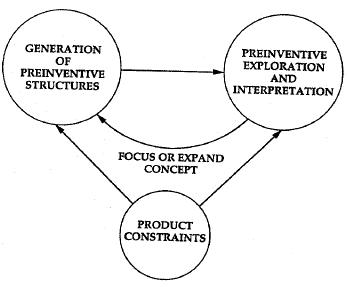
The creative cognition approach is built around the Geneplore model3, and describes two types of processes involved in creative cognition: generative processes and exploratory processes. Generative processes are those that most of us think about when we think of creativity. They are the processes by which creative concepts are first born. These processes are highly visible in extreme acts of creativity, but they are also evident in ordinary, everyday cognition. For instance, concepts are products of generative creative processes. As Ward, et al. (1999) write:
The mere fact that we readily construct a vast array of concrete and abstract concepts from an ongoing stream of otherwise discrete experiences implies a striking generative ability; concepts are creations. (p. 190)
A wide range of ordinary cognitive processes can be used in the service of generating novel ideas. Examples from Ward et al. include memory retrieval, assocation formation among information retrieved from memory, combinations of structures retrieved from memory, the synthesis of new structures, the transformation of retrieved structures into "new forms," analogical transfer between domains, and "categorical reduction," which involves reducing existing structures to "more primitive constituents"(p. 191-2). One type of structure produced by generative processes is called a preinventive structure. Preinventive structures are, in essence, the "germs" of creative ideas. Ultimately, they may not resemble the final product of the creative process, but they are the ideas that get the ball rolling, and they can be created through any of the processes mentioned above, or through other ordinary cognitive processes.

Exploratory processes are just that, processes used to explore the structures produced by generative processes. Examples of exploratory processes given by Ward, et al. include searching retrieved structures for "novel attributes," searching for "metaphorical implications," searching for possible functions, "the evaluation of structures from different perspectives or within different contexts," interpretation of structures from the perspective of the problem(s) to be solved, and "the search for various practical or conceptual limitations that are suggested by the structures" (p. 192).

As you might imagine, it will sometimes be difficult to distinguish between generative and exploratory processes, in practice. The two types of processes interact in a dynamic fashion. In some cases, generative processes may be used to produce a novel idea, after which exploratory processes will disover potentially important limits to the utility of that idea. Generative processes will then produce a new novel idea based on the findings of the exploratory processes, and so on, until a desired solution or otherwise acceptible final structure is arrived at. The complex interactions between generative processes, exploratory processes, and context is presented in the following diagram from Ward, et al.:

Posted by Hello

Figure 10.1 from Ward, et al. (p. 193). The following is their caption:The basic structure of the Geneplore model. Preinventive structures are constructed during an initial, generative phase, and are interpreted during an exploratory phase. The resulting creative insights c an then be focused on specific issues or problems, or expanded conceptually, by modifying the preinventive structures and repeating the cycle. Constraints on the final product can be imposed at any time during the generative or exploratory phase.

One other interesting aspects of the Geneplore model is that most of its processes occur unconsciously, or below the level of awareness. This is particularly true of the generative processes, but also for many of the exploratory processes listed above. For example, the processes involved in analogical mapping occur largely unconsciously, and more often than not, memory retrieval is an automatic process born of cues in the environment. Furthermore, there is evidence that conscious thought, including (and perhaps especially) language, may actually inhibit generative processes. The unconscious nature of many (if not most) of the cognitive processes involved in creativity call into question the many anecdotal accounts of sudden insight and the production of creative ideas that have often fueled the belief that creativity is something mysterious and not amenable to careful empirical study. This does not mean that we can't consciously influence the outcome of creative processes. Exploratory processes can often be used quite deliberately, and even generative processes can benefit from conscious attention to problems and potential solutions. As Pasteur once said, "Chance favors the prepared mind."

So there you have it, the basics of the creative cognition approach. Over the last decade or so, researchers using this approach have produced a great deal of empirical research, with a wide arrange of findings. In the next post on creative cognition, I'll discuss some of these findings, and describe their implications for other disciplines, including science in general and literary theory.


1 Ward, T. B., Smith, S. M., & Finke, R. A. (1999). Creative cognition. In R. J. Sternberg (Ed.), Handbook of creativity. Cambridge: Cambridge University Press.
2 See also The Creative Cognition Approach and the chapter cited in footnote 1.

3 First described in Creative Cognition: Theory, Research, and Applications.

Tuesday, November 23, 2004

My Best Pharyngula Impression

OK, so I'm no PZ Myers. Hell, I'm not even a biologist. That doesn't mean I can't post about evolution, does it? Well, I guess it does, so I'm not even going to try to write something about evolution research. Instead, I'm just going to refer you to a paper that I found very interesting when I read it a couple years ago. I'm not really qualified to evaluate the paper's claims, so I won't even do that. You'll have to check out "Bayesian natural selection and the evolution of perceptual systems" for yourself. Here's a passage from the introduction, just to give you an idea of what the paper is all about:
Here we show that a constrained form of Bayesian statistical decision theory provides an appropriate framework for exploring the formal link between the statistics of the environment and the evolving genome. The framework consists of two components. One is a Bayesian ideal observer with a utility function appropriate for natural selection. The other is a Bayesian formulation of natural selection that neatly divides natural selection into several factors that are measured individually and then combined to characterize the process as a whole. In the Bayesian formulation, each allele vector (i.e. each instance of a polymorphism) in each species under consideration is represented by a fundamental equation, which describes how the number of organisms carrying that allele vector at time t + 1 is related to: (i) the number of organisms carrying that allele vector at time t; (ii) the prior probability of a state of the environment at time t; (iii) the likelihood of a stimulus given the state of the environment; (iv) the likelihood of a response given the stimulus; and (v) the birth and death rates given the response and the state of the environment. The process of natural selection is represented by iterating these fundamental equations in parallel over time, while updating the allele vectors using appropriate probability distributions for mutation and sexual recombination.

Our proposal draws upon two important research traditions in sensation and perception: ideal observer theory (De Vries 1943; Rose 1948; Peterson et al. 1954; Barlow 1957; Green & Swets 1966) and probabilistic functionalism (Brunswik & Kamiya 1953; Brunswik 1956). After reviewing these two research traditions, we motivate and derive the basic formulae for maximum fitness ideal observers and Bayesian natural selection. We then demonstrate the Bayesian approach by simulating the evolutionof camouflage in passive organisms and the evolution of two-receptor sensory systems in active organisms that search for prey. Although we describe Bayesian natural selection in the context of perceptual systems, the approach is quite general and should be appropriate for systems ranging from molecular mechanisms within cells to the behaviour of organisms.
Enjoy.

Monday, November 22, 2004

Late Night Generalizations About Philosophers' Intuitions

With all the talk of intuitions in philosophy (here's the latest installment), and particularly the fear that the intuitions of western academic philosophers may not be shared by members of other cultures, or even nonphilosopher members of the same culture, it's easy to begin to wonder about the validity of many philosophical positions, or at least how to save them from the problem of unshared intuitions. I myself think we should be skeptical about intuitions regardless of whether they're shared across members of different cultures. The reason is that no matter how hard philosophers try, and no matter how clean their intuitions are rendered through the process of making them explicit and filtering them through the sieve of social and academic review, so much of what goes into the production of those intuitions is unconscious and unavailable to introspection. The very idea that through this filtering is possible reminds me of the hubris Nietzsche remarks in his essay "On the Prejudices of the Philosophers," where he writes:
Collectively they take up a position as if they had discovered and reached their real opinions through the self-development of a cool, pure, god-like disinterested dialectic (in contrast to the mystics of all ranks, who are more honestly stupid with their talk of "inspiration"—), while basically they defend with reasons sought out after the fact an assumed principle, an idea, an "inspiration," for the most part some heart-felt wish which has been abstracted and sifted.
Perhaps Nietzsche is a bit harsh, but I can't escape the impression that philosophers' intuitions, like those Kripke and the philosophers who have followed him seem to share about things like reference (as discussed in Fodor's much-blogged about review) are, when they are made explicit, nothing more than post hoc rationalizations of the positions in which our largely unconscious and unexamined conceptual schemes place us in relation to the problems the philosophers are raising. If this is the case, then it's not surprising that members of cultures with conceptual schemes that vary in significant and relevant ways would have different "intuitions" when confronted with those problems. However, these cultural differences only hint at the real problem with intuitions, a problem which is made even more clear by the possibility of members of the same culture failing to share those of philosophers. What this implies is that philosophers' intuitions are a product of their specialized knowledge structures gained through training and reading related to the philosophical issues in question.

There's an upshot to all of this. When I changed disciplines from philosophy to psychology long ago, I used to get into heated discussions about the value of analytic philosophy with my graduate advisor. One of his most frequent remarks was that the biggest difference between philosophers and experimental psychologists is that psychologists are beholding to data. There's something naive about philosophers believing that their intuitions are somehow getting to the heart of the issues, that their intuitions are somehow direct, immediate, or otherwise unreasoned (but not unreasonable) impressions of or responses to the (often counterfactual) scenarios they explore. Regardless of how sophisticated the logical and conceptual tools they may have at their disposal, philosophers are subject to the personal and social limitations idiosyncracies that come with human cognition. And since all that philosophers are beholding to, in most cases, is their own intuitions and those of other philosophers (members of a community that shares at least some relevant knowledge structures) there's no real way to independently test the validity of philosophical positions. If you want to know how something like reference works, you go out and you look at how people use language to refer. That doesn't entail exploring one's own intuitions. Psychologists realized the ineffectiveness of this sort of introspection 100 years ago. Instead, in entails going out and systematically gathering data. It's true that scientists, too, are shackled by their cognitive makeup, but that's the beauty of data - it constrains the range of possible intuitions that one can accept, and the more data one gathers, the fewer intuitions on can reasonable accept.

Obviously there are areas of philosophy where this method won't work. For example, you can't develop a meta-ethical theory, particularly one that's meant to be normative rather than purely descriptive, by going out and looking at peoples' moral reactions to situations. In this case, your goal isn't to understand how people behave, but to come up with theories about how they should behave regardless of how they actually do. However, there are intuitions that go into any moral theory that could benefit from some good data. For instance, any descriptive or moral theory of ethics will have to take into account facts about the human mind, and how it acts in the types of situations (particularly in social situations) that ethical theorists are interested in.Thus in some cases, like theories of reference, philosophy can best be used as a sort of hypothesis-generator, which then passes its hypotheses along for empirical investigation. In other cases, like the case of moral theorizing, philosophy produces the ultimate theories, but it should use knowledge from empirical investigations to gain insight into the potential structures of moral theories. Any philosophy that relies exclusively on intuitions, however, is doomed to be little more than parlor games. As Fodor says in his review, "Is that a way for grown-ups to spend their time?"