Monday, August 22, 2005

Autism and Theory of Mind

Over on Yahoo, we're discussing the role of autism in Tomasello's hypothesis in The Cultural Origins of Human Cognition. Tomasello, you will recall, argues that autism is an example of a disorder that results in a deficit in just the sorts of skills, which fall under the general heading of theory of mind, that he believes are responsible for most of the advances in human cognition because they make possible collaborative learning, and thereby culture. There are two ways in which using the example of autism might come back to bite Tomasello:
  1. If it turns out that some other deficit underlies the theory of mind deficits in autism, then Tomasello would have to revise his hypothesis to admit at least one other cognitive adaptation in humans.
  2. As Clark notes, many autistics are able to function quite well in non-social tasks. In fact, at the top end of the autism spectrum, individuals with Asperger Syndrome show the marked social deficits that characterize autism spectrum disorders, but are able to learn and reason in a way that is uniquely human, including developing language at a normal rate. There are people with Asperger Syndrome in physics departments and writing brilliant music, things that no nonhuman animals can do. If Tomasello is going to explain uniquely human cognitive abilities by reference to theory of mind and the cultural learning that it allows, then Asperger Syndrome and other high-functioning autistic individuals represent a wrench in his argument.
But discussion of those criticisms can wait until we're further along in the book. In this post, I'm not going to elaborate on them. Instead, I'm going to talk about some of the research on autism in cognitive psychology and cognitive neuroscience. In particular, I'm going to talk about the theory of mind theory of autism, and one of its alternatives, the weak central coherence theory. The research I'll describe certainly has implications for Tomasello's hypothesis, but that discussion will have to wait.

Most of the work on the relationship between theory of mind and autism has been conducted by Simon Baron-Cohen and his colleagues. Baron-Cohen (B-C) has theorized that there are two general cognitive styles: empathizing and systemizing. Empathizing, according to B-C, consists of a "drive to identify emotions and thoughts in others and to respond to these appropriately" (p. 302). Systemizing, on the other hand, involves "drive to analyze and build systems, with the aim of understanding and predicting non-agentive events" (p. 302)1. He believes that there are three general types of individuals: those who have strong empathizing skills and relatively weak systemizing skills; those who have strong systemizing skills and weak empathizing skills; and those who have balanced empathizing and systemizing skills. On average, males tend to be strong systemizers, while women tend to be strong empathizers. B-C has used this classification system to explain all sorts of behavioral differences between males and females, including differences in mathematical ability. While his theory that males and females exhibit differences in these abilities, on average, is highly controversial and, to say the least, not widely accepted among cognitive psychologists (see, e.g., this paper for a short critique of his empirical evidence), B-C has extended it to explain many of the symptoms of autism spectrum disorders. He believes that individuals with autism are extreme systemizers, and thus calls his theory the Extreme Mail Brain theory of autism2.

B-C has conducted what I consider to be thoroughly uninteresting experiments to test his systemizing-empathizing view of autism, using mostly Asperger patients. Here's an example experiment3: Asperger patients and non-autistic individuals, who have been matched for IQ (in other words, there's no IQ difference between the two groups) are given a systemizing and an empathizing task. The systemizing task involves making predictions in a simple folk mechanics task, while the empathizing task involves recognizing social faux pas in a set of social stories.

Pause here for a moment here, and look briefly at the diagnostic criteria for autism and Asperger specifically. You'll notice that one of the diagnostic criteria for Asperger (A. 3) is almost identical to B-C's definition of empathizing! Furthermore, one of the most common symptoms of both Asperger Syndrome and autism in general is an inability to perceive social nuances. I'll give you a real life examples. Asperger patients tend to have little knowledge of what is and is not appropriate in a given social context, and thus are unable to recognize faux pas. A doctor I know who works with Asperger patients once met with one for the first time, and in the course of their conversation, the patient used the word "fuck" constantly. He didn't know this doctor from Adam, and any non-autistic person would have avoided cussing in that context, but the Asperger patient used it over and over and over again. Another consequence of failing to pick up social nuances is an almost complete inability to recognize lies and figurative speech, and thus take everything literally. Here's another real life example. Another doctor I know was meeting an Asperger patient for the first time. The patient had just come from the funeral of a male cousin. When he told the doctor this, the doctor said, "Oh, I'm sorry, were you close to him?" The patient replied, "About 5 feet."

In short, B-C's empathizing is exactly what we already knew individuals who fall within the autism spectrum don't do very well! So imagine the surprise B-C and his colleagues must have felt when they learned that Asperger patients performed worse on the faux pas task than non-autistic individuals! I don't think I need to point out to you that if they hadn't performed worse, THEY WOULDN'T BE AUTISTIC! That's not a prediction, it's a truism. It might be somewhat surprising that they found that on a folk mechanics tasks, in which the participants had to had to predict the movement of objects in diagrams, the Asperger patients performed better on average than the non-autistic females (there was no difference between the Asperger patients and non-autistic males). From this, B-C concludes that Asperger patients do, in fact, have extremely male brains (though it would appear that at the top end of the spectrum, Asperger patients just have normal male brains).

OK, now that I've gotten my utter dismay at that totally inane experiment out of my system, I can move on to B-C's more interesting work. This work is on the actual relationship between theory of mind and autism. He and his colleagues have conducted more than 30 experiments, most of which used some version of the false belief task, on children with autism, and in almost every case, autistic children show developmental delays in theory of mind. Of course, there are problems with the use of false belief tasks in testing theory of mind abilities. He and his colleagues have also conducted neuroimaging research, focusing on the amygdala. The amygdala is thought to be important for social reasoning, particularly in the recognition of thought, intention, and emotion in the faces of other individuals. In one experiment, individuals with Asperger syndrome and normal individuals (matched for IQ, again) looked at photos of people's eyes (which also show the eyebrows, and parts of the nose and forehead), and attempted to guess what the people were thinking. Non-autistic individuals perform quite well on this task, while Asperger patients perform very poorly. While the participants were performing the task, their brains were scanned using an fMRI machine. Consistent with the theory of mind theory of autism, non-autistic participants displayed increased activation in the amygdala, while Asperger participants displayed no increased activation, when performing the task4. If you want to look at the figure above (from the Baron-Cohen et al. paper, see footnote 4), the sides are reversed (the right side of the figure is the left side of the brain), the yellow indicates that the area was only active in the non-autistic participants, the red indicates that the area was only active in the Asperger participants, and the blue indicates that the area was active in both. The left amygdala is that little yellow area of activation that is in the middle (from top to bottom) and slightly to the right (meaning it's on the left side of the brain) in the image labeled -7.

In addition to the amygdala theory of autism and theory of mind, others have argued, speculatively, that a type of neuron that may be found in the human left prefrontal cortex (they're found in the analogous region in monkeys, but there's no direct evidence, as of yet, that they exist in humans) called mirror neurons may be involved in autism as well. In monkeys, mirror neurons facilitate imitation. In humans, left frontal cortex lesions are associated with deficits in the ability to imitate the actions of others. Autism patients also tend to show lower levels of activity in the left medial frontal cortex than non-autistic individuals (e.g., in the Baron-Cohen et al study I just described) in response to theory of mind tasks. Some have speculated, then, that autistic individuals may not have a fully functioning mirror neuron system5. If there is a mirror neuron system in the human left medial frontal cortex analogous to the one in monkeys, then it is likely that this system is associated with theory of mind, and lower levels of activation in this area in autistic individuals indicates that, mirror neuron system or no, an area of their the brains associated with imitation is not as active as it is in non-autistic individuals.

There are some problems with the theory of mind theory of autism. For one, some autistic patients do perform well on theory of mind tasks, and by adolescence, most are able to perform the most common theory of mind task, the false belief test. In addition, it doesn't seem to explain the range of symptoms in the autism spectrum. Asperger patients clearly have serious theory of mind deficits, but show few of the other cognitive or linguistic deficits that characterize more extreme forms of autism. If theory of mind deficits are the primary symptom of autism, how can this be? It certainly doesn't explain B-C's (shitty) data suggesting that autism patients are extreme systemisers. At most, the theory of mind theory just describes the systemizing-empathizing symptoms (remember, people can be balanced -- being good at one doesn't preclude being good at the other). Furthermore, neither the theory of mind theory or B-C's systemizing-empathizing distinction speaks to another aspect of autism. On some types of tasks, even highly autistic individuals tend to perform better than non-autistic individuals (I'll describe some of those tasks in a moment).

The holes in the theory of mind theory of autism have led some to look for alternative theories. The most prominent alternative theory today is the weak central coherence theory, first espoused by Uta Frith6. Frith uses "central coherence" to refer to the tendency of non-autistic individuals to process information globally, e.g., at the level of the scene as opposed to the level of individual objects in the scene. It is this tendency that is responsible, among other things, for the schematic memory effects that have been demonstrated by cognitive psychologists over the last 40 years, and of which I am so fond (as you may know, if you've been reading this blog). In schematic memory effect, people tend to remember the "gist" of a story or scene quite well, but forget many of the specific details. This is because while they encode the details, they don't spend much time processing them, instead focusing their resources on the overall context. Autistics, Frith argues, do the opposite: they focus on the details, to the exclusion of the overall context. Whereas non-autistic individuals process information globally, autistics process it locally.

What's most interesting about this theory is that it makes some very interesting predictions. For instance, it predicts that in certain tasks in which the global focus of non-autistics produces errors or poorer memory, autistics will outperform them. These predictions have been confirmed in several different types of tasks. For example, in one experiment7, Francesca Happéé had autistics look at illusion-inducing visual stimuli, such as the Titchner Circles:


These circles produce a classic perceptual illusion. Non-autistic individuals tend to say that the middle circle in the group on the right is larger than the middle circle in the group on the left, despite the fact that they are the same size.Happépé argues that this is because autistics, because they process each of the circles at the local level, are immune to the illusion-inducing effects of the overal context (the surrounding circles). Elsewhere, she has detailed several other cases in which autistics display similar "local perception biases," including a reduced susceptibility to the McGurk effect, in autistics8.

Autistics also perform better on a different sort of task that requires segmenting parts of a scene instead of analyzing the scene as a whole, or Gestalt. This task, called the Embedded Figures Task, involves finding a shape, or several shapes, that is embedded within a complex scene. Non-autistics tend to be pretty slow at this. Autistics, it turns out, are able to find the shapes faster than non-autistics9. This is consistent with the weak central coherence theory: autistics are able to find the shapes faster because they are processing local features, and are not distracted by the overall Gestalt. Further supporting this view, using the Embedded Figures Task and fMRI, Ring et al.10 found that non-autistic participants showed greater activation than autistic participants in brain areas associated with working memory in the right dorsolateral prefrontal cortex, while autistic participants showed greater activation than non-autistic controls in ventro occipitotemporal regions (the cuneus, infrior occipital gyrus, and middle occipital gyrus), which are parts of the visual system. They interpreted these results as indicating that the control participants were utilizing working memory to analyze the scene as a whole, while autistic participants were using the visual system for "object feature analysis."

In addition to areas in which autistics' performance is superior to that of non-autistics, the areas in which autistics perform as well as non-autistics support a weak central coherence theory as well. For example, while autistics are worse than non-autistics at recalling information that requires global processing (e.g., temporal sequences and the source of a memory), they are just as good at memory tasks that are not always subject to schema effects, such as recognition memory11.

But the most powerful test of a theory of autism is to use it to explain the deficits that appear in autism. This is what the theory of mind theory of autism was designed to do, and the weak central coherence theory will have to do it as well if it is going to be a viable alternative. I'll give one such explanation of a deficit here, and then describe how it might be related to some of the other deficits. A couple years ago, Blake et al.12 conducted an interesting experiment in which they presented autistic children and non-autistic controls with two types of motion. One type involved small lines moving together to form a group. The other involved point-light animation of human movement (see the figures on this webpage to get an idea of what point-light animation is). Autistics and controls performed equally well on the line movement task, but autistics were much worse at recognizing biological motion in the point-light animation task. Blake et al. interpreted this finding as support for the theory of mind theory, arguing that deficits in theory of mind make it more difficult to interpret biological motion.

But there's another possible interpretation. In the same year, Bertone et al.13 published a study in which they presented autistic and control participants with tasks involving two different kinds of motion, and asked them to indicate the direction of motion. The two types of motion in this study were first and second-order motion. Previous neuroscientific research has shown that first-order motion (in this study, motion defined by changing the luminance across the screen), which doesn't involve the integration of multiple sources of information, is processed early in the visual system in the primary visual cortex, while second-order motion (in this case, motion defined by changing texture across the screen) is processed further along in the visual system, because it requires integrating multiple sources of visual information. Bertone et al. predicted that, consistent with the weak central coherence theory, autistics would peform well on first-order motion tasks that do not involve integration, but poorly on second-order visual tasks that do, and thus demand a more global processing approach. And that's what they found. Biological motion tasks like those used in the Blake et al. study are second-order tasks, in that the viewer has to integrate the information (often conflicting, directionally, at the local level) in order to perceive and identify biological motion. It could be, then, as Bertone et al. argue, that difficulties in processing complex, integrated visual information underlie theory of mind deficits in autism, rather than the other way around. Much of what makes up theory of mind in humans involves integrating multiple sources of sensory information at a higher level (e.g., faciaexpressionsns, bodily movements, and auditory cues including verbal and nonverbal expressions). If the primary deficit in autism is one of integrating information at a global level, it stands to reason that theory of mind would suffer (perceiving biological motion certainly would).

Baron-Cohen and some others feel that the weak central coherence theory is actually a compliment to the theory of mind theory. They don't think it can stand on its own. It doesn't, for instance, explain B-C's systemizing v. empathizing data. Then again, neither does the theory of mind theory, but B-C's never let that deter him. But for all intents and purposes, the jury is still out. As of yet, there's no direct data that can directly explain the relationship between global processing difficulties and theory of mind deficits in autism. They may be causally related, they may share a common cause, or they may be completely unrelated. Neither theory can as of yet explain all there is to explain about the cognitive deficits in autism, so it's unlikely that either will end up standing alone. We'll have to wait and see.

1 Lawson, J., Baron-Cohen, S., & Wheelwright, S. (2004). Empathising ansystemizingng in adults with and without Asperger Syndrome. Journal of Autism and Developmental Disorders, 34(3), 301-310.
2 Baron-Cohen, S. (1999). The extreme male-brain theory of autism. In H. Tager-Flusberg (Ed.), Neurodevelopmental Disorders. MIT Press.
3 Lawson, Baron-Cohen, & Wheelwright (2004).
4Baron-Cohen, S., Ring, H.A., Bullmore, E.T., Wheelwright, S., Ashwina, C., & Williams, S.C.R. (2000). The amygdala theory of autism. Neuroscience and Biobehavioral Reviews, 24, 355–364. The brain scans are from Figure 2, p. 361.
5 Williams, J.H.G., Whiten, A., & Perrett, D.I. (2001). Imitation, mirror neurons and autism. Neuroscience and Biobehavioral Reviews, 25, 287-295.
6 Frith, U. (1989). Autism: Explaining the Enigma. Blackwell Science.
7 Happé, F.G.E. (1996) Studying weak central coherence at low levels: children with autism do not succumb to visual illusions: a research note. Journal of Child Psychology & Psychiatry, 37, 873–877.
8 Happé, F.G.E. (1999). Autism: Cognitive deficit or cognitive style? Trends in Cognitive Sciences, 3(6), 216-222.
9 Jolliffe, T., & Baron-Cohen, S. (1997). Are people with autism and Asperger syndrome faster than normal on the Embedded Figures Test?
Journal of Child Psycholology & Psychiatry, 38, 527‚–534.
10 Ring, H.A., Baron-Cohen, S., Wheelwright, S., Williams, S.C.R., Brammer, M., Andrew, C., & Bullmore, E.T. (1999). Cerebral correlates of preserved cognitive skills in autism: A functional MRI study of Embedded Figures Task performance. Brain, 122, 1305-1315.
11 Bemnetto, L., Pennington, B.F., & Rogers, S.J. (1996). Intact and impaired memory functions in autism. Child Development, 67(4), 1816-1835.
12 Blake, R., Turner, L.M., Smoski, M.J., Pozdol, S.L., & Stone, W.L. (2003). Visual recognition of biological motion is impaired in children with autism. Psychological Science, 14(2), 151-157.
13 Bertone, A., Mottron, L., Jelenic, P, & Faubert, J. (2003). Motion perception in autism: A "complex" issue. Journal of Cognitive Neuroscience, 15(2), 218-225.

Sunday, August 21, 2005

CogBlog: Tomasello, Chapter 1

What is unpleasant and threatens my modesty is that in fact I am every name in history.

Nietzsche wrote that in a letter to Jacob Burckhardt in January, 1889, after his descent into insanity, but if you look past the self-absorption, in a disturbing and poetic fashion the sentence manages to captures the essence of the hypothesis that Tomasello defends in The Cultural Origins of Human Cognition: our uniquely human cognitive abilities exist because our minds "stand on the shoulders of giants," or contain within them the advances of the human minds that came before us. In Chapter 1, Tomasello puts forth this hypothesis, the basic reasons he thinks it is necessary (the "problem"), and in a very general way, the themes that will guide his defense of it. As Tomasello himself notes, Chapter 1 thus serves as a précis for the rest of the book. That means that it's important that we understand the basic concepts in the chapter, and also that we can begin to see some of the potential problems with Tomasello's view. In this post, I will briefly summarize the main points in Chapter 1, and describe one of the potential problems that may threaten the entire exercise.

In the beginning, Tomasello lays out the problem that motivates his hypothesis. Six million years ago, the evolutionary paths of modern apes and modern humans diverged. Until two million years ago, the evolutionary path of modern humans was dominated by one genus, Australopithecus, which was much more ape-like than human-like, particularly in its cognitive abilities. And it appears that most of our modern cognitive abilities arose within the last 250,000 years. Tomasello believes that this time period does not allow enough time for the evolution of these abilities through the ordinary mechanisms of biological evolution. Hence the problem: how can there be such large cognitive differences between apes and humans if there was not enough time for them to evolve through the ordinary biological evolution?

If there wasn't enough time for biological evolution to produce our uniquely human cognitive abilities through its ordinary mechanisms, then another mechanism is required, and Tomasello's hypothesis is that the mechanism through which most of our uniquely human cognitive abilities developed is cumulative cultural evolution. While other animal species are able to transmit information socially, they are not able to do so cumulatively, and therefore, as Blar notes in his first post on Tomasello, their inability to build on the past leaves them "doomed to repeat it." In Chapter 1, Tomasello gives us his hypothesis for how humans evolved the ability to transmit knowledge culturally. There are two primary parts to this hypothesis, one of which is responsible for the other: the ability to share attention with concspecifics, and the resulting development of uniquely human linguistic abilities. I'll briefly discuss each.

As Tomasello notes, humans and nonhuman animals share many of their basic cognitive skills. Tomasello lists perception, memory, attention, and categorization (p. 10) as shared cognitive abilities. He also notes that nonhuman primates, particularly those closest to us evolutionarily (chimpanzees and bonobos) are capable of innovation, or the creation of new knowledge and abilities (p. 5). But unlike humans, these nonhuman animals are unable to transmit their innovations to future generations. For Tomasello, there is one difference between humans and all nonhuman animals that allows us to develop the ability to transmit information cumulatively through culture (what he calls the ratchet effect). In order to do so, they must be able to understand that other humans have beliefs and intentions (p. 7-8). This understanding allows humans to reason about the actions of others, and this in turn allows us to imitate those actions intelligently. Thus the single difference between humans and nonhuman animals that evolved about a quarter of a million years ago must be one that makes this understanding possible. Tomasello's hypothesis is that this single evolved difference is the ability to identify with others of our species. This allows us to engage in "joint attentional activities," in which we recognize that another is attending to a specific object, and that he or she has beliefs and goals (intentions) that relate his or her actions to that object. This in turn allows us to imitate and learn from those actions. As we will see in later chapters, it also allows us to directly teach our knowledge and skills to others. In other words, once we are able to identify with other members of our species and engage in joint attentional activities with them, we are able to teach and learn collaboratively. According to Tomasello, it is these abilities that "form the basis for children's initial entry into the world of culture" (p. 7-8). Collaborative learning raises the human mind above the minds all of its evolutionary predecessors and all current nonhuman animals.

To illustrate this, Tomasello describes two examples that are missing one of two pieces of this puzzle. In the first example, autistic children are embedded in the "world of culture," but cannot enter it, because they lack the theory of mind abilities that allow us to identify with our conspecifics and thereby reason about their beliefs and intentions. This is why extremely autistic children display such profound deficits in uniquely human cognitive abilities, particularly language. In the second example, a child has the ability to identify with other humans, and thus to learn collaboratively, but grows up in an environment in which she is completely isolated from all other humans, and thus cannot benefit from the collaborative learning of accumulated cultural knowledge. This hypothetical child, Tomasello believes, will resemble the extremely autistic child in its cognitive abilities.

It's here that one objection might be raised against Tomasello's hypothesis (Clark raises a similar one in his post, and Jesse discusses it as well). The idea that the primary deficit from which autistics suffer is in the area of theory of mind (the ability to identify with conspecifics) is still somewhat controversial. A great deal of research has been conducted on the relationship between theory of mind and autism over the last 10-12 years, but most of it has relied on the false belief task (see the previous post on Tomasello for a description of this task). However, several researchers have argued that the false belief task does not actually test for theory of mind. Bloom and German, for example, have argued that the false belief task is a test of more than just theory of mind, and that there is more to theory of mind than is tested in the false belief task. Thus, individuals may have theory of mind abilities, but have deficits on other abilities that are tested in the false belief task, and thus be unable to perform the task. Conversely, they may not have fully developed theory of mind abilities, but pass the false belief task because it does not test for all of the aspects of theory of mind. Thus, it's difficult to conclude from autistic children's inability to perform the false belief task that those children do not have theory of mind abilities. Furthermore, autistic children are able to perform on other theory of mind tests, albeit at a later age than non-autistic children. It may be that autistic children have deficits in other abilities that underlie theory of mind as well as many of the other cognitive deficits that autistic children display. The leading theory is still that autism is related to theory of mind deficits, but exactly what this relationship is, and its effect on the many symptoms of autism is still unknown, and the topic of a great deal of current research. If it turns out that there is a common underlying cause of theory of mind deficits and other cognitive deficits in autism, Tomasello will have lost one of the strongest pieces of evidence for his hypothesis.

Returning to Chapter 1, immediately after the discussion of the ability to identify with conspecifics, Tomasello discusses one of the most important results of this ability: the ability to learn and use a uniquely human language (p. 8-11). It is here that Tomasello writes one of the most interesting and important passages in the entire book, so I will quote it at length:
As the child masters the linguistic symbols of her culture she thereby acquires the ability to adopt multiple perspectives simultaneously on one and the same perceptual situation. As perspectively based cognitive representations, then, linguistic symbols are based not on the recording of direct sensory or motor experiences, as are the cognitive representations of other species and human infants, but rather on the ways in which individuals choose to construe things out of a number of other ways they might have construed them, as embodied in the other available linguistic symbols that they might have chosen, but did not. Liguistic symbols thus free human cognition from the immediate perceptual situation not only by enabling reference to things outside this situation ("displacement" Hockett, 1960), but rather by enabling multiple simultaneous representations of each and every, indeed all possible, perceptual situations. (p. 9, emphasis mine)
The point here is that language enhances the abilities to learn and transmit cultural knowledge, the very abilities that make the learning and use of language possible. Language opens up all sorts of cognitive avenues. Tomasello lists three of these (p. 10): metacognition, in which we think about our own thoughts and thought processes; representational rediscription, which allows us to rerepresent specific knowledge in a way that makes it possible to use it in a broader array of situations; and dialogical thinking, in which we are able to adopt multiple perspectives at once. In addition, language provides us with our most efficient method of cultural transmission. In short, then, through the creation of language, and by making it possible for children to learn language ontogenetically (i.e. developmentally), the abilities that underlie collaborative learning have in essence created an amplifier through which they can develop the full range of human culture and uniquely human cognitive abilities.

This account of the role of language fits nicely with the agent-based model of the creation of a lexicon that I described in a previous post. In simulations using that model, simple agents were able to develop a lexicon for describing all of the possible perceptual inputs in a simple environment. Furthermore, through the development of a consensus between the members of the community, the lexicon allowed the agents to better represent that environment. That consensus was developed entirely through social interactions (speaker-listeneinteractionsns). In fact, all you had to do to make it difficult for such a consensus to develop between two agents was to make it difficult for them to identify with each other. While the model is simple and idealistic, it serves as a nice existence proof of the viability and power of Tomasello's account of the role of language in amplifying cultural learning, and the power of cultural learning in developing a common language.

Now that I've summarized Tomasello's problem and hypothesis, I can briefly discuss one potential objection. Tomasello's hypothesis is motivated entirely by the existence of his problem. If it turns out that six million, or even 250,000 years, is enough time for multiple cognitive abilities to evolve through ordinary biological means, than Tomasello's hypothesis is no longer motivated. This is in fact one of the most common criticisms of the book that reviewers, particularly biologists, have mentioned. Fortunately, we have a few biologists in the group who can help us sort this issue out. In fact, one of those biologists, Bora Zivkovic (whom you may know as Coturnix) offered just this criticism in his post on Chapter 1. Bora argues that chimps may not be as similar to us as Tomasello thinks, which could mean that we must have evolved multiple cognitive abilities biologically in order to explain the uniquely human cognitive skills that we display today. Bora also notes that there are several well-known evolutionary mechanisms that could be used to explain the rapid evolution of multiple cognitive abilities. He lists the Baldwin effect, niche construction, sexual selection, and group selection (multilevel selection). Since I'm not a biologist, I won't attempt to explain these to you (read Bora's post and follow the links for good explanations), but I will note that the first two, the Baldwin effect (the link is to a PhD dissertation that provides a thorough review and critique of the use of the Baldwin effect) and niche construction, have been used in discussions of the evolution of language. If it is in fact the case that there has been enough time in our evolutionary history to develop multiple cognitive adaptations, then the rest of Tomasello's book is interesting, but the validity of the view it describes will be highly questionable.

But we haven't even begun to delve into the substance of Tomasello's arguments, so it's too early to bury his hypothesis entirely. In Chapter 2, he'll present his argument that the evolutionary time period was not sufficient for the development of multiple cognitive adaptations, and will discuss in more detail the process of "cultural inheritance." Things are just starting to get interesting.

Friday, August 19, 2005

Connectionism in Action: Lexicon ex nihilo

After describing the basics of connectionist models the other day, I thought it might be interesting to give an example of their use. A responsible cognitive science blogger would choose a typical model that is designed to implement some individual aspect of cognition. But a responsible cognitive science blogger would be boring! I, on the other hand, not being boring, have chosen something a little different to use as an example: an agent-based model of the development of a lexicon in a community. Agent-based models are a relatively new breed in cognitive science, and I have to admit that I'm not really qualified to speak to all of their strengths and weaknesses, though an in press Trends in Cognitive Sciences paper by Rob Goldstone (aka Mr. Percepts and Concepts; see the picture at the linked site) seems to do a nice job of laying these out. If you want to learn more about agent-based models in general, I recommend reading it.

What is an agent-based model (ABM)? Here's the definition from the TiCS paper (on p. 3 of the pdf version linked above):
[ABMs] build social structures from the "bottom-up," by simulating individuals by virtual agents, and creating emergent organizations out of the operation of rules that govern interactions among agents.
ABMs model the behaviors of groups of individuals by creating individuals (agents) with internal rules for processing information, and having them interact (transfer information) using another set of rules. The difference between these models and those we usually see in cognitive science concerns the focus. In ordinary cog sci models, including ordinary connectionist models, the focus is on the internal processing of information by individuals. In ABMs, the focus is on the interactions between individuals, though the effects that these interactions have on the internal processing of information is of interest to some modelers. ABMs have been used to explain all sorts of social phenomena, from the general, such as innovation and collective action, to the particular, such as promotion in university departments. The model I'm going to describe explores the development of a lexicon in a community.

The problem the model, created by Edwin Hutchins and Brian Hazelhurst1, addresses is how a shared set of symbols (e.g., words) arises in a community. It's not designed to fully explain how this occurs, but to demonstrate that, under relatively controlled conditions, a particular theory of distributed cognition described in Hutchins' book Cognition in the Wild. The theory includes six assumptions that are relevant to the model :
  1. The no telepathy assumption: In order to influence each other, minds must use something external to them.
  2. The cultural grounding of intelligence assumption: The organization of minds comes about only through the interaction with other individuals in a shared environment.
  3. The shallow symbol assumption: The nature of mental representations must be explained.
  4. The material symbols assumption: All symbols, whether they facilitate intra-individual communication or are designed to aid an individual's cognition (e.g., in the form of written memory aids) have a material component, along with the "ideal" component.
  5. The distributed information-processing assumption: "Cognition can be described as the propagation of representational state across representational media that may be internal to or external to individual minds." (p. 164)
  6. The no developmental magic assumption: The same processes characterize cognitive operations and the development of those operations.
To implement these assumptions, Hutchins and Hazelhurst (H&H) use agents that are composed of simple connectionist networks. Just in case you don't want to look back two posts earlier, here is what such a simple network looks like:


To this sort of architecture, H&H added a twist. The output units still produced the output for the individual agent, but the representations in the hidden layers became public. These representations constituted the "material" symbol for the model; they were, in essence, verbal communication. In addition to outputting their representations to other agents, the hidden units (which are no longer really hidden) also received input from the hidden units of other agents in the form of error correction (see the previous post on connectionism to see how this sort of correction works). Thus, the hidden layer allowed an individual agent to be a speaker, when it shared its representations, or a listener, when it took as feedback the output of the hidden layer of another agent (who in that case served as the speaker). Thus Hutchins and Hazelhurst renamed the hidden layer the "Verbal Input/Output" layer.

The usual input and output layers were also renamed. H&H treated them as a simple visual system, which takes as input a visual scene, and outputs a representation that bears a 1:1 correspondence with that scene (in fact, the output representation was identical to the scene, making the network an autoassociator, for the connectionists out there). So the input and output layers were renamed the visual input and visual output layers respectively. This gives us a system that looks like this:

This figure represents the network for agent A. A1, A2, and Am represent the verbal outputs (you can think of them as words) for A for each of the scenes (Scene 1, Scene 2,... Scene m). The system is designed to categorize the verbal input and produce a different verbal output for each scene. This allows each symbol to have a "meaning," or a relationship with an individual scene.

So they create a bunch of individual agents, and give all of the connections between the different units random values, which means that the individual agents will each produce different verbal outputs for the scenes. Each agent is given 36 visual input units, and 36 visual output units, along with 4 verbal input/output units2. They then ran simulations in which a visual scene, which represented one of 12 possible phases of the moon, is presented to two agents at a time. One agent serves as the speaker, and sends its verbal output to the other agent, called the speaker, which takes it as its verbal input. The listener then uses this verbal input to alter the representation that its own verbal input/output units produced for the scene. In this way, the two agents move closer towards a consensus about how to verbally represent that particular scene. They do this over and over again for thousands of trials in which the speaker and listener are determined randomly, so that each agent views each scene with each other agent as both a speaker and a listener at least once.

After running this simulation, along with a simpler one (with fewer scenes), they found that individuals do indeed converge on a shared set of verbal outputs for each scene. In other words, the community of agents develops a shared lexicon. They also found that community size was important in some situations. When there were a large number of agents, and a new agent was added after the original agents were well on their way to acheiving consensus, the new agent had trouble learning the community's lexicon, but the community's lexicon remained relatively intact. H&H believe that this indicates that a system that is organized in a way that is inconsistent with the shared lexicon of a community will have trouble learning that lexicon. They argue that this may indicate one of the reasons for the existence of a critical period for language learning in humans. Early in development, the brain is organized in a relatively unstructured way, as were the networks of the agents before they began to interact. After a significant period of learning, however, the mind becomes highly structured, and if that structure is inconsistent with the structure of the lexicon (e.g., if a person has learned one language as a child and then must learn another in adulthood), it may be difficult to learn the new structure. They also found that when communities were small, the introduction of a new member could wreak havoc with the developing consensus among the original community members, and the community subsequently had a difficult time developing a shared lexicon. This may be another reason for the existence of critical periods. It allows those who've learned the shared lexicon to avoid being influenced by the input of new members (especially children), which prevents the new members from causing problems with the consensus developed among earlier members. They also created simulations in which dialects developed. In these simulations, the likelihood that a listener would use the verbal input from a speaker depended on how similar that input was to the representations that the listener's own verbal input/output layer produced. When they did this, more than one lexicon developed within the community, which H&H described as dialects.

But the main point of the model was to show that a community of communicating individuals could create a structured system of shared symbol-world relationships where no system had previously existed. This implies that the creation of meaning is a social phenomenon that occurs through the interaction of multiple agents in a shared environment. Interestingly, in their simulations, each of the agents developed different internal representations of the visual scenes. This indicates that agents need not have the same internal representations in order to be able to communicate with each other. Shared symbols that represent aspects of the world are made possible through the interactions of individuals over time, rather than through a shared internal structure. This may have a lot of implications for how we view the nature, use, and learning of language and meaning. Here is how H&H conclude the chapter:
Within this theoretical framework, we claim that meaning can be retrieved from the unattractive positions of being equated with: (a) the results of a (usually innate) private language of mental symbols which stand for an uncontested, fixed, and nonsocial objective reality (Fodor 1976; cf. Lakoff 1987), or (b) an unproblematically shared, static (i.e. a nondevelopmental, nonhistorical, and often nonsocial) semantic knowledge base (ethnoscience and much of cognitive anthropology; cf. Hutchins 1980), or (c) a strictly public (i.e. superindividual, nonmental) symbol system (Geertz 1973; cf. Shore 1991). Meaning in our model is an evolving property of the interaction of internal, artificial [i.e. symbolic - Chris], and natural structures. At any point in the evolution of such a system we take meanings to be characterizations of the functional properties of individualsÂ’ viz.-a-viz. the environment (including each other). Meaning, for each individual, describes a range of possibilities for action.
Anyway, this is one way that researchers in cognitive science are now using connectionist architectures. It's not the most common use, but it's certainly an interesting one. Such uses challenge the way we think about cognition, in that they show how it depends both on the individual agent and the community of agents in which the individual exists, and in doing so, they ultimately challenge the way we view ourselves.


1 Hutchins, E. & Hazelhurst, B. (1995). How to invent a lexicon: The development of shared symbols in interaction. In Gilbert, N. & Conte, R. (eds.) Artificial Societies: The Computer Simulation of Social Life p. 157-189: UCL Press.
2 In the process of running the simulation, they learned that 1 hidden layer (the verbal input/output layer) wasn't enough, so they added another. This doesn't really change much for the purposes of a blog explanation, though.

Wednesday, August 17, 2005

Clark on Tomasello

Clark of Mormon Metaphysics has launched the book club with a great post on Tomasello's introductory chapter, which includes some good questions at the end. In general, I'll be posting links to all of the blogs discussing the book at one time in a single post, but since this the first post on the book that I've come across, and since it's quite good, I wanted to put up a link to it now.

Tuesday, August 16, 2005

A Short Connectionism Primer

So I started to write the third post on moral cognition, in which I wanted to include a short section on the connectionist approach to moral cognition of people like the Churchlands (Paul and Patricia), Andy Clark, and William Casebeer, when I realized that I would either have to assume knowledge of connectionism on the reader's part, or write out an explanation of connectionist models, which would make the post too long. So I decided to give a short description of connectionism in a separate post. If you haven't guessed it yet, this is that post. I'm just going to go over the very basics, but that's really all you need to get a sense of what the intersection of connectionism and moral psychology is all about.


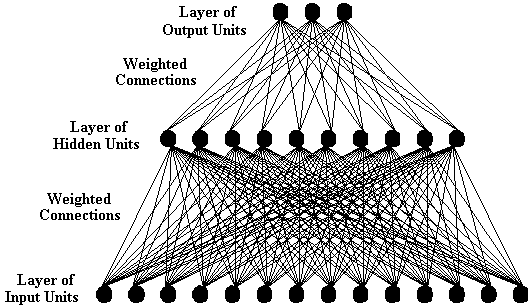
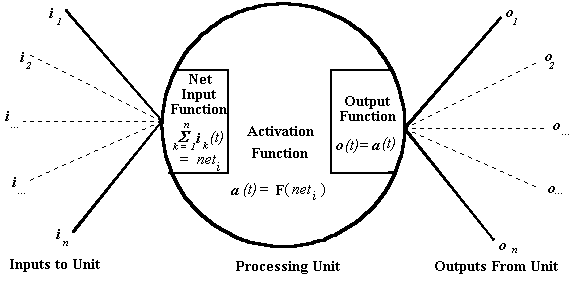
That figure (which I stole from this website) is pretty self-explanatory, right? I can probably just leave it at that and say nothing more. OK, maybe if I add this one (from the same website):


There, that should do it. Can you tell I'm not overly excited about the prospect of talking about connectionism? It reminds me of my undergraduate course in matrix algebra, among other unpleasant things. But I'll suck it up and get on with it.

Actually, most of what you need to know really is contained in those diagrams. Connectionist models are essentially pattern detectors. They involve layers of units that send signals to each other (in the simplest case, the signals only move in one direction, but in more complex models, they can go backwards and forwards), with the aim of producing an output pattern that corresponds to the input pattern the model received. In the simplest models, there are three layers of units: a layer of input units, a layer of hidden units (the second diagram calls a unit in this layer a "processing unit"), and a layer of output units. Between the three layers are connections, running from the input layer to the hidden layer, and from the hidden layer to the output layer. There are two important features of the connections: their sign and their strength, or weight (in more complex models, the direction that the signal moves on a connection is also important). A connection with a positive sign is excitatory, i.e., when a signal is sent down that connection between two units, it increases the level of activation in the receiving unit; a connection with a negative sign is inhibitory, which just means that a signal sent down it decreases the level of activation of the receiving unit. The strength of a connection determines how much the activation level of the receiving unit is increased or decreased by a particular signal. In simple models, the strengths usually vary between 0 to 1.

As the second figure above indicates, even in a simple model, things are a little more complicated than the last paragraph made them out to be. This is because a unit in the hidden layer or output layer generally doesn't receive one signal from one input unit. Instead, it receives a bunch of signals at the same time from multiple input/hidden layer units, and it has to combine them in some way to determine how active it should be. In the simplest models, the receiving unit just sums all of the signals it receives at one time, and then computes an activation level. If the sum of all is inputs are positive, it will become more active for a period of time (the activation function in the second figure usually contains within it a decay function that determines how long it will stay active after receiving input), and if it is negative, it will become less active. You can think about the units as neurons which are just minding their own business, firing away at their baseline rates (the rates they fire when they're not receiving any signals), when all of the sudden a rush of input from several other neurons comes in. Some of the input is excitatory, and some of it inhibitory, so the neuron has to combine all of the signals from multiple other neurons together, and if the net input is excitatory, it raises its activation level above the baseline, while if it is negative, it drops its activation level below the baseline. After a short time, if it doesn't receive any more input, it will return to the baseline (or below the baseline, if it was excited and there is a refractory period). Of course, the units in connectionist models aren't neurons, so they don't actually fire, and they don't really have a resting level. Instead, the level of activation of a unit in a model determines how strong the signal it sends down stream to the next level of units will be.


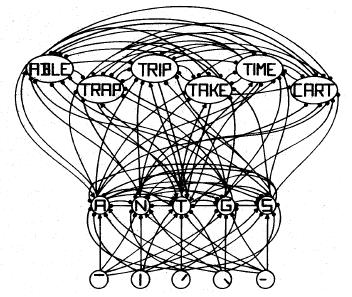
Consider an example model. If you've ever taken a course in cognitive science, you've probably seen this third figure. It's from a classic paper by McClelland and Rumelhart1 on perceiving letters and words. At the bottom are the input units, which detect oriented lines in the first letter of a word that the model receives as input. In the middle are the hidden units which represent the possible first letters. Take, as an example, the T unit (the one in the middle of the hidden layer). When the upper horizontal line input unit (far left) and the vertical line input unit (second from the left) are activated, they send excitatory signals to the T unit. When the angled line input units (middle and second from right) are activated, they send inhibitory signals to the T unit. The other hidden units work the same way (but with the excitatory and inhibitory connections coming from the input units with the components of their letters). The hidden units then send a signal to the output units, based on how active they've become. These signals also have connection weights and signs. The output units work pretty much like the hidden units. The output that wins and gives the models "answer" is the one that ends up with the highest sum of input signals from the hidden units. Obviously, to get whole words (like in the model above), you have to have input units, and perhaps hidden units, for the letter in each position in the word, and the winning output unit gets the most activation from all of those units.

So that is a highly oversimplified explanation of how a connectionist model recognizes a pattern (in this case, a word). But at the start, a model can't recognize any patterns. It has to be trained. To do that, you have to include some method for giving it feedback, and for that feedback to affect the connection strengths between the different layers. First, you randomly assign connection weights between each of the nodes. Then you give the model an input. Inevitably, the output will not be the desired input (the pattern the model is supposed to recognize), so you adjust the weights on each of the connections. The simplest way to do this is to compare each weight to the weight that would yield the correct pattern, and adjust the weight based on the difference. After a lot of training, this method will leave you with a model that can recognize the patterns on which it was trained with a high degree of accuracy. Some models can even generalize to novel patterns (e.g., new words with the same letters that were used to train the model).

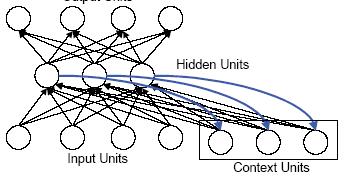
In more complex models (which would include most of the models used today), things get, well, more complex. The simple model I described above is a strictly feed-forward model: the input layer sends signals to the hidden layer, which sends signals to the output layer. However, other models use recursion to allow forward layers to influence backward layers. Some also include another type of layer, a "context layer," that receives input from the hidden layer and records the state of that layer at a given time. When another set of inputs comes in to the hidden layer, the context layer then sends a signal back to the hidden layer. Thus the hidden layer's last state serves as the "context" for its interpretation of the new input. Here's a diagram of such a model (from this paper):

As you can see, the context units have two different kinds of connections: those coming in from the hidden units, which will have one set of connection strengths, and those going back to the hidden units, which will have another set of connection strengths. Things can get pretty messy, mathematically, when you include this and other sorts of recursion in a network. God knows, I can't do the math.

When you look at these models (the simple or the complex) more formally, what you will see is that deep down, they don't really look like the above figures. Instead, the connection strengths and weights are represented as vectors in a multidimensional space (a state space, or vector space -- hence the matrix algebra that makes me shudder). Individual patterns occupy a part of that space. This allows you to use connectionist models to do all sorts of things, like determining the similarity of different patterns. The closer together two patterns are in the space, the more similar they are. It also leads to problems, because spatial representations are somewhat limited. What connectionist models, and spatial representations, can do, and perhaps cannot do, or at least cannot do without looking a lot like their alternatives, the symbolic models, has caused a great deal of debate over the utility and epistemological status of connectionist models over the years (see this article for a short account of the controversies).

But you won't need to know anything about that to understand what connectionism means for moral psychology. Hopefully what's in the preceding paragraphs does give you what you need to know for that. I'm sure you can already guess the basic idea: when you get down to it, moral judgment is just a form of pattern recognition. That makes it sound very noble, doesn't it?

1 McClelland, J.L., & Rumelhart, D.E. (1981). An interactive activation model of the effect of context in letter perception: Part 1. Psychological Review, 88(5), 375-407.

Monday, August 15, 2005

Hahahahaha!

Is it wrong that I find this funny? I especially loved the diagram. (Warning, strong language repeated over, and over, and over, and over, and over again.)

Sunday, August 14, 2005

The Effects of Color Names on Color Concepts, or Like Lazarus Raised from the Tomb

After I finally finished Language in Mind, about which I posted the other day, I went back and looked at some of the literature on linguistic relativity that I had read over the years, but had mostly forgotten. And since linguistic relativity has always been a favorite topic of mine, I thought I'd post a little more about it (it may not be a favorite topic of yours, but hey, this is my blog!). In the early days of cognitive science, the majority of the studies designed to test the Sapir-Whorf hypothesis, or other linguistic relativity hypotheses, looked at the effects of color terms on color concepts. Early on, much of this work produced promising results for supporters of the S-W hypothesis. But in 1972, E.R. Heider published a paper titled "Universals in color naming and memory" that effectively killed the Sapir-Whorf hypothesis1. Heider compared memory for colors in speakers of two different languages, English and the language of the Dugum Dani. The Dugum Dani is a remote hunter-gatherer tribe in New Guinea that has had little exposure to western culture. They have two basic color terms, compared to 11 in English. Thus, the comparison between the two presented a particularly strong test of the Sapir-Whorf hypothesis: if the speakers of a language with 2 color terms and the speakers of a language with 11 both have the same or highly similar color concepts, then we're justified in dropping the idea of linguistic relativity, at least for color. And that's what Heider found: English speakers and members of the Dugum Dani tribe displayed highly similar color memory. Other researchers found similar evidence in the comparisons of speakers of several other languages with varying numbers of color terms, but for all intents and purposes, linguistic relativity was dead after Heider.

Until the 1990s, that is. Looking at color terms presents a test of a particularly strong version of linguistic relativity. Color is a concrete, physically-defined category with a well-known neural basis. Thus, the explanation for Heider's data, which was widely accepted, was that color concepts are determined not by color names, but by the physiology of color perception. However, in the 90s, researchers began to think color was too strong a test, and that for more abstract domains, language does play a constraining role. Over the last several years, a growing body of evidence has shown that this is in fact the case. For abstract domains like time, number, space, and substance, language can be highly influential. But anyone who's really interested in linguistic relativity always has color in the back of his or her mind. If evidence for universal color categories can kill the Sapir-Whorf hypothesis, then evidence for cultural variance in color categories can bring it back to life.

But there are difficulties in studying cultural variation in color. You can't just study the speakers of languages spoken by people in industrialized nations, because there has been a lot of interaction between the speakers of those languages. You can't even study languages spoken exclusively by people in unindustrialized nations who have had a lot of exposure to western culture, because speakers of those languages tend to adopt color terms from western languages (especially from English). So, you have to find remote tribes that speak languages that have had relatively little outside influence. That takes money and time. Furthermore, there is always the problem of running the same experiment in multiple languages. You never know whether the experiment is exactly the same to speakers of different languages (and if you're an adherent of some version of linguistic relativity, you have to believe that it isn't!). That's a particularly big problem when you're studying members of remote hunter-gatherer tribes. Psychology experiments seem weird to American undergraduates who are taking a course about psychology and its experiments. Imagine how odd they must seem to hunter-gatherers who've never heard of psychology. But Heider's experiments suffered from these problems, too, so if there's reason to doubt any cross-cultural research on color concepts, then there's reason to doubt Heider's. For some, that doubt is all the motivation they need to do more research.

Enter Debi Roberson, and her colleagues. Roberson believes that there is evidence in Heider's data that Heider's conclusions may have been a bit hasty. For instance, Dani color memory was much worse than that of English speakers, even though the error patterns were highly similar. Heider has no explanation for this. Perhaps it is an indication that Dani color concepts really are different from those of English speakers. Armed with her doubt of Heider's data, Roberson set out to replicate his results, and further test the effects of color names on color concepts using new methods. For this post, I'll describe two of her methods: color memory, which attempts to replicate Heider's findings, and categorical perception.

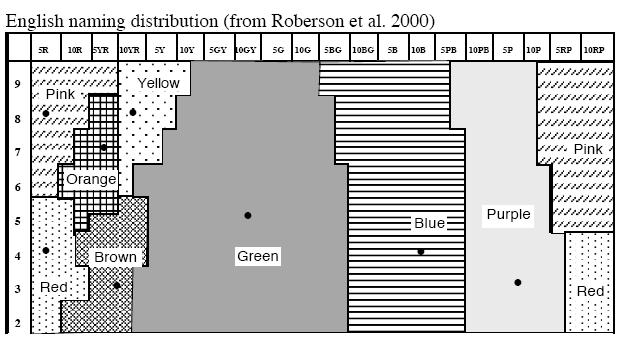
The experiments on color memory go like this. First, you have to determine the number of basic color terms in a language. You do this by having people name Munsell color chips, which depict colors across the visible spectrum. You then determine the color names that were used to describe the bulk of the spectrum. In doing so, you get graphs that look like the following for English-speakers (from Roberson et al. 20002:

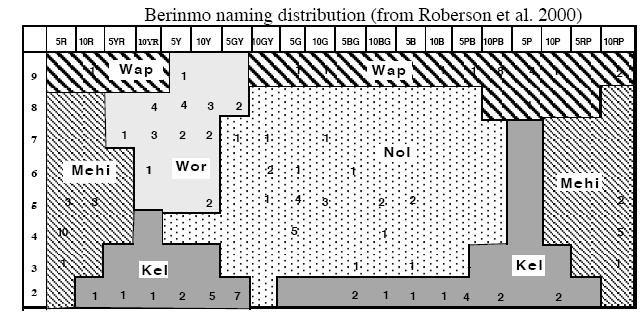
The numbers at the top and on the side (which are hard to see, I know) are the numbers and labels for the Munsell chips. While you're eliciting color names, you also ask the participants to indicate the best example of each color (the most common answer to this question for each name is represented in the above graph by the dots). Roberson and her colleagues have done this for three cultures, English (in the graph above, which gives 10 basic color terms, as compared to the 11 that Heider found), as well as the Berinmo tribe, which is also from New Guinea, and the Himba tribe from Namibia. Both the Berinmo and Himba tribes have had very little exposure to western culture, and their languages lack any color terms borrowed from other languages. Both of them have five color terms. Here are the graphs of their color names, which you can compare to the graph of English color names above3:


The Berinmo and Himba graphs look somewhat similar, but are different enough for comparison. The numbers on these two graphs indicate the number of participants who said that that chip was the best example.

After you've got the naming data, you can do the memory task. The materials for the task include low saturation color chips (i.e., chips that are near naming boundaries, or otherwise far from the best examples of a color name) from the English color categories. The participants are shown a chip by itself for five seconds, and then the chip is covered. After thirty seconds, the participants are shown a full array of chips (40 total) and asked to identify the color they had just seen. The low saturation chips are chosen because they will produce high error rates. The key data is what sorts of errors participants make. If they tend to mistakenly choose other chips from the same color category in English, as English participants do, then we can infer that color categories are universal. However, if there errors tend to involve choosing chips that have the same name in Berinmo or Himba, then we can reason that color terms affect color perception and memory, and thus that color categorization is not universal. This would be strong evidence for linguistic relativity in color concepts. And that's what Roberson and her colleagues found. Berinmo participants tended to make errors consistent with their color names, while Himba participants made errors consistent with theirs. Neither made errors consistent with English color names (the correlations between naming and memory for Himba participants were r = .559 for memory and Himba names and r = .036 memory and English names; the correlations were similar for Berinmo vs. English for Berinmo speakers).

To provide further evidence that color names affect color categories, Roberson et al. (2000) and Roberson et al. (2005) conducted an experiment on categorical perception with the Berinmo and Himba. In categorical perception, within-category exemplars tend to be treated as more similar than between-category exemplars, even when the between-category exemplars are more similar physically. This is particularly interesting in color perception: a color exemplar classified as red will be more similar to other exemplars of red, particularly the best examples of red, than it will be to examplars of neighboring colors, even if the exemplar falls on the physical boundary between the two colors and is thus closer, physically, to exemplars from the neighboring colors than it is to the best example of red. If Berinmo and Himba speakers demonstrate categorical perception effects consistent with their labels, but not with other labels (particularly English), then we can conclude that their color naming affects their color concepts.

To test this with Berinmo speakers, they tested participants on a category distinction present in English, but not Berinmo (green-blue) and one present in Berinmo, but not English ("nor" and "wor," as in the graph above). They presented participants with three Munsell color chips, and asked them which two were the most similar to each other. Two of the chips were highly physically similar, i.e., they were close to each other in the physical color space. One of those two chips also shared the same label as the third chip. Thus, you might have two "wor" chips, and one "nor" chip, with the "nor" chip being physically more similar to one of the "nor" chips than the other "nor" chip. If participants consistently answer that the two "nor" chips are more similar than the physically similar "nor" and "wor" chips, then they will have exhibited a categorical perception effect. Furthermore, if they do not exhibit a categorical perception effect for the green-blue distinction (i.e., they pick the more physically similar chips when the choices are two classified as green and one as blue), then we can conclude that it is the naming, rather than any universal physiological aspect of color perception, that is driving the categorical perception effect. And that's what Roberson et al. (2000) found for Berinmo. Roberson et al. (2005) found similar categorical perception effects for the Himba speakers.

It's interesting that the Berinmo and Himba tribes have the same number of color terms, as well, because that rules out one possible alternative explanation of their data. It could be that as languages develop, they develop a more sophisticated color vocabulary, which eventually approximates the color categories that are actually innately present in our visual systems. We would expect, then, that two languages that are at similar levels of development (in other words, they both have the same number of color categories) would exhibit similar effects, but the speakers' of the two languages remembered and perceived the colors differently. Thus it appears that languages do not develop towards any single set of universal color categories. In fact, Roberson et al. (2004) reported a longitudinal study that implies that exactly the opposite may be the case4. They found that children in the Himba tribe, and English-speaking children in the U.S., initially categorized color chips in a similar way, but as they grew older and more familiar with the color terms of their languages, their categorizations diverged, and became more consistent with their color names. This is particularly strong evidence that color names affect color concepts.

It appears, then, that Roberson and her colleagues have laid their hands on the Sapir-Whorf hypothesis and raised it from the dead with their experiments using members of the Berinmo and Himba tribes. We should, of course, take these results with a healthy dose of skepticism, because it does involve testing people in very different languages and cultures and comparing their results, which, as I said earlier, is a big problem. However, the growing body of evidence from Roberson and her colleagues' experiments is hard to deny. I don't know about you folks, but I find the revival of Sapir-Whorf incredibly exciting.

1 Heider, E.R. (1972). Universals in color naming and memory. Journal of Experimental Psychology, 93, 10-20.
2 Roberson, D., Davies I. & Davidoff, J. (2000) Colour categories are not universal: Replications and new evidence from a Stone-age culture. Journal of Experimental Psychology: General , 129, 369-398.
3 The Himba graph is from Roberson, D., Davidoff, J., Davies, I. & Shapiro, L. (2005) Colour categories in Himba: Evidence for the cultural relativity hypothesis. Cognitive Psychology, 50, 378-411.
4 Roberson, D., Davidoff, J., Davies, I.R.L. & Shapiro, L. R. (2004) The Development of Color Categories in Two languages: a longitudinal study. Journal of Experimental Psychology: General, 133, 554-571.

Friday, August 12, 2005

The Cultural Origins of Human Cognition: Introduction and Context

In many of the great responses I received to my initial email to the reading group, people indicated that they would like to see me introduce books by placing them in historical and theoretical context. So that's what I plan to do in this post. My plan is to avoid discussing the book directly, because I think that should wait until everyone's started reading it. Hopefully this post will serve as a good launching point for subsequent discussions of Tomasello's positions as he lays them out in the book, though. At the end of this book, and probably each book, I'm going to solicit feedback (sort of like course evaluations, but since you're not getting grades, I assume that there won't be any really nasty feedback from people who know they're getting F's), so if what I post in this introduction doesn't seem sufficient to you, you will be able to let me know. I've never conducted an online reading group, or a reading group with people with so many different intellectual and professional backgrounds, so this will be as much of a learning experience for me as it will be for everyone else.

The Overall Context

In the book, Tomasello discusses a wide variety of research, from human language acquisition to the nesting behaviors of orangutans, but he does a good job of discussing the findings of much of that research, so I won't go into most of it in the introduction to the book. However, there are three things that it's important to understand in order to fully grasp the concepts in the book: the two most prominent contrasting views, namely the Chomskyan universal grammar paradigm in linguistics and Evolutionary Psychology, and what is perhaps the most important concept in the book, the concept of theory-of-mind. So in this post, I'll briefly discuss both the Chomskyan view of language and the basic beliefs of Evolutionary Psychology, and briefly define theory-of-mind. At the end, I'll provide a list of links that provide further discussion of each.

Evolutionary Psychology

As you can probably tell from the title of the book, Tomasello believes that many aspects of modern-day human cognition evolved culturally, rather than biologically (i.e., through changes in our genetic makeup caused by the mechanisms of biological evolution, most notably natural selection). This means that we are born with a fairly plastic mind that is shaped through experience, and the experiences that modern humans have benefit from the experiences of the humans who have come before us in the form of cumulative culture. In the terminology of philosophy, Tomasello is a fairly radical empiricist. He's not a tabula rasa empiricist, but he's about as close to that as people in cognitive science come these days. His position is particularly interesting because, at the same time Tomasello began to espouse it, a group of psychologists, anthropologists, philosophers, and neuroscientists who called themselves Evolutionary Psychologists was becoming more prominent. Evolutionary Psychologists are nativists, people who believe that much of our modern-day cognition is the result of innate, biologically evolved, domain-specific mechanisms in the brain. In other words, Tomasello and Evolutionary Psychologists are in many respects polar opposites, theoretically.

While Evolutionary Psychology is not widely respected among cognitive scientists (Evolutionary Psychologists get a lot of popular press, while Tomasello gives a plenary speech at the most prestigious cognitive science conference), some of its basic ideas, in less extreme and absurd forms, are. The extreme contrast between Tomasello's work and that of Evolutionary Psychologists can therefore serve as an illustration of the generally more subtle contrasts between Tomasello and the beliefs of most cognitive scientists. To understand this contrast, then, it's important to understand the basic tenets of Evolutionary Psychology.

Here is how Stephen Pinker, one of the foremost proponents of Evolutionary Psychology, describes its purpose:
The goal of research in evolutionary psychology is to discover and understand the design of the human mind... Evolutionary psychology often investigates the adaptive functions of cognitive and emotional systems -- how natural selection "engineered" them to solve the kinds of problems faced by our ancestors in their struggle to survive and reproduce... Complex organs like eyes have many precise parts in exacting arrangements, and the odds are astronomically stacked against their having arisen fortuitously from random genetic drift or as a by-product of something else. Second, the brain, like the eyes and the feet, shows signs of good design. The adaptive problems it solves, such as perceiving depth and color, grasping, walking, reasoning, communicating, avoiding hazards, recognizing people and their mental states, and juggling competing demands in real time are among the most challenging engineering tasks ever stated, far beyond the capacity of foreseeable computers and robots. Put the premises together -- complex design comes from natural selection, and the brain shows signs of complex design -- and we conclude that much of the brain should be explained by natural selection.
The idea that the brain evolved through natural selection is not a controversial one, and is part of Tomasello's view as well, but even in this short description Pinker hints at what makes Evolutionary Psychology interesting and controversial: the idea that the brain evolved, through natural selection, specific abilities to perform specific tasks, like theory-of-mind ("recognizing people and their mental states"). This is how Leda Cosmides and John Tooby put it:
[T]he reason we have one set of [brain] circuits rather than another is that the circuits that we have were better at solving problems that our ancestors faced during our species' evolutionary history than alternative circuits were. The brain is a naturally constructed computational system whose function is to solve adaptive information-processing problems (such as face recognition, threat interpretation, language acquisition, or navigation). Over evolutionary time, its circuits were cumulatively added because they "reasoned" or "processed information" in a way that enhanced the adaptive regulation of behavior and physiology.
There are two important parts to these claims, against which Tomasello will argue: 1) The neural circuits that evolved did so in response to (highly) specific adaptive problems, and 2) these problems were the ones faced by our evolutionary ancestors that existed in the time between our common ancestor with modern apes. The argument for the first of these is pretty simple and intuitive. In essence, it says that there was no such thing as a "domain-general" problem in our evolutionary environment, and therefore, we could not have evolved brains that were designed with domain-general problem solving mechanisms. Our evolutionary ancestors' environment involved many specific problems that, if they were to survive, they would have to deal with adaptively. This would require the brain to develop specific mechanisms designed to deal with those specific problems. The problems that Evolutionary Psychologists often discuss in this vein include the problems of detecting cheaters and rewarding cooperators (reciprocal altruism), the problems of selecting and procuring mates, the problem of detecting when your mate is mating with others behind your back (so that, if you're male, you can know whether her offspring are actually yours), and the problem of figuring out what's going on in other people's minds (theory-of-mind).

The idea that we evolved several specific brain mechanisms that are designed to deal with specific adaptive problems that were faced by our ancestors leads to a view of the makeup of the mind that is sometimes called "massive modularity," the view that the mind is made up of a bunch of individual modules, or tiny computers, that selectively process information that is relevant to the problems they were designed to solve. The various circuits then work together to produce complex adaptive behaviors in complex environments. Here is the substance of the massive modularity view in the words of Cosmides and Tooby:
We have all these specialized neural circuits because the same mechanism is rarely capable of solving different adaptive problems. For example, we all have neural circuitry designed to choose nutritious food on the basis of taste and smell -- circuitry that governs our food choice. But imagine a woman who used this same neural circuitry to choose a mate. She would choose a strange mate indeed (perhaps a huge chocolate bar?). To solve the adaptive problem of finding the right mate, our choices must be guided by qualitatively different standards than when choosing the right food, or the right habitat. Consequently, the brain must be composed of a large collection of circuits, with different circuits specialized for solving different problems. You can think of each of these specialized circuits as a mini-computer that is dedicated to solving one problem. Such dedicated mini-computers are sometimes called modules. There is, then, a sense in which you can view the brain as a collection of dedicated mini-computers -- a collection of modules. There must, of course, be circuits whose design is specialized for integrating the output of all these dedicated mini-computers to produce behavior. So, more precisely, one can view the brain as a collection of dedicated mini-computers whose operations are functionally integrated to produce behavior.
Claim two makes involves an argument about when these domain-specific abilities evolved. We humans have only been hanging around in civilizations for about 10,000 years. That's not enough time for complex problem-solving mechanisms to evolve. So, they must have evolved earlier than that. We know that modern apes, with whom we share a common ancestor that lived about 6 million years ago, don't have the cognitive and behavioral repertoire that Evolutionary Psychologists are interested in. So, they have to have evolved within the last 6 million years. We also know that until about 2 million years ago, our ancestors were mostly various Australopithecine species that don't appear to have had many of the cognitive traits of modern humans that Evolutionary Psychologists believed have evolved through natural selection either. Therefore, most of the evolutionary work had to have been done between 2 million and 10,000 years ago, a time period called the Pleistocene. Furthermore, because most of the work was done in the Pleistocene, our brains are composed of a bunch of mini-computers, or modules, that were designed to handle the problems faced by our ancestors, but which we no longer face, or which have, in the modern world, changed so dramatically that they no longer resemble our Pleistocene problems. In the words of Cosmides and Tooby, "our modern skulls house a stone age mind."

Tomasello will argue that, in fact, the two million years in which humans have had to evolve these complex, domain-specific modules is simply not enough time. Instead, he believes that a single, fairly simple adaptation that built onto capabilities that were already present in our primate relatives. In a paper published just before the book, he wrote:
If we are searching for the origins of uniquely human cognition... our search must be for some small difference that made a big difference, some adaptation, or small set of adaptations, that changed the process of primate cognitive evolution in fundamental ways.
For him, the most likely "adaptation, or small set of adaptations" are those that created in our ancestors the ability to learn and transmit cultural knowledge.

Chomsky, Universal Grammar, and the Evolution of Language

Most of you are probably familiar with Noam Chomsky, and have some level of knowledge of his contributions to linguistics. Chomsky is one of the founding fathers of cognitive science, and his work, including his criticisms of behaviorism, constituted one of the driving forces behind the cognitive revolution in the 1950s and 60s. It would be impossible to give a sufficiently detailed account of Chomsky's theories over the years, and I'm not really qualified to do that anyway. However, for the purposes of situating Tomasello's book, it will be sufficient to briefly discuss one of the foundations of Chomsky's views, the idea that humans possess an innate language faculty that house's knowledge of the underlying rule-based structure of all languages (a universal grammar). On top of that, I'll also mention some of the views of how that language faculty came to be.

The primary argument for the existence of an innate language faculty is that there simply isn't enough information in the environment to learn the complex set of rules required to be a competent user of human language. Here's a simplified version of the argument:
i. A complex set of principles and rules (grammar) underlies all human languages.
ii. The only information that a child receives from his or her environment about these principles and rules comes from observing people use language.
iii. There is not enough information in those observations to learn the complex set of principles and rules required to acquire a human language. The utterances a child hears are incomplete, ungrammatical, and more importantly, only a tiny fraction of the set of possible utterances (which is infinite).
iv. Therefore, in order to acquire a language through observation, the human child must come to the table equipped with an innate set of principles and rules that can be tweaked through exposure to instances of language in his or her environment.
Put another way, the evidence to which a child is exposed in his or her linguistic environment can be accounted for by a large, if not infinite number of possible sets of principles and rules. Figuring out which is the correct set (which one allows you to learn and use the language correctly) requires that the language faculty already contain the basics of that set. From what I can tell, the most popular version of this approach, today, is the "principles and parameters" approach that Chomsky first laid out in Lectures on Government and Binding. According to this version, we are born with a set of principles and parameters which underlie the syntax of all languages. What children learn through experience is the content of the language's lexicon, along with the values of the parameters. It is differences in these that produce the variations we see across different languages.

After establishing that there is a universal grammar, it becomes important to understand how it came to be. Understanding its origins may help us to understand the specifics of its content. Thus, it becomes important to understand the evolution of the language faculty. Chomsky himself has insisted that it is unlikely that the language faculty evolved through natural selection, and that if it did, it is impossible to know under what conditions, and in response to which adaptive problems, it evolved. He, along with Marc Hauser and Tecumseh Fitch articulated this position in this paper. Others within the Chomskyan tradition, most notably Derek Bickerton, Stephen Pinker, and Ray Jackendoff, disagree. Each has argued for his own version of language evolution. For Bickerton, language evolved out of a protolanguage which resembled, in some ways, modern pidgin languages. For Pinker and Jackendoff, there were a series of steps leading from the use of Saussurean signs (signs that bear only arbitrary relationships to the signified, like the word "dog" bears no nonarbitrary relationship to dogs) to complex rules for the combination of phonetic, syntactic, and semantic information into the complex utterances of human languages. There doesn't appear to be any single dominant theory of language evolution yet, but most of them assume that what evolved was some form of the Chomskyan language faculty.

The idea that humans are born with a universal grammar is pretty uncontroversial within linguistics, though it is still questioned by many outside of linguistics (especially in psychology and computer science). The poverty of stimulus argument, in particular, is still widely questioned outside of linguistics (see, e.g., this recent paper on machine learning). Tomasello himself has devoted much of his professional career to developing an alternative account of language acquisition, which he's laid out in a separate book titled Constructing a Language: A Usage-Based Theory of Language Acquisition. In that book, as well as in The Cultural Origins of Human Cognition, he argues that there is in fact sufficient information in the child's linguistic environment to acquire language. This acquisition is done not through a faculty specific to language, but using the same mechanisms that enable other forms of cultural learning. In other words, there is no innate universal grammar, and because of this, there is no need for a highly evolved language faculty. Instead, most of what constitutes modern languages evolved culturally. As you can probably imagine, this is a pretty controversial position, and it is not widely accepted, even among those who doubt the validity of the poverty of stimulus argument and the existence of a universal grammar.

Theory of Mind

The one area in which Tomasello is in agreement with most other cognitive scientists, including Evolutionary Psychologists, is in the belief that the basic capacities that allow us to infer the thoughts, beliefs, feelings, and intentions of other human beings is evolved. These capacities are generally discussed under the heading "theory of mind." The most often used test for theory of mind is the false-belief task. In a typical version of this task, a child sits in a room with two experimenters, with a pair of boxes in front of them. One of the experimenters takes an object (a toy, candy, or something else that will interest the child), shows it to the child and the other experimenter, and places it into one of the boxes. The other experimenter then leaves the room. While he or she is gone, the first experimenter takes the object out of the box, and places it in the other box (or somewhere else in the room, out of sight). The child is then asked where the experimenter who left will look for the object. The logic of the experiment is that if the child is able to reason about the mental states of other people, he or she should be able to understand that other people can have false beliefs. Therefore, if the child has theory of mind abilities, he or she should answer that the other experimenter will look in the box into which the first experimenter originally placed the object. If the child does not have theory of mind abilities, he or she will answer that the experimenter who left the room will look in the place that the object was placed after he or she left the room. Human children are able to perform this task by age 3 or 4, while most nonhuman primates are not able to perform it without extensive training.

The false belief task has many problems, and may not test for all of the aspects of theory of mind. In fact, other experimental paradigms demonstrate evidence for theory of mind abilities in nonhuman primates as well as human infants. However, there are definite differences between the theory of mind capabilities of nonhuman primates and those of young human children (perhaps even infants). Tomasello's account of the evolution of modern human cognition centers around these differences. He will argue that it is the faculties that underlie these differences that allow humans to develop, through cultural learning, a wide range of cognitive abilities, including the use of language, that no other animal has developed.

Once again, this is a very controversial position, and it has not been widely accepted, though it is garnering more and more attention in psychology and cognitive anthropology (I'm not sure what linguists think of it). I think this means that Tomasello's book, which is controversial pretty much from page 1, will spark a lot of great discussion, and will thus make for a great first book for our group. I hope this introductory post helps to situate the book. As we go along, I will try to define the concepts and explain Tomasello's positions in more depth, and may go in to more detail on the differences between his and other views in the field.